
Back to cruise search
Home/Cruises/From Amsterdam To Berlin
From Amsterdam To Berlin, 26 Jul 2026 (11 nights)
3.0 ship ratingMS Victor Hugo - CroisiEurope


Cruise search
We are checking available sailings, ship details and guide prices for you.
Ask our cruise specialists about cruise line loyalty benefits, status match options, drinks packages, gratuities and any current offers available on this sailing.
Sail with confidence
We explain the relevant financial protection before you book.
Always here to help
When plans change, your cruise specialists are here to help.
Carefully selected cruises
From short breaks to big adventures, we help narrow down the right sailing.
Cruise summary
Gallery

Dining
1 of 9 onboard highlights
Your itinerary
Port descriptions and imagery are shown where available for each day or port.
Amsterdam is the Netherlands’ capital, known for its artistic heritage, elaborate canal system and narrow houses with gabled facades, legacies of the city’s 17th-century Golden Age. Its Museum District houses the Van Gogh Museum, works by Rembrandt and Vermeer at the Rijksmuseum, and modern art at the Stedelijk. Cycling is key to the city’s character, and there are numerous bike paths.
Amsterdam is the Netherlands’ capital, known for its artistic heritage, elaborate canal system and narrow houses with gabled facades, legacies of the city’s 17th-century Golden Age. Its Museum District houses the Van Gogh Museum, works by Rembrandt and Vermeer at the Rijksmuseum, and modern art at the Stedelijk. Cycling is key to the city’s character, and there are numerous bike paths.
Amsterdam is the Netherlands’ capital, known for its artistic heritage, elaborate canal system and narrow houses with gabled facades, legacies of the city’s 17th-century Golden Age. Its Museum District houses the Van Gogh Museum, works by Rembrandt and Vermeer at the Rijksmuseum, and modern art at the Stedelijk. Cycling is key to the city’s character, and there are numerous bike paths.
Groningen is the northeasternmost province of the Netherlands. It borders on Friesland to the west, Drenthe to the south, the German state of Lower Saxony to the east, and the Wadden Sea to the north. As of November 2019, Groningen had a population of 585,881 and a total area of 2,960 km².
Delfzijl is a city and former municipality with a population of 25,651 in the province of Groningen in the northeast of the Netherlands. Delfzijl was a sluice between the Delf and the Ems, which became fortified settlement in the 16th century. The fortifications were removed in the late 19th century.
Delfzijl is a city and former municipality with a population of 25,651 in the province of Groningen in the northeast of the Netherlands. Delfzijl was a sluice between the Delf and the Ems, which became fortified settlement in the 16th century. The fortifications were removed in the late 19th century.
Papenburg is a city in the district of Emsland in Lower Saxony, Germany, situated at the river Ems. It is known for its large shipyard, the Meyer-Werft, which specializes in building cruise liners.
Oldenburg is a city in northwest Germany. The central Horst-Janssen-Museum displays works by the 20th-century artist, including lithographs and drawings. The State Museum for Nature and Man has exhibits exploring the region's natural history, plus an aquarium. Oldenburg Castle houses part of the State Museum for Art and Cultural History, which showcases regional artifacts and European paintings.
Oldenburg is a city in northwest Germany. The central Horst-Janssen-Museum displays works by the 20th-century artist, including lithographs and drawings. The State Museum for Nature and Man has exhibits exploring the region's natural history, plus an aquarium. Oldenburg Castle houses part of the State Museum for Art and Cultural History, which showcases regional artifacts and European paintings.
Bremen is a city straddling the Weser River in northwest Germany. It’s known for its role in maritime trade, represented by Hanseatic buildings on the Market Square. The ornate and Gothic town hall has a Renaissance facade and large model ships in its upper hall. Nearby is the Roland statue, a giant stone figure symbolizing freedom of trade. St. Peter’s Cathedral features medieval crypts and twin spires.
Nienburg is a town and capital of the district Nienburg, in Lower Saxony, Germany.
Stolzenau is a municipality in the district of Nienburg, in Lower Saxony, Germany. It is situated on the left bank of the Weser, approx. 20 km southwest of Nienburg, and 25 km northeast of Minden. During the second half of the 20th century, a unit of the Royal Netherlands Air Force was stationed in Stolzenau.
Minden is a town of about 83,000 inhabitants in the north-east of North Rhine-Westphalia, Germany. The town extends along both sides of the River Weser. It is the capital of the district of Minden-Lübbecke, which is part of the region of Detmold.
Minden is a town of about 83,000 inhabitants in the north-east of North Rhine-Westphalia, Germany. The town extends along both sides of the River Weser. It is the capital of the district of Minden-Lübbecke, which is part of the region of Detmold.
Anderten
Braunschweig, also known as Brunswick, is a city in north-central Germany. On Burgplatz square, Dankwarderode Castle has art from the Middle Ages. Across the square stands the Brunswick Lion monument and Romanesque-style Brunswick Cathedral. The Braunschweigisches Landesmuseum showcases local history. The neoclassical Brunswick Palace, rebuilt in the 2000s, is topped with the huge Brunonia Quadriga chariot sculpture.
Brandenburg an der Havel is a German town west of Berlin. It’s known for its Gothic, red-brick buildings, including the 15th-century Old Town Hall. Close by, Brandenburg Cathedral has a chapel with a painted vault, a baroque organ and a museum displaying medieval textiles. The late-medieval St. Paul’s Monastery is home to the Archaeological Museum. Nearby are the ruins of the medieval town wall.
Magdeburg is a central German city on the Elbe River. In the city center, the Gothic-style Magdeburg Cathedral is the burial place of the Holy Roman emperor Otto the Great. The Museum of Cultural History details the city’s medieval importance with exhibitions on archaeology and local history. Kloster Unser Lieben Frauen, a Romanesque monastery complex, is home to a contemporary art gallery and sculpture park.
Magdeburg is a central German city on the Elbe River. In the city center, the Gothic-style Magdeburg Cathedral is the burial place of the Holy Roman emperor Otto the Great. The Museum of Cultural History details the city’s medieval importance with exhibitions on archaeology and local history. Kloster Unser Lieben Frauen, a Romanesque monastery complex, is home to a contemporary art gallery and sculpture park.
Brandenburg an der Havel is a German town west of Berlin. It’s known for its Gothic, red-brick buildings, including the 15th-century Old Town Hall. Close by, Brandenburg Cathedral has a chapel with a painted vault, a baroque organ and a museum displaying medieval textiles. The late-medieval St. Paul’s Monastery is home to the Archaeological Museum. Nearby are the ruins of the medieval town wall.
Potsdam is a city on the border of Berlin, Germany. Sanssouci Palace was once the summer home of Frederick the Great, former King of Prussia. On the grounds of the complex, the Renaissance Orangery Palace overlooks Italian-style gardens with fountains. Historic Mill offers city views. English gardens surround neoclassical Charlottenhof Palace. The 19th-century Roman Baths were built in several architectural styles.
Potsdam is a city on the border of Berlin, Germany. Sanssouci Palace was once the summer home of Frederick the Great, former King of Prussia. On the grounds of the complex, the Renaissance Orangery Palace overlooks Italian-style gardens with fountains. Historic Mill offers city views. English gardens surround neoclassical Charlottenhof Palace. The 19th-century Roman Baths were built in several architectural styles.
Potsdam is a city on the border of Berlin, Germany. Sanssouci Palace was once the summer home of Frederick the Great, former King of Prussia. On the grounds of the complex, the Renaissance Orangery Palace overlooks Italian-style gardens with fountains. Historic Mill offers city views. English gardens surround neoclassical Charlottenhof Palace. The 19th-century Roman Baths were built in several architectural styles.
Berlin, Germany’s capital, dates to the 13th century. Reminders of the city's turbulent 20th-century history include its Holocaust memorial and the Berlin Wall's graffitied remains. Divided during the Cold War, its 18th-century Brandenburg Gate has become a symbol of reunification. The city's also known for its art scene and modern landmarks like the gold-colored, swoop-roofed Berliner Philharmonie, built in 1963.
Berlin, Germany’s capital, dates to the 13th century. Reminders of the city's turbulent 20th-century history include its Holocaust memorial and the Berlin Wall's graffitied remains. Divided during the Cold War, its 18th-century Brandenburg Gate has become a symbol of reunification. The city's also known for its art scene and modern landmarks like the gold-colored, swoop-roofed Berliner Philharmonie, built in 1963.
What's included
Fare overview
This sailing is shown as a cruise-only guide fare with CroisiEurope. The fare is linked to the ship, itinerary and cabin category you choose. Drinks packages, gratuities, Wi-Fi, flights, transfers and shore experiences are only treated as included where they are confirmed before booking.
Sailing aboard
MS Victor Hugo
Your ship
One of the most illustrious characters in French literature has given his name at this pretty 4-anchor boat which sails on the Tisza, the Sava, the Elbe, the Rhine and the Danube, rivers of great historical and cultural richness. Completely refurbished in 2019, the MS Victor Hugo is a 4-anchor boat. human dimension, measuring 82 meters long and 9.50 meters wide. It can accommodate 90 passengers, in 45 cabins arranged on two decks. Each of them has all the amenities and offers the best living conditions. The decoration is imbued with romanticism. The mineral and bluish colors refer to the Channel Islands where the writer was exiled, while touches of brass and a few art-deco elements evoke the characteristic style of the time. Located at the level of the upper deck, the restaurant, where are served all meals during the trip, offers delicate cuisine in a refined setting, where large bay windows allow you to take full advantage of the panorama. On this same deck is also the lounge bar with dance floor, while on the sun deck, an ideal place to relax and admire the landscapes, passengers can have comfortable deckchairs, as well as a large shaded area.
Onboard facilities

Bars/Lounges
Deck plans
Explore the ship deck by deck. Deck plans can change and should be checked before booking.
Main Deck

These facilities are available aboard the ship. Their deck locations can be confirmed before booking.
No cabin types are listed for this deck.
Match cabin grade codes and colours to the selected deck plan.
Choose your cabin
Compare the cabin types and onboard features shown for this sailing. Final price and availability are confirmed before booking.
Cabin details
Outside/Oceanview
£3,385
Cabin fare
Code
C_DBL_PP
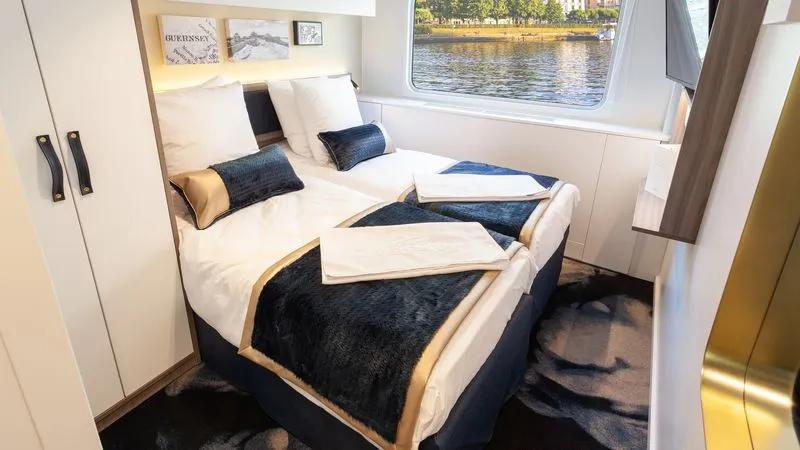
Comfortable cabin with a large bed, with a bathroom (sink, shower and private toilet, towels provided), hair dryer, television, safe and radio . Located on the main deck with a high window, it offers a panoramic view of the landscapes.
Facilities and amenities
Next step
Continue to a separate page to review cruise extras and booking options around this sailing.
More sailings
Use horizontal scrolling, touch swipes, or the arrow keys to browse.
CroisiEurope - MS Victor Hugo
From
£942
CroisiEurope - MS Victor Hugo
From
£740
CroisiEurope - MS Victor Hugo
From
£930
CroisiEurope - MS Victor Hugo
From
£1,059
Important information
ATOL protected holidays
Where your booking includes flights, ATOL protection applies so your money and travel arrangements are financially protected.
Travel Trust Association
Book with confidence through a Travel Trust Association member, with customer money protected under approved trust arrangements.
Low deposit options
Secure selected sailings with flexible low deposit options, then spread the remaining balance before you travel.
Excellent customer service
Our cruise specialists are here before, during and after booking. Send an enquiry or call 0161 222 0822 for friendly support.
Clear price checks
Live prices and cabin options are checked before you continue.