
Back to cruise search
Home/Cruises/Southampton to Lisbon
Southampton to Lisbon, 27 Aug 2026 (22 nights)
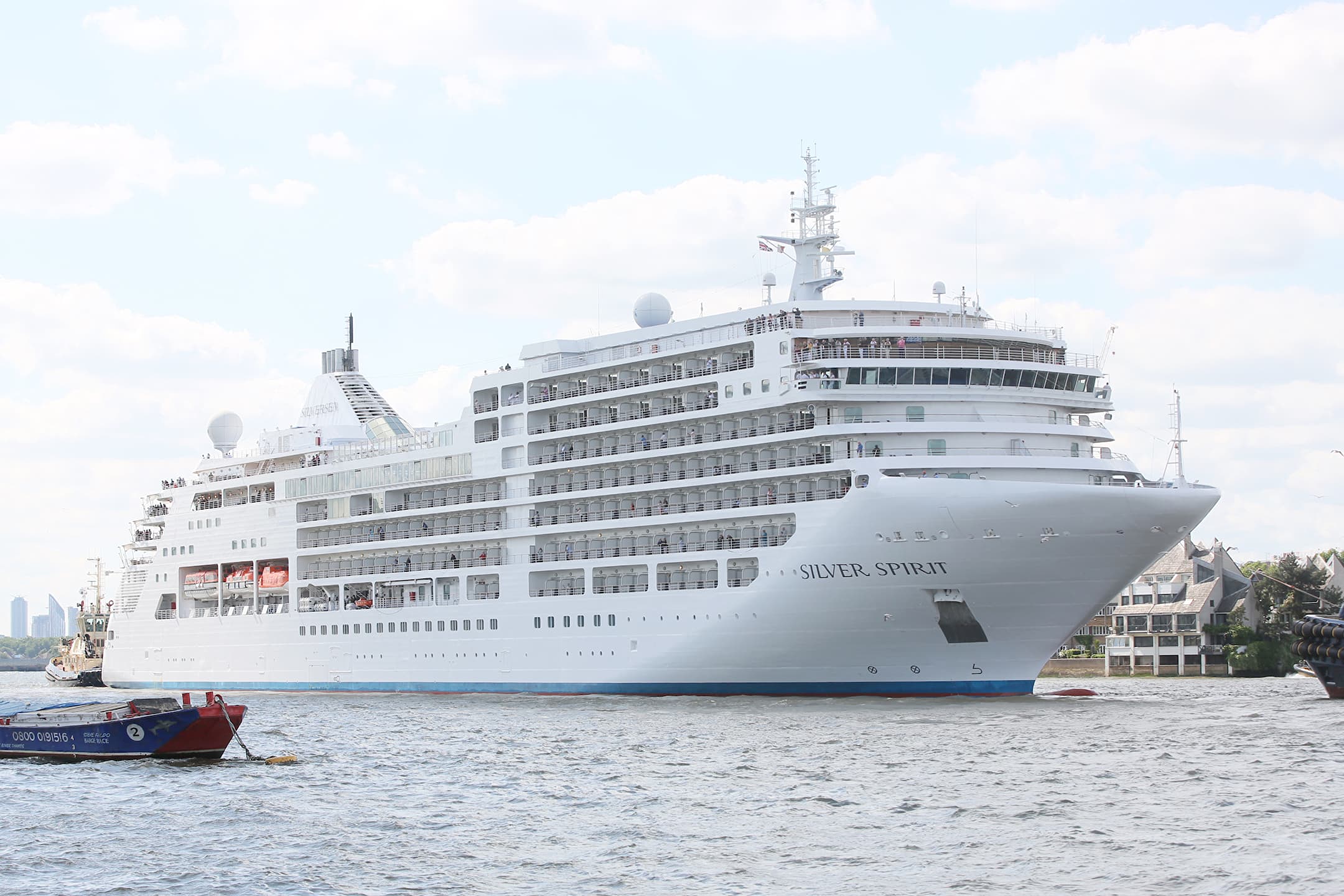
5.0 ship ratingSilver Spirit - Silversea

Cruise search
We are checking available sailings, ship details and guide prices for you.
Ask our cruise specialists about cruise line loyalty benefits, status match options, drinks packages, gratuities and any current offers available on this sailing.
Sail with confidence
We explain the relevant financial protection before you book.
Always here to help
When plans change, your cruise specialists are here to help.
Carefully selected cruises
From short breaks to big adventures, we help narrow down the right sailing.
Cruise summary
Gallery
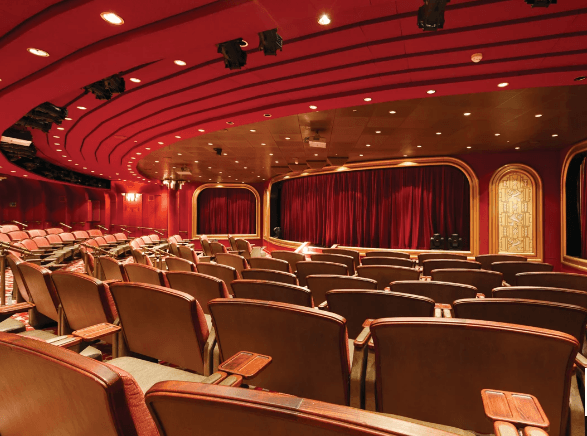
Bars and lounges
1 of 13 onboard highlights
Your itinerary
Port descriptions and imagery are shown where available for each day or port.
Standing on a triangular peninsula formed at the place where the rivers Itchen and Test flow into an eight-mile inlet from the Solent, Southampton has figured in numerous stirring events and for centuries has been of strategic maritime importance. It was from here that the Pilgrim Fathers departed for America in the tiny Mayflower in 1620 and many great ocean liners, such as the Queen Mary and the Titanic have followed since. The image of the thousand-year-old city was greatly blemished by the bombing during World War II and postwar planning caused changes almost beyond recognition.
Twenty-five square mile (40 sq km) Guernsey is the second largest of the Channel Islands, which lie in the English Channel west of the Cherbourg peninsula. Along with its sister island of Jersey, Guernsey has been a part of Britain since 1066, though retaining a culture entirely of its own.
Ship sails flutter in the breeze, at the natural port of Saint-Malo - a historic and resilient walled city, which watches out over golden sands and island fortresses. Strung tenuously to the mainland, Saint Malo was the historic home of a rowdy mix of skilled sailors and new world explorers - as well as the plunderers who earned the place its 'Pirate City' title. Some of history's great voyages have launched from here - including Jacques Cartier's, which led to the settlement of New France and modern-day Quebec. View less Founded by a Welsh monk, who made his way here in the 6th century, Saint Malo's castle is forged from sheer granite, and its steep defensive ramparts arise defiantly. The atmospheric walled town turns its back to the mainland and gazes out longingly into the sea. Explore streets that breathe with maritime tales and medieval charm - restored from the intense damage sustained during the Second World War. Cathédrale de St Malo rises above the tight paths, offering views…
The name alone conjures images of sun-ripened grapes, splashes of refined flavour, and the joy of clinking glasses. Bordeaux is synonymous with quality and prestige, and the promise of endless opportunities to sample the city’s famous, full-bodied red wines makes a visit to this elegant French port city one to truly savour. Sprinkled with scenic, turret-adorned mansion castles, which stand above soil softened by the Atlantic and winding flow of the Garonne River, the vineyards of Bordeaux consistently produce revered wines, enjoyed right across the globe. Explore France’s largest wine region, walking through vineyards where dusty clumps of grapes hang, before descending into cellars to see the painstaking processes that make this region a global wine centre. The acclaimed, sensory experience of Cité du Vin wine museum lets you put your own nose to the test, learning more about the craft involved in producing world class vintages. Brush up on your wine knowledge, with our blog [insert…
The name alone conjures images of sun-ripened grapes, splashes of refined flavour, and the joy of clinking glasses. Bordeaux is synonymous with quality and prestige, and the promise of endless opportunities to sample the city’s famous, full-bodied red wines makes a visit to this elegant French port city one to truly savour. Sprinkled with scenic, turret-adorned mansion castles, which stand above soil softened by the Atlantic and winding flow of the Garonne River, the vineyards of Bordeaux consistently produce revered wines, enjoyed right across the globe. Explore France’s largest wine region, walking through vineyards where dusty clumps of grapes hang, before descending into cellars to see the painstaking processes that make this region a global wine centre. The acclaimed, sensory experience of Cité du Vin wine museum lets you put your own nose to the test, learning more about the craft involved in producing world class vintages. Brush up on your wine knowledge, with our blog [insert…
The name alone conjures images of sun-ripened grapes, splashes of refined flavour, and the joy of clinking glasses. Bordeaux is synonymous with quality and prestige, and the promise of endless opportunities to sample the city’s famous, full-bodied red wines makes a visit to this elegant French port city one to truly savour. Sprinkled with scenic, turret-adorned mansion castles, which stand above soil softened by the Atlantic and winding flow of the Garonne River, the vineyards of Bordeaux consistently produce revered wines, enjoyed right across the globe. Explore France’s largest wine region, walking through vineyards where dusty clumps of grapes hang, before descending into cellars to see the painstaking processes that make this region a global wine centre. The acclaimed, sensory experience of Cité du Vin wine museum lets you put your own nose to the test, learning more about the craft involved in producing world class vintages. Brush up on your wine knowledge, with our blog [insert…
Whether it’s the flow of its boundary pushing architecture, delights of its finger food tapas, or sweeps of gorgeous shoreline nearby, Bilbao is a city that places a premium on aesthetics. The relentless drive to all things beautiful may be a reaction to the city’s industrial past, but it has led this Basque city to emerge as a new beacon of artistry. American architect Frank Gehry’s masterpiece of flowing metal is the shining standout here, a perfect harmony of smooth titanium and glass, and a thrilling piece in itself. Inside the Guggenheim Museum Bilbao, world-class exhibitions are exhibited in the bright, expansive interior - which practically begs you to explore more. The city has gorgeous historical presence too. Casco Viejo - the medieval area - is its historic core, and home to the original seven streets and cathedral, dating back to the 14thcentury. Tall banks of coloured buildings rise either side as you walk, dwarfed by a tide of pretty facades, overflowing flower boxes, an…
Northern Spain might not have the same allure as the Mediterranean end of the country, yet as every traveller knows, often the best places are those that are the least known. Enter Santander. With heritage hailing from the prehistoric, Roman and Middle ages, suffice to say that Santander’s roots stretch very far back. As one of Spain’s more important ports during the New World trading era, Santander enjoyed great wealth during the Middle Ages. View less King Alfonso 13th (1886-1941) made the city his summer residence, bringing about a further economic boom and laying the foundations for modern Santander: a popular summer resort that enjoys one of the most beautiful bay in Spain, a fantastic art and cultural hub (don’t miss the Centro Botin) and a great lust for la vida. Tragically, a two-day fire in 1941 destroyed much of the city, including almost all the medieval heritage. Thus, Santander is today a city of two faces. One: an elegant seaside resort with at least six urban beaches, f…
Located in in Galicia, in the northwest of Spain on the Portuguese border, Vigo is perhaps the country’s most underrated destination. Considered by many as “just’ an industrial fishing port (meaning the seafood rarely travels further than a mile to your plate), Vigo seduces everyone with its cuisine, landscape and warm Spanish welcomes. Like many of Galicia’s coastal towns, life in Vigo has been dictated by the ocean. View less The city dates back to Roman times and Romanesque architecture such as the churches of Santa María de Castrelos, Santiago de Bembrive, San Salvador de Coruxo can be found all over the city. From the 16th-18th centuries it became alive with commercial trade and buccaneers looking for sunken treasure. The town still enjoys its status as having sunken treasure in its waters, and debates about who would own this if ever discovered periodically colour local conversations. The old town and fishermen’s quarter are worth exploring, although unfortunately with the port’…
Lively, commercial Oporto is the second largest city in Portugal after Lisbon. Also called Porto for short, the word easily brings to mind the city's most famous product - port wine. Oporto’s strategic location on the north bank of the Douro River has accounted for the town’s importance since ancient times. The Romans built a fort here where their trading route crossed the Douro, and the Moors brought their own culture to the area. Oporto profited from provisioning crusaders en route to the Holy Land and enjoyed the riches from Portuguese maritime discoveries during the 15th and 16th centuries.
Lisbon, the capital of Portugal, is a city open to the sea and carefully planned with 18th-century elegance. Its founder is said to be the legendary Ulysses, but the theory of an original Phoenician settlement is probably more realistic. Known in Portugal as Lisboa, the city was inhabited by the Romans, Visigoths and, beginning in the 8th century, the Moors. Much of the 16th century was a period of great prosperity and overseas expansion for Portugal. Tragedy struck on All Saints' Day in 1755 with a devastating earthquake that killed about 40,000 people. The destruction of Lisbon shocked the continent. As a result, the Baixa (lower city) emerged in a single phase of building, carried out in less than a decade by the royal minister, the Marques de Pombal. His carefully planned layout of a perfect neo-classical grid survived to this day and remains the heart of the city. Evidence of pre-quake Lisbon can still be seen in the Belém suburb and the old Moorish section of the Alfama that spr…
Lively, commercial Oporto is the second largest city in Portugal after Lisbon. Also called Porto for short, the word easily brings to mind the city's most famous product - port wine. Oporto’s strategic location on the north bank of the Douro River has accounted for the town’s importance since ancient times. The Romans built a fort here where their trading route crossed the Douro, and the Moors brought their own culture to the area. Oporto profited from provisioning crusaders en route to the Holy Land and enjoyed the riches from Portuguese maritime discoveries during the 15th and 16th centuries.
Located in in Galicia, in the northwest of Spain on the Portuguese border, Vigo is perhaps the country’s most underrated destination. Considered by many as “just’ an industrial fishing port (meaning the seafood rarely travels further than a mile to your plate), Vigo seduces everyone with its cuisine, landscape and warm Spanish welcomes. Like many of Galicia’s coastal towns, life in Vigo has been dictated by the ocean. View less The city dates back to Roman times and Romanesque architecture such as the churches of Santa María de Castrelos, Santiago de Bembrive, San Salvador de Coruxo can be found all over the city. From the 16th-18th centuries it became alive with commercial trade and buccaneers looking for sunken treasure. The town still enjoys its status as having sunken treasure in its waters, and debates about who would own this if ever discovered periodically colour local conversations. The old town and fishermen’s quarter are worth exploring, although unfortunately with the port’…
The name alone conjures images of sun-ripened grapes, splashes of refined flavour, and the joy of clinking glasses. Bordeaux is synonymous with quality and prestige, and the promise of endless opportunities to sample the city’s famous, full-bodied red wines makes a visit to this elegant French port city one to truly savour. Sprinkled with scenic, turret-adorned mansion castles, which stand above soil softened by the Atlantic and winding flow of the Garonne River, the vineyards of Bordeaux consistently produce revered wines, enjoyed right across the globe. Explore France’s largest wine region, walking through vineyards where dusty clumps of grapes hang, before descending into cellars to see the painstaking processes that make this region a global wine centre. The acclaimed, sensory experience of Cité du Vin wine museum lets you put your own nose to the test, learning more about the craft involved in producing world class vintages. Brush up on your wine knowledge, with our blog [insert…
The name alone conjures images of sun-ripened grapes, splashes of refined flavour, and the joy of clinking glasses. Bordeaux is synonymous with quality and prestige, and the promise of endless opportunities to sample the city’s famous, full-bodied red wines makes a visit to this elegant French port city one to truly savour. Sprinkled with scenic, turret-adorned mansion castles, which stand above soil softened by the Atlantic and winding flow of the Garonne River, the vineyards of Bordeaux consistently produce revered wines, enjoyed right across the globe. Explore France’s largest wine region, walking through vineyards where dusty clumps of grapes hang, before descending into cellars to see the painstaking processes that make this region a global wine centre. The acclaimed, sensory experience of Cité du Vin wine museum lets you put your own nose to the test, learning more about the craft involved in producing world class vintages. Brush up on your wine knowledge, with our blog [insert…
Northern Spain might not have the same allure as the Mediterranean end of the country, yet as every traveller knows, often the best places are those that are the least known. Enter Santander. With heritage hailing from the prehistoric, Roman and Middle ages, suffice to say that Santander’s roots stretch very far back. As one of Spain’s more important ports during the New World trading era, Santander enjoyed great wealth during the Middle Ages. View less King Alfonso 13th (1886-1941) made the city his summer residence, bringing about a further economic boom and laying the foundations for modern Santander: a popular summer resort that enjoys one of the most beautiful bay in Spain, a fantastic art and cultural hub (don’t miss the Centro Botin) and a great lust for la vida. Tragically, a two-day fire in 1941 destroyed much of the city, including almost all the medieval heritage. Thus, Santander is today a city of two faces. One: an elegant seaside resort with at least six urban beaches, f…
Whether it’s the flow of its boundary pushing architecture, delights of its finger food tapas, or sweeps of gorgeous shoreline nearby, Bilbao is a city that places a premium on aesthetics. The relentless drive to all things beautiful may be a reaction to the city’s industrial past, but it has led this Basque city to emerge as a new beacon of artistry. American architect Frank Gehry’s masterpiece of flowing metal is the shining standout here, a perfect harmony of smooth titanium and glass, and a thrilling piece in itself. Inside the Guggenheim Museum Bilbao, world-class exhibitions are exhibited in the bright, expansive interior - which practically begs you to explore more. The city has gorgeous historical presence too. Casco Viejo - the medieval area - is its historic core, and home to the original seven streets and cathedral, dating back to the 14thcentury. Tall banks of coloured buildings rise either side as you walk, dwarfed by a tide of pretty facades, overflowing flower boxes, an…
Gijón is a large coastal city in northern Spain. It’s known for its maritime heritage and the old fishermen’s quarter of Cimadevilla. Santa Catalina hill has a clifftop park and sculpture. The 18th-century Revillagigedo Palace houses an international arts center. It adjoins the Collegiate Church of San Juan Bautista, now a concert hall. Nearby is the 16th-century Clock Tower, with a museum about the city.
Lisbon, the capital of Portugal, is a city open to the sea and carefully planned with 18th-century elegance. Its founder is said to be the legendary Ulysses, but the theory of an original Phoenician settlement is probably more realistic. Known in Portugal as Lisboa, the city was inhabited by the Romans, Visigoths and, beginning in the 8th century, the Moors. Much of the 16th century was a period of great prosperity and overseas expansion for Portugal. Tragedy struck on All Saints' Day in 1755 with a devastating earthquake that killed about 40,000 people. The destruction of Lisbon shocked the continent. As a result, the Baixa (lower city) emerged in a single phase of building, carried out in less than a decade by the royal minister, the Marques de Pombal. His carefully planned layout of a perfect neo-classical grid survived to this day and remains the heart of the city. Evidence of pre-quake Lisbon can still be seen in the Belém suburb and the old Moorish section of the Alfama that spr…
What's included
Fare overview
This sailing is shown as a cruise-only guide fare with Silversea. The fare is linked to the ship, itinerary and cabin category you choose. Drinks packages, gratuities, Wi-Fi, flights, transfers and shore experiences are only treated as included where they are confirmed before booking.
Sailing aboard
Silver Spirit
Your ship
The all-new Silver Spirit has never looked better, nor felt cosier. Fully refurbished for a superlative onboard adventure, she retains our world famous standards of service and home away from home feel. With one of the highest space to guest ratios in the business and eight superlative luxury dining options, Silver Spirit offers its guests one of the most complete cruise experiences available. Spacious decks leave plenty of room for relaxation, yet the cosy niches make sure that there is something for everyone. Meet like-minded friends; enjoy first class dining and relax in what is possibly the best place between sea and sky.
Onboard facilities
Bars/Lounges
Deck plans
Explore the ship deck by deck. Deck plans can change and should be checked before booking.
Deck 10

These facilities are available aboard the ship. Their deck locations can be confirmed before booking.
No cabin types are listed for this deck.
Match cabin grade codes and colours to the selected deck plan.
Choose your cabin
Compare the cabin types and onboard features shown for this sailing. Final price and availability are confirmed before booking.
Next step
Continue to a separate page to review cruise extras and booking options around this sailing.
More sailings
Use horizontal scrolling, touch swipes, or the arrow keys to browse.
Silversea - Silver Spirit
From
£9,200
Silversea - Silver Spirit
From
£6,800
Silversea - Silver Spirit
From
£9,000
Silversea - Silver Spirit
From
£5,050
Important information
ATOL protected holidays
Where your booking includes flights, ATOL protection applies so your money and travel arrangements are financially protected.
Travel Trust Association
Book with confidence through a Travel Trust Association member, with customer money protected under approved trust arrangements.
Low deposit options
Secure selected sailings with flexible low deposit options, then spread the remaining balance before you travel.
Excellent customer service
Our cruise specialists are here before, during and after booking. Send an enquiry or call 0161 222 0822 for friendly support.
Clear price checks
Live prices and cabin options are checked before you continue.
Use horizontal scrolling, trackpad gestures, touch swipes, or the arrow keys to browse cabin types.
Cabin details
Suite
Code
CV
Deck
Deck 5
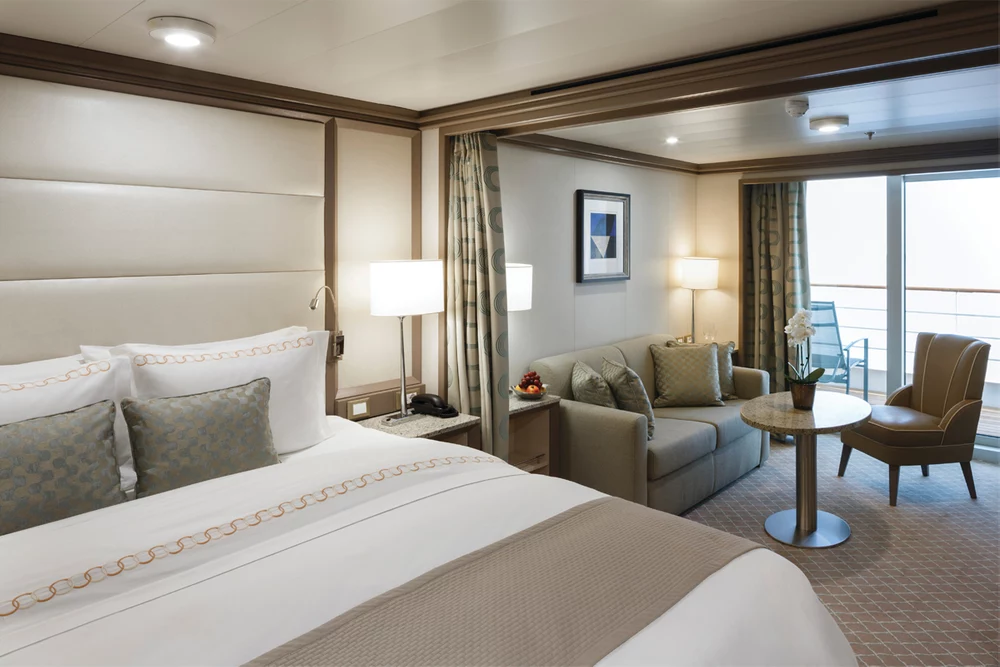
The Classic Veranda Suite provides generous living space for voyagers. Located lower bow, the Classic Veranda Suite offers all the comfort and attention to detail that you can expect aboard — both inside and out. A generous expanse of interior comforts — elegant décor, stunning marble bathroom and ample seating area, make this a cosy home away from home. But perhaps this suite’s finest asset lies just outside, as floor-to-ceiling glass doors open onto a private veranda, making every sunset feel as if it is yours alone. Veranda with patio furniture and floor-to-ceiling glass doors. Sitting area. Twin beds or queen-sized bed. Marble bathroom with vanity, full-sized bath, separate shower. Walk-in rain shower (no full-sized bath. Walk-in wardrobe with personal safe. Writing desk. One 40” / 102 cm flat-screen HD TV. Unlimited Standard Wifi.
Facilities and amenities
Cabin details
Suite
Code
DX
Deck
Deck 6
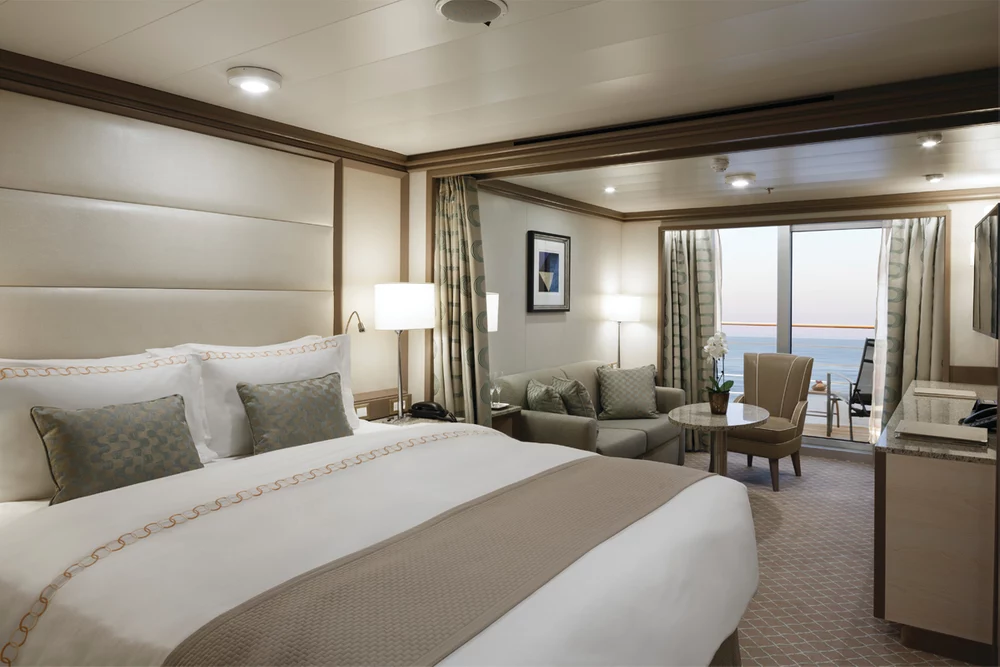
The Deluxe Veranda Suite offers a comfortable living space, close to the heart of the ship. With its preferred mid-ship location and all the comfort and attention to detail that you can expect aboard, the Deluxe Veranda Suite is the savvy traveller’s paradise— both inside and out. Elegant décor, stunning marble bathroom and ample seating area, make this a cosy home away from home. But perhaps this suite’s finest asset lies just outside, as floor-to-ceiling glass doors open onto a private veranda, making every sunset feel as if it is yours alone. Veranda with patio furniture and floor-to-ceiling glass doors. Sitting area. Twin beds or queen-sized bed. Marble bathroom with vanity, full-sized bath, separate shower. Walk-in rain shower (no full-sized bath. Walk-in wardrobe with personal safe. Writing desk. One 40” / 102 cm flat-screen HD TV. Unlimited Standard Wifi.
Facilities and amenities
Cabin details
Suite
Code
G1
Deck
Deck 8
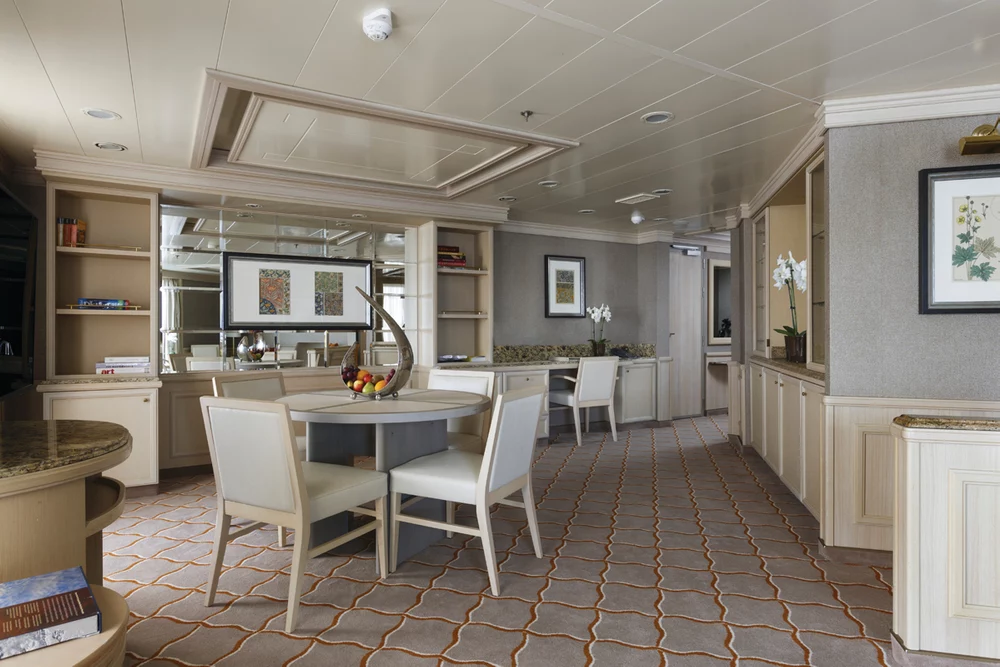
Expertly designed and exquisitely appointed. Ideal for entertaining friends while you cruise or enjoying a quiet dinner “at home”. Available as a one-bedroom configuration or as two-bedrooms by adjoining with a Veranda Suite. Two verandas with patio furniture and floor-to-ceiling glass doors; bedroom two has additional veranda. Living room with convertible sofa to accommodate an additional guest. Sitting area; bedroom two has additional sitting area. Separate dining area. Twin beds or king-sized bed; bedroom two has additional twin beds or queensized bed. Marble bathroom with double vanity, separate shower and full-sized bath, plus a powder room; bedroom two has additional marble bathroom with fullsized bath, separate shower. Beds mattresses. Walk-in wardrobe(s) with personal safe. Vanity table(s). Writing desk(s). One 55” / 140 cm and one 40” / 102 cm flat-screen HD TVs in main suite, plus one 40” / 102 cm flat-screen HD TV in bedroom two. Sound System with Bluetooth connectivity. Illy espresso machine. Unlimited Premium Wifi.
Facilities and amenities
Cabin details
Suite
Code
G2
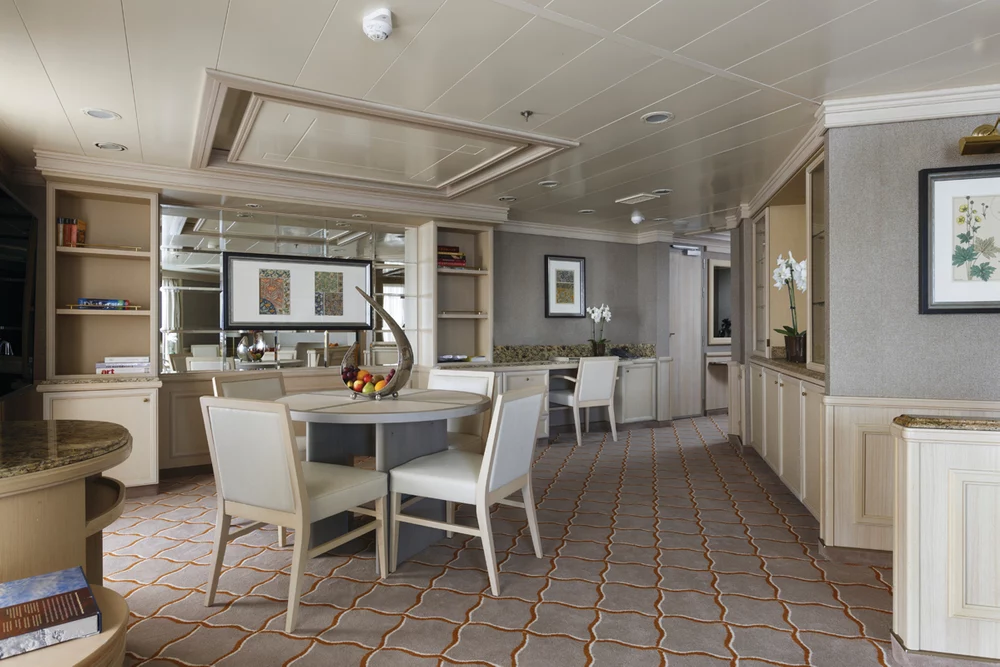
Expertly designed and exquisitely appointed. Ideal for entertaining friends while you cruise or enjoying a quiet dinner “at home”. Available as a one-bedroom configuration or as two-bedrooms by adjoining with a Veranda Suite. Two verandas with patio furniture and floor-to-ceiling glass doors; bedroom two has additional veranda. Living room with convertible sofa to accommodate an additional guest. Sitting area; bedroom two has additional sitting area. Separate dining area. Twin beds or king-sized bed; bedroom two has additional twin beds or queensized bed. Marble bathroom with double vanity, separate shower and full-sized bath, plus a powder room; bedroom two has additional marble bathroom with fullsized bath, separate shower. Beds mattresses. Walk-in wardrobe(s) with personal safe. Vanity table(s). Writing desk(s). One 55” / 140 cm and one 40” / 102 cm flat-screen HD TVs in main suite, plus one 40” / 102 cm flat-screen HD TV in bedroom two. Sound System with Bluetooth connectivity. Illy espresso machine. Unlimited Premium Wifi.
Facilities and amenities
Cabin details
Suite
Code
O1
Deck
Deck 8
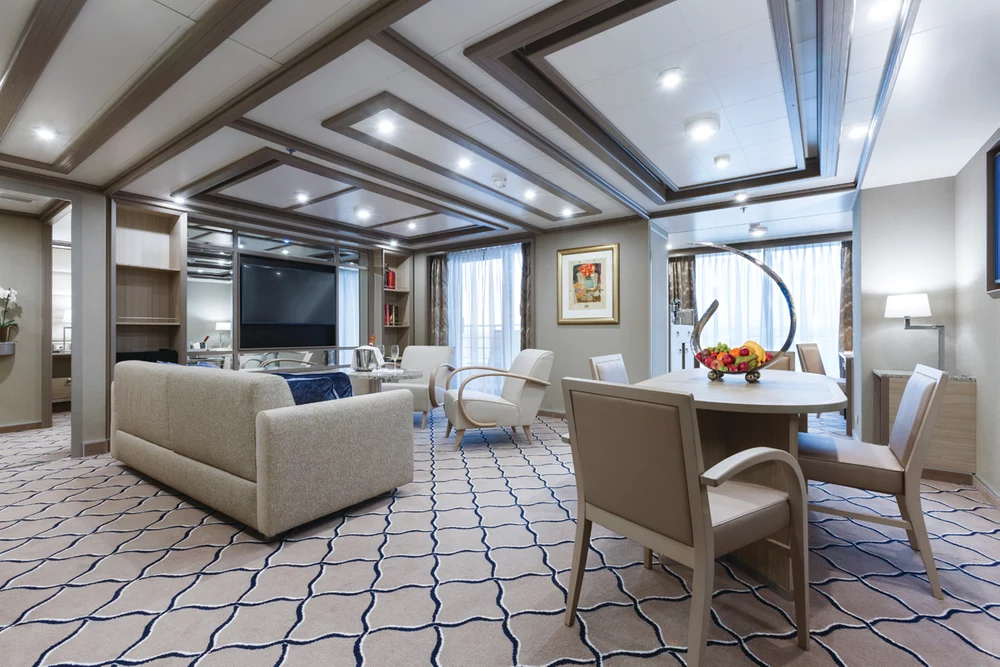
The name Owner's Suite says it all. A stylish apartment. Prestigious and classic. For those who seek the superlative level of space, comfort and service on board. Available as a one-bedroom configuration or as two-bedrooms by adjoining with Panorama Suite. Large veranda with patio furniture and floor-to-ceiling glass doors; bedroom two has additional large picture window. Living room with sitting area; bedroom two has additional sitting area. Separate dining area. Twin beds or king-sized bed; bedroom two has additional twin beds or queensized bed. Marble bathroom with double vanity, separate shower and full-sized bath, plus a powder room; bedroom two has additional marble bathroom with fullsized bath, separate shower. Beds mattresses. Walk-in wardrobe(s) with personal safe. Vanity table(s). Writing desk(s). One 55” / 140 cm and one 40” / 102 cm flat-screen HD TVs in main suite, plus one 40” / 102 cm flat-screen HD TV in bedroom two. Sound System with Bluetooth connectivity. Illy espresso machine. Unlimited Premium Wifi.
Facilities and amenities
Cabin details
Suite
Code
O2
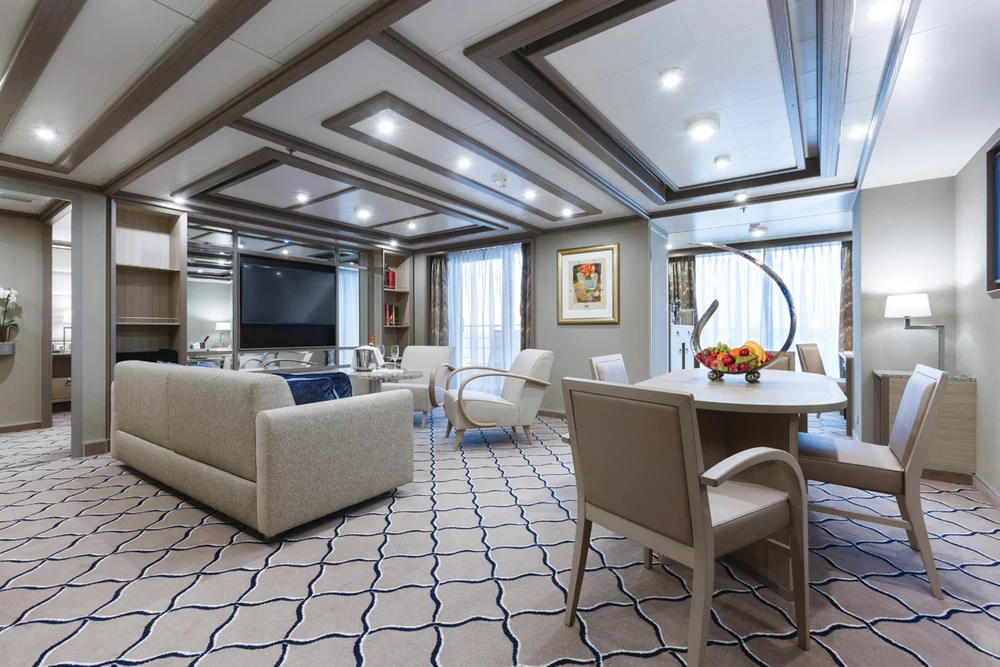
The name Owner's Suite says it all. A stylish apartment. Prestigious and classic. For those who seek the superlative level of space, comfort and service on board. Available as a one-bedroom configuration or as two-bedrooms by adjoining with Panorama Suite. Large veranda with patio furniture and floor-to-ceiling glass doors; bedroom two has additional large picture window. Living room with sitting area; bedroom two has additional sitting area. Separate dining area. Twin beds or king-sized bed; bedroom two has additional twin beds or queensized bed. Marble bathroom with double vanity, separate shower and full-sized bath, plus a powder room; bedroom two has additional marble bathroom with fullsized bath, separate shower. Beds mattresses. Walk-in wardrobe(s) with personal safe. Vanity table(s). Writing desk(s). One 55” / 140 cm and one 40” / 102 cm flat-screen HD TVs in main suite, plus one 40” / 102 cm flat-screen HD TV in bedroom two. Sound System with Bluetooth connectivity. Illy espresso machine. Unlimited Premium Wifi.
Facilities and amenities
Cabin details
Suite
Code
PA
Deck
Deck 8
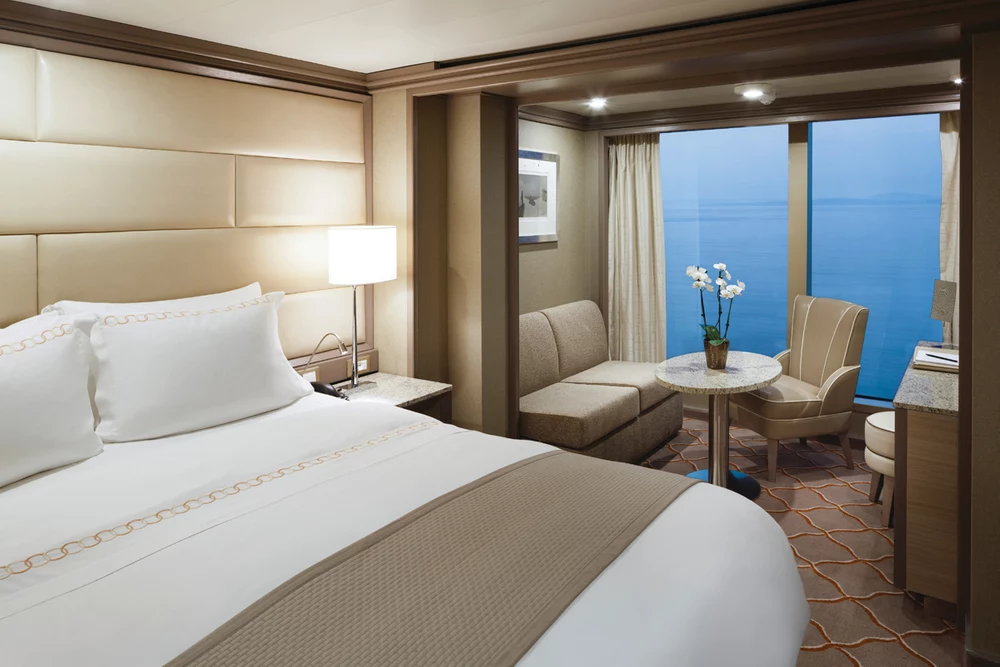
The Panorama Suite provides generous living space for voyagers. Located lower bow, the Panorama offers all the comfort and attention to detail that you can expect aboard. A generous expanse of interior comforts — elegant décor, stunning marble bathroom and ample seating area, make this a cosy home away from home. The seating area of the Panorama Suite has plenty of room to relax, while large picture windows frame panoramic ocean views. Sitting area. Twin beds or queen-sized bed. Marble bathroom with vanity, full-sized bath, separate shower. Walk-in rain shower (no full-sized bath) from suite number 852 to 853. Walk-in wardrobe with personal safe. Writing desk. One 40” / 102 cm flat-screen HD TV. Unlimited Standard Wifi.
Facilities and amenities
Cabin details
Suite
Code
R1
Deck
Deck 7
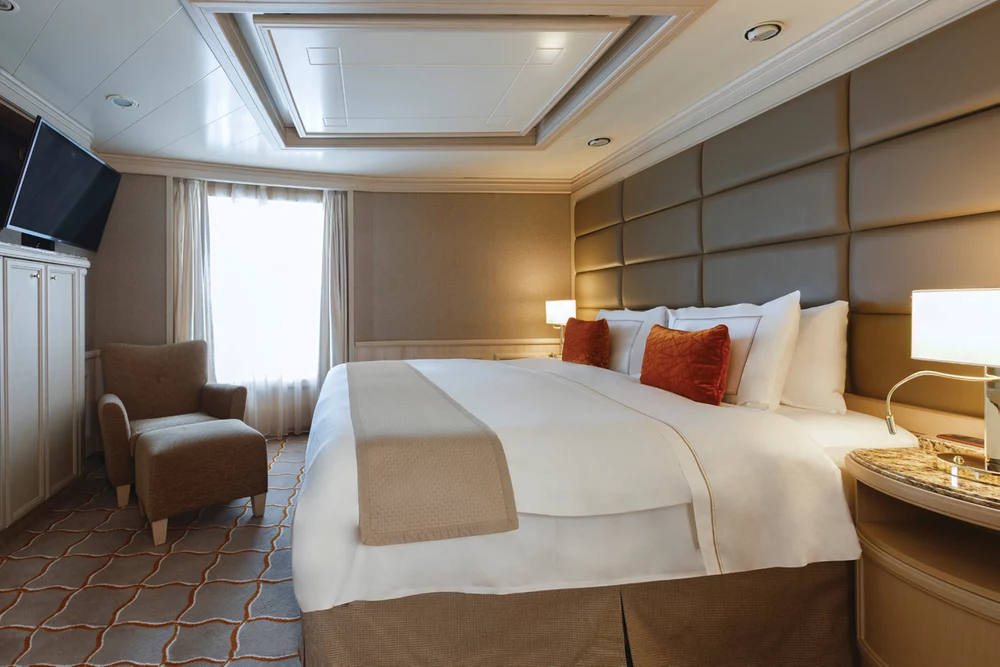
Stately describes the Royal Suite. Commanding and majestic. Perfect for entertaining. Enough living space to roam. The pinnacle of good living. Available as a one-bedroom configuration or as two bedrooms by adjoining with a Veranda Suite. Large veranda with patio furniture and floor-to-ceiling glass doors; bedroom two has additional veranda. Living room with convertible sofa to accommodate an additional guest. Sitting area; bedroom two has additional sitting area. Separate dining area. Twin beds or king-sized bed; bedroom two has additional twin beds or queensized bed. Marble bathroom with double vanity, separate shower and full-sized bath, plus a powder room; bedroom two has additional marble bathroom with fullsized bath, separate shower. Beds mattresses. Walk-in wardrobe(s) with personal safe. Vanity table(s). Writing desk(s). One 55” / 140 cm and one 40” / 102 cm flat-screen HD TVs in main suite, plus one 40” / 102 cm flat-screen HD TV in bedroom two. Sound System with Bluetooth connectivity. Illy espresso machine. Unlimited Premium Wifi.
Facilities and amenities
Cabin details
Suite
Code
R2
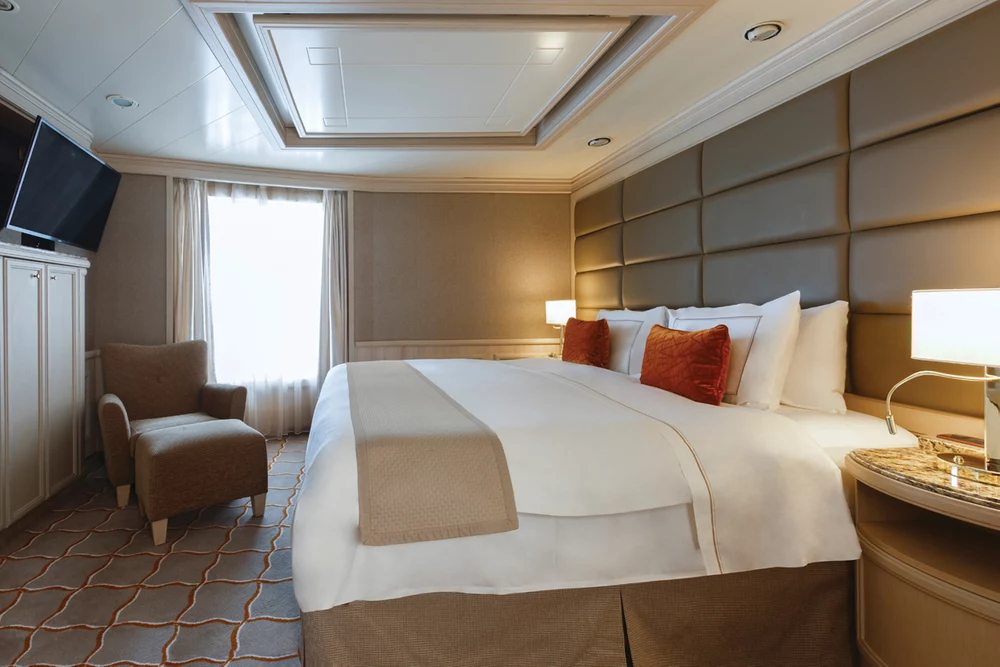
Stately describes the Royal Suite. Commanding and majestic. Perfect for entertaining. Enough living space to roam. The pinnacle of good living. Available as a one-bedroom configuration or as two bedrooms by adjoining with a Veranda Suite. Large veranda with patio furniture and floor-to-ceiling glass doors; bedroom two has additional veranda. Living room with convertible sofa to accommodate an additional guest. Sitting area; bedroom two has additional sitting area. Separate dining area. Twin beds or king-sized bed; bedroom two has additional twin beds or queensized bed. Marble bathroom with double vanity, separate shower and full-sized bath, plus a powder room; bedroom two has additional marble bathroom with fullsized bath, separate shower. Beds mattresses. Walk-in wardrobe(s) with personal safe. Vanity table(s). Writing desk(s). One 55” / 140 cm and one 40” / 102 cm flat-screen HD TVs in main suite, plus one 40” / 102 cm flat-screen HD TV in bedroom two. Sound System with Bluetooth connectivity. Illy espresso machine. Unlimited Premium Wifi.
Facilities and amenities
Cabin details
Suite
Code
SL
Deck
Deck 8
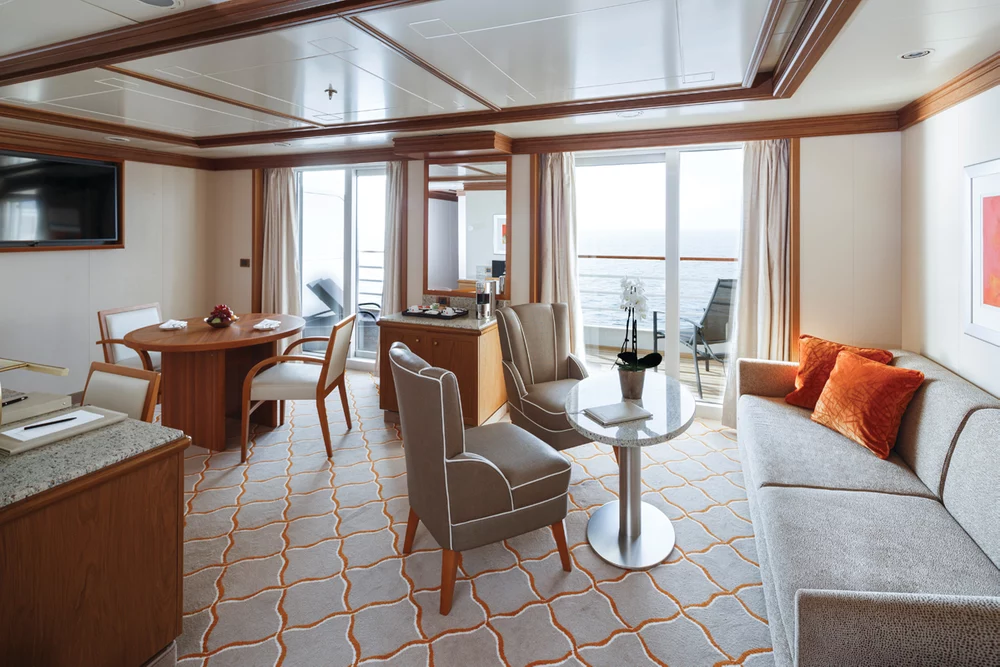
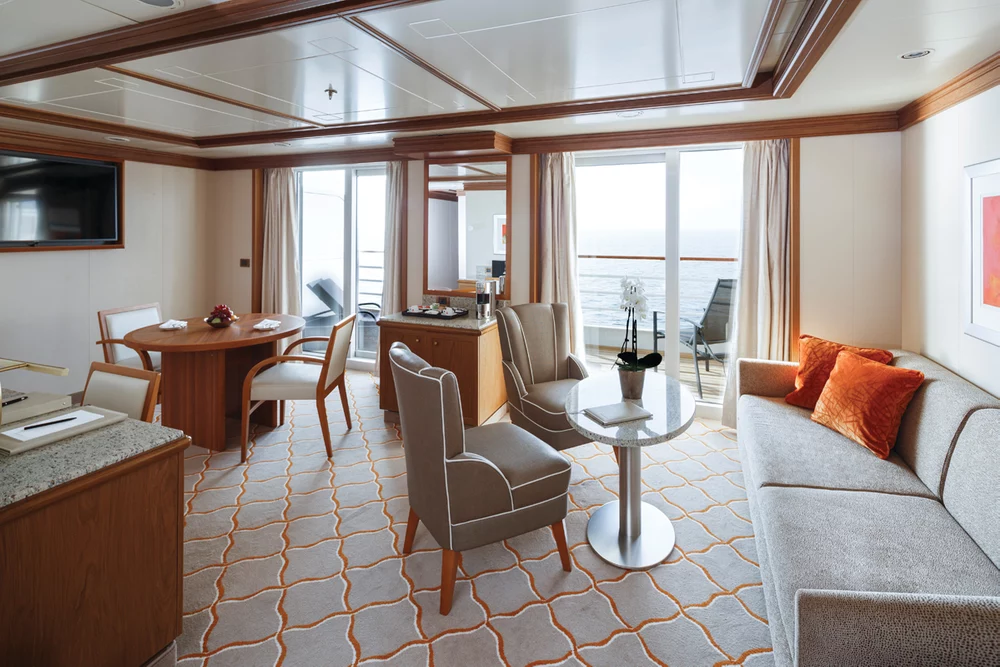
Step onto your terrace and bask in the calm feeling of the ocean breeze. Dissolve into the comfort of your king size bed. Prepare for the evening in the beautiful marble bathroom. The upper deck location gives the most spectacular of sea views, the spacious living area allows for comfortable relaxing where cosy nights in become veritable experiences in themselves. The two-bedroom configuration of this suite makes this it the ideal option for families. Veranda with patio furniture and floor-to-ceiling glass doors. Living room with convertible sofa to accommodate an additional guest. Sitting area. Separate dining area. Twin beds or king-sized bed. Marble bathroom with double vanity, full-sized bath, separate shower; bedroom two has additional marble bathroom with walk-in rain shower. Walk-in wardrobe with personal safe. Vanity table. Writing desk. One 49” / 125 cm and one 40” / 102 cm flat-screen HD TVs in main suite. Sound System with Bluetooth connectivity. Illy espresso machine. Unlimited Premium Wifi.
Facilities and amenities
Cabin details
Suite
Code
S2
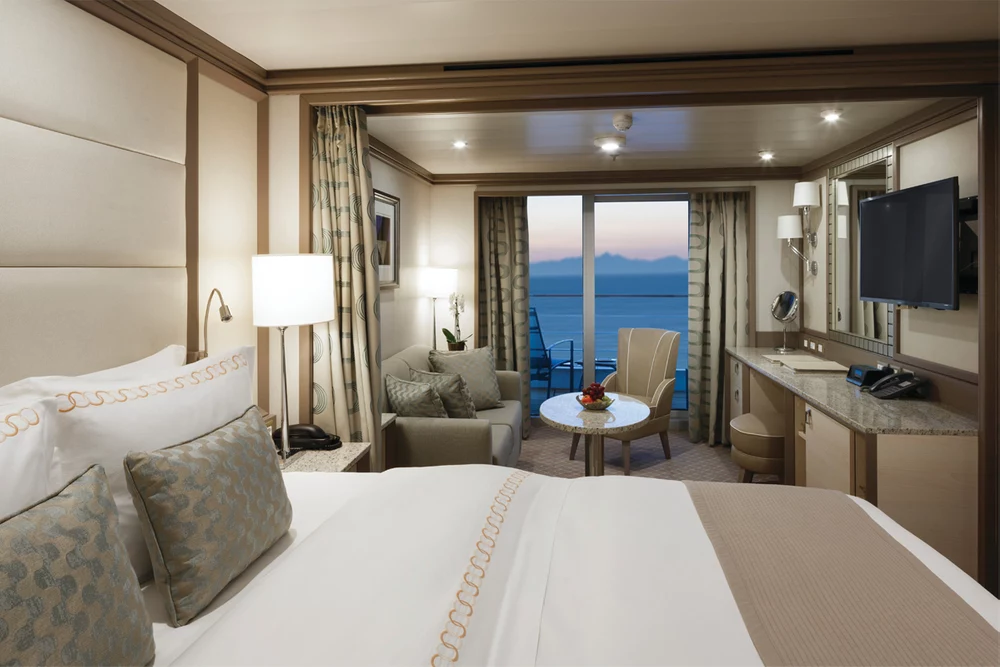
Step onto your terrace and bask in the calm feeling of the ocean breeze. Dissolve into the comfort of your king size bed. Prepare for the evening in the beautiful marble bathroom. The upper deck location gives the most spectacular of sea views, the spacious living area allows for comfortable relaxing where cosy nights in become veritable experiences in themselves. The two-bedroom configuration of this suite makes this it the ideal option for families. Veranda with patio furniture and floor-to-ceiling glass doors. Living room with convertible sofa to accommodate an additional guest. Sitting area. Separate dining area. Twin beds or king-sized bed. Marble bathroom with double vanity, full-sized bath, separate shower; bedroom two has additional marble bathroom with walk-in rain shower. Walk-in wardrobe with personal safe. Vanity table. Writing desk. One 49” / 125 cm and one 40” / 102 cm flat-screen HD TVs in main suite. Sound System with Bluetooth connectivity. Illy espresso machine. Unlimited Premium Wifi.
Facilities and amenities
Cabin details
Suite
Code
SV
Deck
Deck 7
Located on the upper deck, and offering spectacular sunset views, the Superior Veranda Suite has all the comforts and luxury that you can expect aboard. A comfortable living space, attention to detail and a generous expanse of amenities, this stunning suite makes for a cosy home while on the seas. But perhaps this suite’s finest asset lies just outside, as floor-to-ceiling glass doors open onto a private veranda, making every sunset feel as if it is yours alone. Veranda with patio furniture and floor-to-ceiling glass doors. Sitting area. Twin beds or queen-sized bed. Marble bathroom with vanity, full-sized bath, separate shower. Walk-in rain shower (no full-sized bath. Walk-in wardrobe with personal safe. Writing desk. One 40” / 102 cm flat-screen HD TV. Unlimited Standard Wifi.
Facilities and amenities
Cabin details
Suite
Code
VI
Deck
Deck 4
A quiet sanctuary. The sitting area of the Vista Suite has plenty of room to relax. Large picture windows frame panoramic ocean views. The perfect backdrop for breakfast in bed during the cruise. Some Vista Suites accommodate three guests. Sitting area. Twin beds or queen-sized bed. Marble bathroom with vanity, full-sized bath, separate shower. Walk-in wardrobe with personal safe. Writing desk. One 40” / 102 cm flat-screen HD TV. Unlimited Standard Wifi.
Facilities and amenities