Back to cruise search
Home/Cruises/Palma De Mallorca to Lisbon
Palma De Mallorca to Lisbon, 22 Sept 2026 (64 nights)
5.0 ship ratingMS EUROPA - Hapag-Lloyd Cruises


Cruise search
We are checking available sailings, ship details and guide prices for you.
Ask our cruise specialists about cruise line loyalty benefits, status match options, drinks packages, gratuities and any current offers available on this sailing.
Sail with confidence
We explain the relevant financial protection before you book.
Always here to help
When plans change, your cruise specialists are here to help.
Carefully selected cruises
From short breaks to big adventures, we help narrow down the right sailing.
Cruise summary
Gallery

Dining
1 of 9 onboard highlights
Your itinerary
Port descriptions and imagery are shown where available for each day or port.
Palma is a resort city and capital of the Spanish island of Mallorca (Majorca), in the western Mediterranean. The massive Santa María cathedral, a Gothic landmark begun in the 13th century, overlooks the Bay of Palma. The adjacent Almudaina is a Moorish-style Arab fortress converted to a royal residence. West of the city, hilltop Bellver Castle is a medieval fortress with a distinctive circular shape.
Ajaccio is the capital of Corsica, a French island in the Mediterranean Sea. A port city on the rugged isle's western coast, it was the birthplace of French Emperor Napoléon Bonaparte in 1769. His ancestral home, Maison Bonaparte, is now a museum displaying family heirlooms.
Alghero is a city on the northwest coast of Sardinia, Italy. Encircled by ancient walls, it’s known for its cobblestoned old center. Its Catalan Gothic buildings include the Cattedrale di Santa Maria, with an imposing bell tower, Palazzo Guillot and Chiesa di San Francesco, a 14th-century church. The nearby Chiesa San Michele has a colorful tiled dome.
Messina is a harbor city in northeast Sicily, separated from mainland Italy by the Strait of Messina. It’s known for the Norman Messina Cathedral, with its Gothic portal, 15th-century windows and an astronomical clock on the bell tower. Nearby are marble fountains decorated with mythological figures, like the Fontana di Orione, with its carved inscriptions, and the Neptune Fountain, topped by a statue of the sea god.
Dubrovnik is a city in southern Croatia fronting the Adriatic Sea. It's known for its distinctive Old Town, encircled with massive stone walls completed in the 16th century. Its well-preserved buildings range from baroque St. Blaise Church to Renaissance Sponza Palace and Gothic Rector’s Palace, now a history museum. Paved with limestone, the pedestrianized Stradun (or Placa) is lined with shops and restaurants.
Korčula is a Croatian island in the Adriatic Sea. It has an area of 279 km²; 46.8 km long and on average 7.8 km wide — and lies just off the Dalmatian coast.
Trogir is a town on the central Adriatic coast of Croatia. Its preserved old town, known for its mix of Renaissance, baroque and Romanesque buildings, lies on a small island connected to the mainland and the island of Čiovo by bridges. The 13th-century Cathedral of St. Lawrence houses the Renaissance Chapel of St. John and offers sweeping views from its bell tower. Parts of the medieval city walls remain intact.
Trieste is the capital city of the Friuli Venezia Giulia region in northeast Italy. A port city, it occupies a thin strip of land between the Adriatic coast and Slovenia’s border on the limestone-dominated Karst Plateau. Italian, Austro-Hungarian and Slovenian influences are all evident in its layout, which encompasses a medieval old city and a neoclassical Austrian quarter.
Piran is a resort city on Slovenia’s Adriatic coast, known for its long pier and Venetian architecture. Tartini Square is flanked by the Gothic red Venetian House and the frescoed Tartini House. The latter is the birthplace of violinist Giuseppe Tartini. The 19th-century town hall has a stone lion, a symbol of the former Republic of Venice. St. George’s Cathedral, nearby, has 17th-century paintings and marble altars.
Venice, the capital of northern Italy’s Veneto region, is built on more than 100 small islands in a lagoon in the Adriatic Sea. It has no roads, just canals – including the Grand Canal thoroughfare – lined with Renaissance and Gothic palaces. The central square, Piazza San Marco, contains St. Mark’s Basilica, which is tiled with Byzantine mosaics, and the Campanile bell tower offering views of the city’s red roofs.
Venice, the capital of northern Italy’s Veneto region, is built on more than 100 small islands in a lagoon in the Adriatic Sea. It has no roads, just canals – including the Grand Canal thoroughfare – lined with Renaissance and Gothic palaces. The central square, Piazza San Marco, contains St. Mark’s Basilica, which is tiled with Byzantine mosaics, and the Campanile bell tower offering views of the city’s red roofs.
Split
Monopoli
Kotor is a fortified town on Montenegro’s Adriatic coast, in a bay near the limestone cliffs of Mt. Lovćen. Characterized by winding streets and squares, its medieval old town has several Romanesque churches, including Kotor Cathedral. It's also home to the Maritime Museum, which explores local seafaring history. Sveti Đorđe, one of 2 tiny islands off the ancient town of Perast, features a centuries-old church.
Corfu Town is the capital of the Greek island of Corfu, in the Ionian Sea. It’s known for its cobblestone streets and pastel-colored Venetian architecture. To the west, the Venetian-built New Fortress has a network of tunnels underneath and views over the harbor. The 15th-century Old Fortress overlooks the town from the east and features a small chapel and mosaics. The Esplanade is a landscaped park near the water.
Katakolo is a seaside town in the municipality of Pyrgos in western Elis, Greece. It is situated on a headland overlooking the Ionian Sea and separating the Gulf of Kyparissia from the rest of the Ionian. It is 11 km west of Pyrgos.
Heraklion, also known as Iraklio, is a port city and the capital of the Greek island of Crete. It’s known for the Palace of Knossos, just outside the city. The huge archaeological site dates back thousands of years to the Minoan civilization, and includes frescoes and baths. Guarding the city’s Venetian port is the 16th-century Koules fortress. Heraklion Archaeological Museum has a large collection of Minoan art.
Thira
Piraeus, is a port city within the Athens urban area, in the Attica region of Greece. It is located in the Athens Riviera, 8 kilometres southwest of Athens’ city centre, along the east coast of the Saronic Gulf.
Nafplio is a seaport town in the Peloponnese in Greece that has expanded up the hillsides near the north end of the Argolic Gulf.
Mykonos is an island in the Cyclades group in the Aegean Sea. It's popularly known for its summer party atmosphere. Beaches such as Paradise and Super Paradise have bars that blare thumping music. Massive dance clubs attract world-renowned DJs and typically stay open well past dawn. Iconic landmarks include a row of 16th-century windmills, which sit on a hill above Mykonos town.
Mykonos is an island in the Cyclades group in the Aegean Sea. It's popularly known for its summer party atmosphere. Beaches such as Paradise and Super Paradise have bars that blare thumping music. Massive dance clubs attract world-renowned DJs and typically stay open well past dawn. Iconic landmarks include a row of 16th-century windmills, which sit on a hill above Mykonos town.
Delos is a Greek island and archaeological site in the Aegean Sea's Cyclades archipelago, near Mykonos. The mythological birthplace of Apollo, it was a major religious center and port during the 1st millennium B.C. The island's ruins encompass Doric temples, markets, an amphitheater, houses with mosaics and the iconic Terrace of the Lions statues.
Kuşadası is a beach resort town on Turkey’s western Aegean coast. A jumping-off point for visiting the classical ruins at nearby Ephesus (or Efes), it’s also a major cruise ship destination. Its seafront promenade, marina, and harbor are lined with hotels and restaurants. Just offshore on Pigeon Island is a walled Byzantine castle that once guarded the town, connected to the mainland via causeway.
Istanbul is a major city in Turkey that straddles Europe and Asia across the Bosphorus Strait. Its Old City reflects cultural influences of the many empires that once ruled here. In the Sultanahmet district, the open-air, Roman-era Hippodrome was for centuries the site of chariot races, and Egyptian obelisks also remain. The iconic Byzantine Hagia Sophia features a soaring 6th-century dome and rare Christian mosaics.
Istanbul is a major city in Turkey that straddles Europe and Asia across the Bosphorus Strait. Its Old City reflects cultural influences of the many empires that once ruled here. In the Sultanahmet district, the open-air, Roman-era Hippodrome was for centuries the site of chariot races, and Egyptian obelisks also remain. The iconic Byzantine Hagia Sophia features a soaring 6th-century dome and rare Christian mosaics.
Istanbul is a major city in Turkey that straddles Europe and Asia across the Bosphorus Strait. Its Old City reflects cultural influences of the many empires that once ruled here. In the Sultanahmet district, the open-air, Roman-era Hippodrome was for centuries the site of chariot races, and Egyptian obelisks also remain. The iconic Byzantine Hagia Sophia features a soaring 6th-century dome and rare Christian mosaics.
Kavala is a city in northern Greece, the principal seaport of eastern Macedonia and the capital of Kavala regional unit. It is situated on the Bay of Kavala, across from the island of Thasos and on the Egnatia motorway, a one-and-a-half-hour drive to Thessaloniki and a forty-minute drive to Drama and Xanthi.
Volos is a coastal port city in Thessaly situated midway on the Greek mainland, about 330 kilometres north of Athens and 220 kilometres south of Thessaloniki. It is the sixth most populous city of Greece. It is the capital of the Magnesia regional unit of Thessaly Region.
Piraeus, is a port city within the Athens urban area, in the Attica region of Greece. It is located in the Athens Riviera, 8 kilometres southwest of Athens’ city centre, along the east coast of the Saronic Gulf.
Valletta (or Il-Belt) is the tiny capital of the Mediterranean island nation of Malta. The walled city was established in the 1500s on a peninsula by the Knights of St. John, a Roman Catholic order. It’s known for museums, palaces and grand churches. Baroque landmarks include St. John’s Co-Cathedral, whose opulent interior is home to the Caravaggio masterpiece "The Beheading of Saint John."
Syracuse is a city on the Ionian coast of Sicily, Italy. It's known for its ancient ruins. The central Archaeological Park Neapolis comprises the Roman Amphitheater, the Teatro Greco and the Orecchio di Dionisio, a limestone cave shaped like a human ear. The Museo Archeologico Regionale Paolo Orsi exhibits terracotta artifacts, Roman portraits and Old Testament scenes carved into white marble.
Civitavecchia is a coastal town northwest of Rome, in Italy. Built in the 2nd century, the Port of Civitavecchia still retains some of its original features, like the Roman Dock. The port area also includes the 16th-century Michelangelo Fort. Nearby, the National Archaeological Museum displays bronze and ceramic artifacts. Northeast of town are the Terme Taurine, the ruins of a Roman thermal bath complex.
Livorno is an Italian port city on the west coast of Tuscany. It's known for its seafood, Renaissance-era fortifications and modern harbor with a cruise ship port. Its central Terrazza Mascagni, a waterside promenade with checkerboard paving, is the city's main gathering place. The bastions of the 16th-century Fortezza Vecchia face the harbor and open onto Livorno's canal-laced Venezia Nuova quarter.
Nice, capital of the Alpes-Maritimes department on the French Riviera, sits on the pebbly shores of the Baie des Anges. Founded by the Greeks and later a retreat for 19th-century European elite, the city has also long attracted artists. Former resident Henri Matisse is honored with a career-spanning collection of paintings at Musée Matisse. Musée Marc Chagall features some of its namesake's major religious works.
Marseille, a port city in southern France, has been a crossroads of immigration and trade since its founding by the Greeks circa 600 B.C. At its heart is the Vieux-Port (Old Port), where fishmongers sell their catch along the boat-lined quay. Basilique Notre-Dame-de-la-Garde is a Romanesque-Byzantine church. Modern landmarks include Le Corbusier’s influential Cité Radieuse complex and Zaha Hadid’s CMA CGM Tower.
Palma is a resort city and capital of the Spanish island of Mallorca (Majorca), in the western Mediterranean. The massive Santa María cathedral, a Gothic landmark begun in the 13th century, overlooks the Bay of Palma. The adjacent Almudaina is a Moorish-style Arab fortress converted to a royal residence. West of the city, hilltop Bellver Castle is a medieval fortress with a distinctive circular shape.
Barcelona, the cosmopolitan capital of Spain’s Catalonia region, is known for its art and architecture. The fantastical Sagrada Família church and other modernist landmarks designed by Antoni Gaudí dot the city. Museu Picasso and Fundació Joan Miró feature modern art by their namesakes. City history museum MUHBA, includes several Roman archaeological sites.
Barcelona, the cosmopolitan capital of Spain’s Catalonia region, is known for its art and architecture. The fantastical Sagrada Família church and other modernist landmarks designed by Antoni Gaudí dot the city. Museu Picasso and Fundació Joan Miró feature modern art by their namesakes. City history museum MUHBA, includes several Roman archaeological sites.
The port city of Valencia lies on Spain’s southeastern coast, where the Turia River meets the Mediterranean Sea. It’s known for its City of Arts and Sciences, with futuristic structures including a planetarium, an oceanarium and an interactive museum. Valencia also has several beaches, including some within nearby Albufera Park, a wetlands reserve with a lake and walking trails.
Gibraltar is a British Overseas Territory and headland, on Spain's south coast. It’s dominated by the Rock of Gibraltar, a 426m-high limestone ridge. First settled by the Moors in the Middle Ages and later ruled by Spain, the outpost was ceded to the British in 1713. Layers of fortifications include the remains of a 14th-century Moorish Castle and the 18th century Great Siege Tunnels, which were expanded in WWII.
The capital of Portugal, Lisbon is a city open to the sea and carefully planned with 18th-century elegance. Its founder is said to be the legendary Ulysses, but the theory of an original Phoenician settlement is probably more realistic. Known in Portugal as Lisboa, the city was inhabited by the Romans, Visigoths and, beginning in the 8th century, the Moors. Much of the 16th century was a period of great prosperity and overseas expansion for Portugal. Tragedy struck on All Saints' Day in 1755 with a devastating earthquake that killed about 40,000 people. The destruction of Lisbon shocked the continent. As a result, the Baixa (Lower City) emerged in a single phase of building, carried out in less than a decade by the royal minister, the Marques de Pombal. His carefully planned layout of a perfect neo-classical grid is still evident and remains the heart of the city.There are still remains of pre-quake Lisbon in the Belйm suburb, which survived the destruction, and the old Moorish…
The capital of Portugal, Lisbon is a city open to the sea and carefully planned with 18th-century elegance. Its founder is said to be the legendary Ulysses, but the theory of an original Phoenician settlement is probably more realistic. Known in Portugal as Lisboa, the city was inhabited by the Romans, Visigoths and, beginning in the 8th century, the Moors. Much of the 16th century was a period of great prosperity and overseas expansion for Portugal. Tragedy struck on All Saints' Day in 1755 with a devastating earthquake that killed about 40,000 people. The destruction of Lisbon shocked the continent. As a result, the Baixa (Lower City) emerged in a single phase of building, carried out in less than a decade by the royal minister, the Marques de Pombal. His carefully planned layout of a perfect neo-classical grid is still evident and remains the heart of the city.There are still remains of pre-quake Lisbon in the Belйm suburb, which survived the destruction, and the old Moorish…
Portimão is a port city in the Algarve region of southern Portugal. It’s known for its old quarter, busy marina and proximity to many beaches. Museu de Portimão is housed in a restored 19th-century cannery, with displays on local history. The Gothic-style Nossa Senhora da Conceição church has azulejo tiles. To the south are Rocha Beach, backed by ochre cliffs, and the medieval Fort of Santa Catarina de Ribamar.
Cádiz is an ancient port city in the Andalucia region of southwestern Spain. The home of the Spanish Navy, the port boomed in the 16th-century as a base for exploration and trade. It has more than 100 watchtowers, including the iconic Torre Tavira, which was traditionally used for spotting ships.
Malaga
Tangier, a Moroccan port on the Strait of Gibraltar, has been a strategic gateway between Africa and Europe since Phoenician times. Its whitewashed hillside medina is home to the Dar el Makhzen, a palace of the sultans that's now a museum of Moroccan artifacts. The American Legation Museum, also in the medina, documents early diplomatic relations between the U.S. and Morocco in an 1821 Moorish-style former consulate.
Casablanca is a port city and commercial hub in western Morocco, fronting the Atlantic Ocean. The city's French colonial legacy is seen in its downtown Mauresque architecture, a blend of Moorish style and European art deco. Standing partly over the water, the enormous Hassan II Mosque, completed in 1993, has a 210m minaret topped with lasers directed toward Mecca.
Arrecife is a port city on the east coast of Lanzarote, one of Spain’s Canary Islands. In the old quarter, the 17th-century San Ginés Church has a bell tower and a Mudéjar-style ceiling. The Agustín De La Hoz mansion now houses a cultural center. Playa del Reducto beach has golden sand and calm waters. The International Museum of Contemporary Art displays abstract works in San José Castle, an 18th-century fortress.
Santa Cruz de La Palma is the capital city of the island of La Palma, in Spain’s Canary Islands. It’s known for its centuries-old architecture, cobbled streets and busy port. A former convent hosts the Museum of the Island of La Palma, with an art collection and exhibits on natural history and ethnography. The Naval Museum is in a replica of Christopher Columbus's 15th-century Santa Maria sailing ship.
Santa Cruz de Tenerife is a port city on the island of Tenerife, in Spain’s Canary Islands. Well-preserved buildings in its old town include the colonial Church of the Immaculate Conception. The 1700s Palacio de Carta has baroque and neoclassical features. In the Old Civil Hospital, the Museum of Nature and Man has interactive displays on the islands. The city’s squares include the central Plaza de España.
Funchal is the capital city of Portugal's Madeira archipelago. It's backed by hills, and known for its harbor, gardens and Madeira wine cellars. The centuries-old Funchal Cathedral, which mixes Gothic and Romanesque styles, is notable for its carved wooden ceiling. Fronting the harbor is the São Tiago Fortress, built in the 1600s. It now houses the Contemporary Art Museum, with a large collection of Portuguese works.
Funchal is the capital city of Portugal's Madeira archipelago. It's backed by hills, and known for its harbor, gardens and Madeira wine cellars. The centuries-old Funchal Cathedral, which mixes Gothic and Romanesque styles, is notable for its carved wooden ceiling. Fronting the harbor is the São Tiago Fortress, built in the 1600s. It now houses the Contemporary Art Museum, with a large collection of Portuguese works.
The capital of Portugal, Lisbon is a city open to the sea and carefully planned with 18th-century elegance. Its founder is said to be the legendary Ulysses, but the theory of an original Phoenician settlement is probably more realistic. Known in Portugal as Lisboa, the city was inhabited by the Romans, Visigoths and, beginning in the 8th century, the Moors. Much of the 16th century was a period of great prosperity and overseas expansion for Portugal. Tragedy struck on All Saints' Day in 1755 with a devastating earthquake that killed about 40,000 people. The destruction of Lisbon shocked the continent. As a result, the Baixa (Lower City) emerged in a single phase of building, carried out in less than a decade by the royal minister, the Marques de Pombal. His carefully planned layout of a perfect neo-classical grid is still evident and remains the heart of the city.There are still remains of pre-quake Lisbon in the Belйm suburb, which survived the destruction, and the old Moorish…
What's included
Fare overview
This sailing is shown as a cruise-only guide fare with Hapag-Lloyd Cruises. The fare is linked to the ship, itinerary and cabin category you choose. Drinks packages, gratuities, Wi-Fi, flights, transfers and shore experiences are only treated as included where they are confirmed before booking.
Sailing aboard
MS EUROPA
Your ship
Welcome to a ship that sets the global benchmarks for luxury cruises. It may be smaller than other cruise ships, but the EUROPA is miles ahead of the crowd. Enjoy the unrivalled freedom for personal relaxation on a cruise with no more than 400 guests – with plenty of scope for fresh ideas, indulgence and inspiring perspectives. However you define it, enjoy your own personal luxury throughout your time on the EUROPA. Come aboard and experience an exceptional cruise as you travel to the world’s most beautiful destinations.
Onboard facilities

Bars/Lounges
Deck plans
Explore the ship deck by deck. Deck plans can change and should be checked before booking.
Deck 4 | Europa Deck
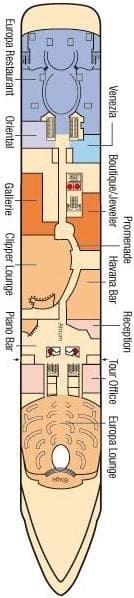
These facilities are available aboard the ship. Their deck locations can be confirmed before booking.
No cabin types are listed for this deck.
Match cabin grade codes and colours to the selected deck plan.
Choose your cabin
Compare the cabin types and onboard features shown for this sailing. Final price and availability are confirmed before booking.
Cabin details
Suite
£33,495
Cabin fare
Code
10
Size
27 m2
Decks
Atlantik Deck, Bellevue Deck, Pazifik Deck, Penthouse Deck, Sports Deck
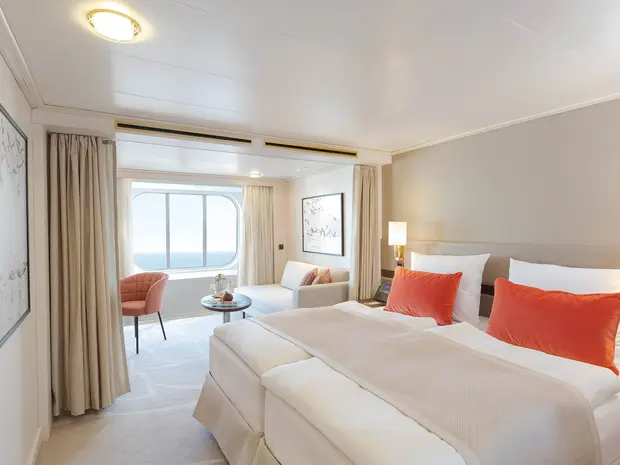
Max passengers: 3 Staterooms number: Cabin size: 290 ft2 / 27 m2 Balcony size: included Location (on decks): 7-Sport Type (categories): (K10) Spa Suite SPA Suite passengers receive 24-hour butler service (packing / unpacking, laundry, ironing, onboard reservations), SPA package, cabin balcony treatments (on request), SPA service privileges (nutritional advice), SPA drinks (smoothies, fresh fruit juices, wellness tea), daily in-cabin dining (fresh canapes, chocolates), Nespresso coffee maker, bathroom with large window (natural light and sea view, blinds between bathroom-living area), Jacuzzi whirlpool bath, emotional shower (color effects and sequences of alternating water jets), walk-in closet, free minibar (re-stocked daily with bottled water, juices, soft drinks, beer, premium spirits).
Facilities and amenities
Next step
Continue to a separate page to review cruise extras and booking options around this sailing.
More sailings
Use horizontal scrolling, touch swipes, or the arrow keys to browse.
Hapag-Lloyd Cruises - MS EUROPA
From
£8,690

Hapag-Lloyd Cruises - MS EUROPA 2
From
£20,690
Hapag-Lloyd Cruises - MS EUROPA 2
From
£4,990
Hapag-Lloyd Cruises - MS EUROPA 2
From
£7,690
Important information
ATOL protected holidays
Where your booking includes flights, ATOL protection applies so your money and travel arrangements are financially protected.
Travel Trust Association
Book with confidence through a Travel Trust Association member, with customer money protected under approved trust arrangements.
Low deposit options
Secure selected sailings with flexible low deposit options, then spread the remaining balance before you travel.
Excellent customer service
Our cruise specialists are here before, during and after booking. Send an enquiry or call 0161 222 0822 for friendly support.
Clear price checks
Live prices and cabin options are checked before you continue.