
Back to cruise search
Home/Cruises/Nice to Travemunde
Nice to Travemunde from Nice (Villefranche), 31 May 2027 (60 nights)
5.0 ship ratingMS EUROPA - Hapag-Lloyd Cruises


Cruise search
We are checking available sailings, ship details and guide prices for you.
Ask our cruise specialists about cruise line loyalty benefits, status match options, drinks packages, gratuities and any current offers available on this sailing.
Sail with confidence
We explain the relevant financial protection before you book.
Always here to help
When plans change, your cruise specialists are here to help.
Carefully selected cruises
From short breaks to big adventures, we help narrow down the right sailing.
Cruise summary
Gallery

Dining
1 of 9 onboard highlights
Your itinerary
Port descriptions and imagery are shown where available for each day or port.
Nice, capital of the Alpes-Maritimes department on the French Riviera, sits on the pebbly shores of the Baie des Anges. Founded by the Greeks and later a retreat for 19th-century European elite, the city has also long attracted artists. Former resident Henri Matisse is honored with a career-spanning collection of paintings at Musée Matisse. Musée Marc Chagall features some of its namesake's major religious works.
The port city of Valencia lies on Spain’s southeastern coast, where the Turia River meets the Mediterranean Sea. It’s known for its City of Arts and Sciences, with futuristic structures including a planetarium, an oceanarium and an interactive museum. Valencia also has several beaches, including some within nearby Albufera Park, a wetlands reserve with a lake and walking trails.
Marbella is a city and resort area on southern Spain’s Costa del Sol, part of the Andalusia region. The Sierra Blanca Mountains are the backdrop to 27 km of sandy Mediterranean beaches, villas, hotels, and golf courses. West of Marbella town, the Golden Mile of prestigious nightclubs and coastal estates leads to Puerto Banús marina, filled with luxury yachts, and surrounded by upmarket boutiques and bars.
The capital of Portugal, Lisbon is a city open to the sea and carefully planned with 18th-century elegance. Its founder is said to be the legendary Ulysses, but the theory of an original Phoenician settlement is probably more realistic. Known in Portugal as Lisboa, the city was inhabited by the Romans, Visigoths and, beginning in the 8th century, the Moors. Much of the 16th century was a period of great prosperity and overseas expansion for Portugal. Tragedy struck on All Saints' Day in 1755 with a devastating earthquake that killed about 40,000 people. The destruction of Lisbon shocked the continent. As a result, the Baixa (Lower City) emerged in a single phase of building, carried out in less than a decade by the royal minister, the Marques de Pombal. His carefully planned layout of a perfect neo-classical grid is still evident and remains the heart of the city.There are still remains of pre-quake Lisbon in the Belйm suburb, which survived the destruction, and the old Moorish…
The capital of Portugal, Lisbon is a city open to the sea and carefully planned with 18th-century elegance. Its founder is said to be the legendary Ulysses, but the theory of an original Phoenician settlement is probably more realistic. Known in Portugal as Lisboa, the city was inhabited by the Romans, Visigoths and, beginning in the 8th century, the Moors. Much of the 16th century was a period of great prosperity and overseas expansion for Portugal. Tragedy struck on All Saints' Day in 1755 with a devastating earthquake that killed about 40,000 people. The destruction of Lisbon shocked the continent. As a result, the Baixa (Lower City) emerged in a single phase of building, carried out in less than a decade by the royal minister, the Marques de Pombal. His carefully planned layout of a perfect neo-classical grid is still evident and remains the heart of the city.There are still remains of pre-quake Lisbon in the Belйm suburb, which survived the destruction, and the old Moorish…
La Coruсa, the largest city in Spain's Galicia region, is among the country's busiest ports. The remote Galicia area is tucked into the northwest corner of the Iberian Peninsula, surprising visitors with its green and misty countryside that is so much unlike other parts of Spain. The name “Galicia” is Celtic in origin, for it was the Celts who around the 6th century BC occupied the region and constructed fortified defenses. La Coruсa was already a busy port under the Romans.They were followed by an invasion of Suevians, Visigoths and, much later in 730, the Moors. It was after Galicia was incorporated into the Kingdom of Asturias that the epic saga of the Pilgrimage to Santiago (St. James) began. From the 15th century, overseas trade developed rapidly; in 1720, La Coruсa was granted the privilege of trading with America - a right previously only held by Cadiz and Seville. This was the great era when adventurous men voyaged to the colonies and returned with vast riche…
Saint-Malo is a port city in Brittany, in France's northwest. Tall granite walls surround the old town, which was once a stronghold for privateers (pirates approved by the king). The Saint-Malo Cathedral, in the center of the old town, is built in Romanesque and Gothic styles and features stained-glass windows depicting city history. Nearby is La Demeure de Corsaire, an 18th-century privateer’s house and museum.
Honfleur is a city in the department of Calvados, in northern France's Normandy region. It's on the estuary where the Seine river meets the English Channel. The Vieux-Bassin (old harbor), lined with 16th- to 18th-century townhouses, has been a subject for artists including Claude Monet and native son Eugène Boudin. Nearby is 15th-century St. Catherine's Church, a vaulted timber structure erected by shipbuilders.
Honfleur is a city in the department of Calvados, in northern France's Normandy region. It's on the estuary where the Seine river meets the English Channel. The Vieux-Bassin (old harbor), lined with 16th- to 18th-century townhouses, has been a subject for artists including Claude Monet and native son Eugène Boudin. Nearby is 15th-century St. Catherine's Church, a vaulted timber structure erected by shipbuilders.
Antwerp is a port city on Belgium’s River Scheldt, with history dating to the Middle Ages. In its center, the centuries-old Diamond District houses thousands of diamond traders, cutters and polishers. Antwerp’s Flemish Renaissance architecture is typified by the Grote Markt, a central square in the old town. At the 17th-century Rubens House, period rooms display works by the Flemish Baroque painter Peter Paul Rubens.
Hamburg, a major port city in northern Germany, is connected to the North Sea by the Elbe River. It's crossed by hundreds of canals, and also contains large areas of parkland. Near its core, Inner Alster lake is dotted with boats and surrounded by cafes. The city's central Jungfernstieg boulevard connects the Neustadt (new town) with the Altstadt (old town), home to landmarks like 18th-century St. Michael’s Church.
The seventy or so Orcadian isles apart from rugged rock of Hoy - are low-lying and richly fertile. First inhabited by late Stone Age settlers, followed by broch-builders and Picts, fromthe 15th centuries Orkney was ruled as a Norse kingdom, passing to the Scottish crown in 1471. Mainland Kirkwall is the capital. The Orkney Islands are politically a part of Britain, yet seem quite different in many ways. Numerous place names have non-English sounds, reflecting the original Viking settlement of the 9th century. Norse crafts and traditions are obvious everywhere. These islands were ruled from Norway and Denmark until 1468, when a Norwegian king gave them to Scotland in lieu of a dowry for his daughter's marriage to King James III. In addition to the Norse heritage there are numerous remains of prehistoric monuments such as the Stenness Standing Stones at Finstown. The archipelago is located at the same latitude as southern Greenland; the Gulfstream accounts for the islands' temperate cli…
Vestmannaeyjar, group of 15 small islands, c.10 mi (16 km) S of Iceland. In English they are known as the Westman Islands. The largest and most populous is Heimaey [home island]. The people live by fishing, fowling, and farming; great colonies of gannets and other waterfowl breed in these islands. The chief town is Vestmannaeyjar (1993 pop. 4,886) on Heimaey. In 1627, Algerian pirates ravaged the islands and carried nearly 300 people into slavery. In 1963 a volcanic eruption created the island of Surtsey. The eruption of a volcano on Heimaey in 1973 damaged Vestmannaeyjar and curtailed the fishing industry.
The fire, frost and water symbolized by the red, white and blue of Iceland's flag are manifested by the ice and snow of its glaciers, the hot mud pools, geysers and glowing lava flows in the country's volcanic regions. The island's settlement dates back to 874 when a Norwegian named Ingolf Arnarson arrived at present-day Reykjavik. In 930, the settlers formed a legislature, the Alting, which was the beginning of the Commonwealth of Iceland. From the 10th to the 14th centuries, Iceland developed a literary form, the Icelandic Saga, which spread throughout the Nordic culture and into the English and German languages. It was used to spin stories of the gods, record historic events and glorify heroes.
Akureyri is a city at the base of Eyjafjörður Fjord in northern Iceland. In the center, the 1940 Akureyri Church has stained-glass windows portraying scenes from Icelandic Christian history. There are views of the fjord from the forecourt. Nearby, the Akureyri Art Museum displays contemporary art from Iceland and farther afield. To the south are the Botanical Gardens, with specimens from across Iceland.
Ålesund is a port town on the west coast of Norway, at the entrance to the Geirangerfjord. It’s known for the art nouveau architectural style in which most of the town was rebuilt after a fire in 1904, as documented at the Jugendstilsenteret museum. There are panoramic views of Ålesund’s architecture, the surrounding archipelago and fjords from the Mount Aksla lookout.
Olden is a village and urban area in the municipality of Stryn in Vestland county, Norway. Olden is located at the mouth of the Oldeelva river at the northern end of the Oldedalen valley on the southern shore of the Nordfjorden.
Rosendal is the administrative centre of the municipality of Kvinnherad in Vestland county, Norway. The village is located on the southern shore of the Hardangerfjorden, about 4 kilometres north of the .
Hamburg, a major port city in northern Germany, is connected to the North Sea by the Elbe River. It's crossed by hundreds of canals, and also contains large areas of parkland. Near its core, Inner Alster lake is dotted with boats and surrounded by cafes. The city's central Jungfernstieg boulevard connects the Neustadt (new town) with the Altstadt (old town), home to landmarks like 18th-century St. Michael’s Church.
Cowes is an English seaport town and civil parish on the Isle of Wight. Cowes is located on the west bank of the estuary of the River Medina, facing the smaller town of East Cowes on the east bank. The two towns are linked by the Cowes Floating Bridge, a chain ferry.
Dartmouth is a former city and current community located in the Halifax Regional Municipality of Nova Scotia, Canada. Dartmouth is located on the eastern shore of Halifax Harbour. Dartmouth has been nicknamed the City of Lakes, after the large number of lakes located within its boundaries.
The Isles of Scilly are an archipelago off the Cornish coast, in southwest England. The islands are covered in heathland, and fringed by sandy beaches such as Great Bay on St. Martin’s. On Tresco, one of the 5 inhabited islands, Tresco Abbey Garden is home to subtropical plants and also the Valhalla Museum, displaying shipwrecked figureheads. The tower of 17th-century Cromwell’s Castle stands at the north of Tresco.
Cobh is a town in Ireland, on an island in Cork city’s harbour. It’s known as the Titanic’s last port of call in 1912. Titanic Experience Cobh is a themed attraction in the former White Star Line ticket office. More displays on the liner are in the Cobh Heritage Centre, which also explores how Cobh became an embarkation point during Ireland’s mass emigrations. North of town, huge Fota Wildlife Park is on Fota Island.
Dingle is a small port town on southwest Ireland’s Dingle Peninsula, known for its rugged scenery, trails and sandy beaches. A statue of long-time harbour resident Fungie the dolphin is by the waterfront. Dingle Oceanworld Aquarium has penguins, otters and sharks. To the northwest, Gallarus Oratory is an ancient dry-stone church with sloping sides. Clifftop Dún Beag is a prehistoric promontory fort to the southwest.
Galway, a harbour city on Ireland’s west coast, sits where the River Corrib meets the Atlantic Ocean. The city’s hub is 18th-century Eyre Square, a popular meeting spot surrounded by shops and traditional pubs that often offer live Irish folk music. Nearby, stone-clad cafes, boutiques and art galleries line the winding lanes of the Latin Quarter, which retains portions of the medieval city walls.
Portree is the largest town on, and capital of, the Isle of Skye in the Inner Hebrides of Scotland. It is the location for the only secondary school on the island, Portree High School. Public transport services are limited to buses. Portree has a harbour, fringed by cliffs, with a pier designed by Thomas Telford.
Ullapool is a port and a village of around 1,500 inhabitants in Ross and Cromarty, Scottish Highlands, located around 45 miles north-west of Inverness. Despite its small size it is the largest settlement for many miles around, and an important port and tourist destination.
The seventy or so Orcadian isles apart from rugged rock of Hoy - are low-lying and richly fertile. First inhabited by late Stone Age settlers, followed by broch-builders and Picts, fromthe 15th centuries Orkney was ruled as a Norse kingdom, passing to the Scottish crown in 1471. Mainland Kirkwall is the capital. The Orkney Islands are politically a part of Britain, yet seem quite different in many ways. Numerous place names have non-English sounds, reflecting the original Viking settlement of the 9th century. Norse crafts and traditions are obvious everywhere. These islands were ruled from Norway and Denmark until 1468, when a Norwegian king gave them to Scotland in lieu of a dowry for his daughter's marriage to King James III. In addition to the Norse heritage there are numerous remains of prehistoric monuments such as the Stenness Standing Stones at Finstown. The archipelago is located at the same latitude as southern Greenland; the Gulfstream accounts for the islands' temperate cli…
The Highlands in the northern part of Scotland are known for their magnificent scenery, boasting a landscape of dramatic mountains and forested hills. This region also is of historic importance and full of legends including the fabled Loch Ness monster. For centuries, Scotland was England's principal enemy. Then in 1603, James VI of Scotland became James I of England, thus establishing the first political union between the two countries. Despite these ties, Scottish nationalism persisted.The resistance came to an end in 1746 when Bonnie Prince Charlie, in a sad but heroic attempt to reclaim the throne, was defeated in the Battle of Culloden. It changed the social structure of the Highlands forever. Powerful clans were disarmed; for many years wearing kilts was prohibited because the kilt was seen as a symbol of Scottish pride. Scotland ultimately was ruled from London. Invergordon is the port for Inverness, the capital of the Scottish Highlands and junction of many routes. Over the ce…
Hamburg, a major port city in northern Germany, is connected to the North Sea by the Elbe River. It's crossed by hundreds of canals, and also contains large areas of parkland. Near its core, Inner Alster lake is dotted with boats and surrounded by cafes. The city's central Jungfernstieg boulevard connects the Neustadt (new town) with the Altstadt (old town), home to landmarks like 18th-century St. Michael’s Church.
Wonderful Copenhagen is a city of bridge-spanned canals, copper-roofed buildings and manicured parks. This famous Baltic seaport is one of Europe's loveliest capitals and the seat of the oldest monarchy in the world. Home to a quarter of Denmark's population, Copenhagen is a focus for commerce, culture, industry and cosmopolitan atmosphere. Although Vikings and fishermen knew this site for years as Havn (Harbor), the founding of Copenhagen dates from 1167, when the warrior-bishop Absalon established a citadel here. As commerce flourished, the name was changed to Kшpmannжhafn (Merchants' Harbor); in 1443 the city became capital of the Kingdom of Denmark. A century later, Christian IV began the building program that was the basis of the modern city; in 1669 Frederik III graced the city with its first royal palace, Amalienborg, for his queen, Sophie Amalie. Many of these structures still exist; the taller ones remain the dominant features on what is a refreshingly low skyline.
Gdańsk (Danzig in German) is a port city on the Baltic coast of Poland. At the center of its Main Town, reconstructed after WWII, are the colorful facades of Long Market, now home to shops and restaurants. Nearby is Neptune Fountain, a 17th-century symbol of the city topped by a bronze statue of the sea god. Gdańsk is also a center for the world’s amber trade; boutiques throughout the city sell the ossified resin.
Klaipėda is a port city in Lithuania, where the Baltic Sea meets the Danė River. The old town features German-style, 18th-century wood-framed buildings. Theater Square, the city’s main gathering spot, is home to the neoclassical Drama Theater. The square’s 1912 Taravos Anikė sculpture pays tribute to a local poet. The waterside Lithuanian Sea Museum includes dolphin shows and maritime exhibits in a 19th-century fort.
Founded in the 13th century, Stockholm is Sweden's strikingly elegant and beautiful capital, spread out over many islands at the meeting point of the Baltic with Lake Mдlaren. Stockholm, noted for its outstanding architecture, is one of Scandinavia's most attractive cities. In addition to its many man-made monuments, Stockholm boasts a world of natural beauty. One-third of the city's total land area is devoted to parks.
Founded in the 13th century, Stockholm is Sweden's strikingly elegant and beautiful capital, spread out over many islands at the meeting point of the Baltic with Lake Mдlaren. Stockholm, noted for its outstanding architecture, is one of Scandinavia's most attractive cities. In addition to its many man-made monuments, Stockholm boasts a world of natural beauty. One-third of the city's total land area is devoted to parks.
Riga, Latvia’s capital, is set on the Baltic Sea at the mouth of the River Daugava. It's considered a cultural center and is home to many museums and concert halls. The city is also known for its wooden buildings, art nouveau architecture and medieval Old Town. The pedestrian-only Old Town has many shops and restaurants and is home to busy Livu Square, with bars and nightclubs.
Riga, Latvia’s capital, is set on the Baltic Sea at the mouth of the River Daugava. It's considered a cultural center and is home to many museums and concert halls. The city is also known for its wooden buildings, art nouveau architecture and medieval Old Town. The pedestrian-only Old Town has many shops and restaurants and is home to busy Livu Square, with bars and nightclubs.
The island of Gotland, with its magnificent walled town of Visby, is one of Sweden's most popular summer destinations and an outstanding tourist attraction. Already settled in the Stone Age, Visby reached prominence in medieval times when it was annexed by the powerful Hanseatic League, a confederation of merchants in Northern Europe. By the 13th century, Visby was a prosperous commercial center that minted its own coins and had a code of law.
Travemünde is a relaxed Baltic Sea resort and a port for Scandinavian ferries. Seafood restaurants dot the banks of the Trave River as well as the Strandpromenade overlooking Travemünde Beach and the Bay of Lübeck, and stalls sell fish sandwiches at the Fishermen’s harbor. The Alter Leuchtturm is a brick lighthouse from 1539 housing a maritime museum, and the 4-masted sailing ship Passat is open for guided tours.
What's included
Fare overview
This sailing is shown as a cruise-only guide fare with Hapag-Lloyd Cruises. The fare is linked to the ship, itinerary and cabin category you choose. Drinks packages, gratuities, Wi-Fi, flights, transfers and shore experiences are only treated as included where they are confirmed before booking.
Sailing aboard
MS EUROPA
Your ship
Welcome to a ship that sets the global benchmarks for luxury cruises. It may be smaller than other cruise ships, but the EUROPA is miles ahead of the crowd. Enjoy the unrivalled freedom for personal relaxation on a cruise with no more than 400 guests – with plenty of scope for fresh ideas, indulgence and inspiring perspectives. However you define it, enjoy your own personal luxury throughout your time on the EUROPA. Come aboard and experience an exceptional cruise as you travel to the world’s most beautiful destinations.
Onboard facilities

Bars/Lounges
Deck plans
Explore the ship deck by deck. Deck plans can change and should be checked before booking.
Deck 4 | Europa Deck
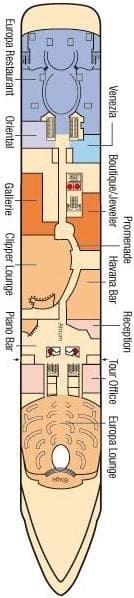
These facilities are available aboard the ship. Their deck locations can be confirmed before booking.
No cabin types are listed for this deck.
Match cabin grade codes and colours to the selected deck plan.
Choose your cabin
Compare the cabin types and onboard features shown for this sailing. Final price and availability are confirmed before booking.
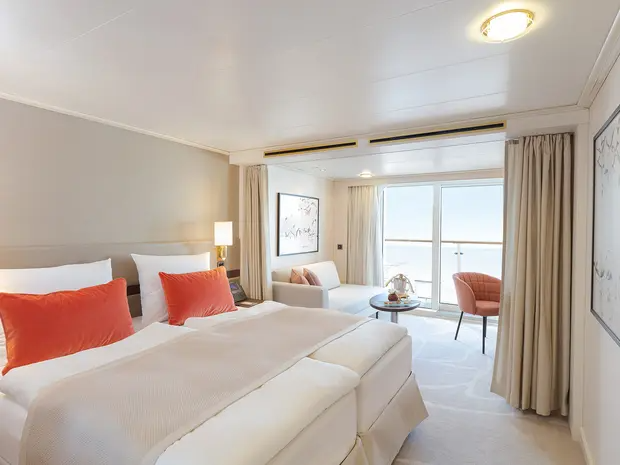
Cabin details
Suite
£23,496
Cabin fare
Code
10
Size
27 m2
Decks
Atlantik Deck, Bellevue Deck, Pazifik Deck, Penthouse Deck, Sports Deck
Max passengers: 3 Staterooms number: Cabin size: 290 ft2 / 27 m2 Balcony size: included Location (on decks): 7-Sport Type (categories): (K10) Spa Suite SPA Suite passengers receive 24-hour butler service (packing / unpacking, laundry, ironing, onboard reservations), SPA package, cabin balcony treatments (on request), SPA service privileges (nutritional advice), SPA drinks (smoothies, fresh fruit juices, wellness tea), daily in-cabin dining (fresh canapes, chocolates), Nespresso coffee maker, bathroom with large window (natural light and sea view, blinds between bathroom-living area), Jacuzzi whirlpool bath, emotional shower (color effects and sequences of alternating water jets), walk-in closet, free minibar (re-stocked daily with bottled water, juices, soft drinks, beer, premium spirits).
Facilities and amenities
Next step
Continue to a separate page to review cruise extras and booking options around this sailing.
More sailings
Use horizontal scrolling, touch swipes, or the arrow keys to browse.
Hapag-Lloyd Cruises - MS EUROPA
From
£8,690

Hapag-Lloyd Cruises - MS EUROPA 2
From
£20,690
Hapag-Lloyd Cruises - MS EUROPA 2
From
£4,990
Hapag-Lloyd Cruises - MS EUROPA 2
From
£7,690
Important information
ATOL protected holidays
Where your booking includes flights, ATOL protection applies so your money and travel arrangements are financially protected.
Travel Trust Association
Book with confidence through a Travel Trust Association member, with customer money protected under approved trust arrangements.
Low deposit options
Secure selected sailings with flexible low deposit options, then spread the remaining balance before you travel.
Excellent customer service
Our cruise specialists are here before, during and after booking. Send an enquiry or call 0161 222 0822 for friendly support.
Clear price checks
Live prices and cabin options are checked before you continue.