Back to cruise search
Home/Cruises/Atlantic islands and the aura of Spain - Lisbon to Bilbao
Atlantic islands and the aura of Spain - Lisbon to Bilbao, 3 Apr 2028 (13 nights)
5.0 ship ratingMS EUROPA 2 - Hapag-Lloyd Cruises


Cruise search
We are checking available sailings, ship details and guide prices for you.
Ask our cruise specialists about cruise line loyalty benefits, status match options, drinks packages, gratuities and any current offers available on this sailing.
Sail with confidence
We explain the relevant financial protection before you book.
Always here to help
When plans change, your cruise specialists are here to help.
Carefully selected cruises
From short breaks to big adventures, we help narrow down the right sailing.
Cruise summary
Gallery

Dining
1 of 13 onboard highlights
Your itinerary
Port descriptions and imagery are shown where available for each day or port.
The capital of Portugal, Lisbon is a city open to the sea and carefully planned with 18th-century elegance. Its founder is said to be the legendary Ulysses, but the theory of an original Phoenician settlement is probably more realistic. Known in Portugal as Lisboa, the city was inhabited by the Romans, Visigoths and, beginning in the 8th century, the Moors. Much of the 16th century was a period of great prosperity and overseas expansion for Portugal. Tragedy struck on All Saints' Day in 1755 with a devastating earthquake that killed about 40,000 people. The destruction of Lisbon shocked the continent. As a result, the Baixa (Lower City) emerged in a single phase of building, carried out in less than a decade by the royal minister, the Marques de Pombal. His carefully planned layout of a perfect neo-classical grid is still evident and remains the heart of the city.There are still remains of pre-quake Lisbon in the Belйm suburb, which survived the destruction, and the old Moorish…
The capital of Portugal, Lisbon is a city open to the sea and carefully planned with 18th-century elegance. Its founder is said to be the legendary Ulysses, but the theory of an original Phoenician settlement is probably more realistic. Known in Portugal as Lisboa, the city was inhabited by the Romans, Visigoths and, beginning in the 8th century, the Moors. Much of the 16th century was a period of great prosperity and overseas expansion for Portugal. Tragedy struck on All Saints' Day in 1755 with a devastating earthquake that killed about 40,000 people. The destruction of Lisbon shocked the continent. As a result, the Baixa (Lower City) emerged in a single phase of building, carried out in less than a decade by the royal minister, the Marques de Pombal. His carefully planned layout of a perfect neo-classical grid is still evident and remains the heart of the city.There are still remains of pre-quake Lisbon in the Belйm suburb, which survived the destruction, and the old Moorish…
Cádiz is an ancient port city in the Andalucia region of southwestern Spain. The home of the Spanish Navy, the port boomed in the 16th-century as a base for exploration and trade. It has more than 100 watchtowers, including the iconic Torre Tavira, which was traditionally used for spotting ships.
Funchal is the capital city of Portugal's Madeira archipelago. It's backed by hills, and known for its harbor, gardens and Madeira wine cellars. The centuries-old Funchal Cathedral, which mixes Gothic and Romanesque styles, is notable for its carved wooden ceiling. Fronting the harbor is the São Tiago Fortress, built in the 1600s. It now houses the Contemporary Art Museum, with a large collection of Portuguese works.
Ponta Delgada, on São Miguel Island, is the capital of the Azores archipelago of Portugal. The striking, 3-arched city gates and the Gothic-style Church of St. Sebastian are near the harbor. The Convent and Chapel of Our Lady of Hope houses a revered image of Christ. The Carlos Machado Museum offers diverse artifacts of Azorean culture. The city is a gateway to the crater lakes of Sete Cidades, to the northwest.
Praia da Vitória is a municipality in the Portuguese archipelago of the Azores. With a population of 21,035, the second largest administrative authority on the island of Terceira, it covers an area of 161.27 square kilometres, that extends from the northern coast halfway into the interior.
The Port of Leixões is one of Portugal's major seaports, located 4 km north of the mouth of the Douro River, in Matosinhos municipality, near the city of Porto. Leixões Sport Club, commonly known simply as Leixões, is Matosinhos' sports club.
La Coruсa, the largest city in Spain's Galicia region, is among the country's busiest ports. The remote Galicia area is tucked into the northwest corner of the Iberian Peninsula, surprising visitors with its green and misty countryside that is so much unlike other parts of Spain. The name “Galicia” is Celtic in origin, for it was the Celts who around the 6th century BC occupied the region and constructed fortified defenses. La Coruсa was already a busy port under the Romans.They were followed by an invasion of Suevians, Visigoths and, much later in 730, the Moors. It was after Galicia was incorporated into the Kingdom of Asturias that the epic saga of the Pilgrimage to Santiago (St. James) began. From the 15th century, overseas trade developed rapidly; in 1720, La Coruсa was granted the privilege of trading with America - a right previously only held by Cadiz and Seville. This was the great era when adventurous men voyaged to the colonies and returned with vast riche…
Gijón began as a fishing village nearly 3,000 years ago, according to the records of the Campa Torres Archaeological and Nature Reserve in Gijón. Today the city is an important port on the Atlantic coast of Spain. The historic fishing village, known as Cimadevilla, is located on a penninsula that divides the port in half. The village is the main tourist attraction of the city. Most of the streets are cobble stone and barely two cars wide. Many of the buildings have been renovated to display the colorful life of the village. Those that have not are evidence of centuries of construction designed to withstand the powerful forces of the Atlantic. A hike up the hill and through Cimadevilla leads to Cerro de Santa Catalina. It is a park on the tip of the pennisula that provides a view of the outstretched coastline forming the port. On the very edge of the penisula is a sculpture the size of a house, Eligio del Horizonte, or Praise of the Horizon. It is one of 16 large sculptures placed in p…
Bilbao, an industrial port city in northern Spain, is surrounded by green mountains. It’s the de facto capital of Basque Country, with a skyscraper-filled downtown. It’s famed for the Frank Gehry–designed Guggenheim Museum Bilbao, which sparked revitalization when it opened in 1997. The museum houses prominent modern and contemporary works, but it’s the curvy, titanium-clad building that receives the most attention.
What's included
Fare overview
This sailing is shown as a cruise-only guide fare with Hapag-Lloyd Cruises. The fare is linked to the ship, itinerary and cabin category you choose. Drinks packages, gratuities, Wi-Fi, flights, transfers and shore experiences are only treated as included where they are confirmed before booking.
Sailing aboard
MS EUROPA 2
Your ship
With a maximum of 500 guests, you can expect maximum personal space and individualised service. And all this with an extremely luxurious number ratio of almost one to one. The EUROPA 2 combines comfort with a high degree of flexibility by also calling at small harbours and remote corners off the beaten track. Welcome aboard the best cruise ship in the world!
Onboard facilities

Bars/Lounges
Deck plans
Explore the ship deck by deck. Deck plans can change and should be checked before booking.
Deck 4

These facilities are available aboard the ship. Their deck locations can be confirmed before booking.
No cabin types are listed for this deck.
Match cabin grade codes and colours to the selected deck plan.
Choose your cabin
Compare the cabin types and onboard features shown for this sailing. Final price and availability are confirmed before booking.
Cabin details
Suite
£9,534
Cabin fare
Code
11
Size
114 square metres
Decks
Deck 5, Deck 6, Deck 7, Deck 8, Deck 10
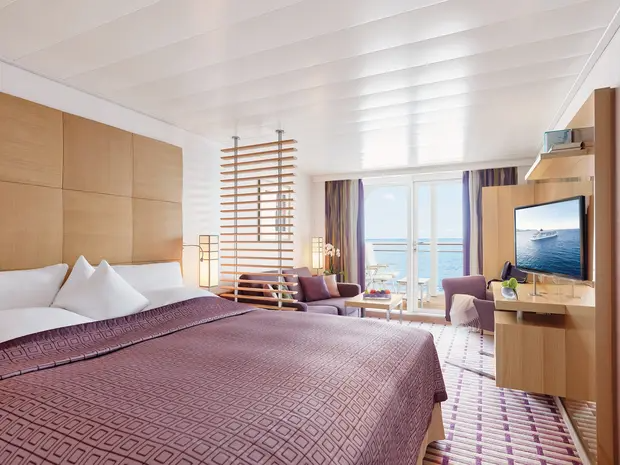
The Owner’s Suite is far more than our most exclusive suite; it is a select domicile on the oceans of the world. Enjoy every imaginable convenience on more than 114 square metres of personal freedom. Living area: 99 m²; veranda: 15 m². Separate living and sleeping areas. Separate dining table. Guest WC. Bathroom with two washbasins. Shower with steam sauna. Whirlpool. Daybed and TV in the bathroom area. Spacious walk-in wardrobe. Butler service. Free mini bar (beer, soft drinks and a selection of high-quality spirits). Further exclusive service privileges.
Facilities and amenities
Next step
Continue to a separate page to review cruise extras and booking options around this sailing.
More sailings
Use horizontal scrolling, touch swipes, or the arrow keys to browse.
Hapag-Lloyd Cruises - MS EUROPA 2
From
£20,690
Hapag-Lloyd Cruises - MS EUROPA 2
From
£4,990
Hapag-Lloyd Cruises - MS EUROPA 2
From
£7,690
Hapag-Lloyd Cruises - MS EUROPA 2
From
£15,796
Hapag-Lloyd Cruises - MS EUROPA 2
From
£6,690
Important information
ATOL protected holidays
Where your booking includes flights, ATOL protection applies so your money and travel arrangements are financially protected.
Travel Trust Association
Book with confidence through a Travel Trust Association member, with customer money protected under approved trust arrangements.
Low deposit options
Secure selected sailings with flexible low deposit options, then spread the remaining balance before you travel.
Excellent customer service
Our cruise specialists are here before, during and after booking. Send an enquiry or call 0161 222 0822 for friendly support.
Clear price checks
Live prices and cabin options are checked before you continue.