
40-Day Wild North Atlantic Isles & Svalbard Expedition
Seabourn · Seabourn Pursuit
Depart
Jun 2, 2028
Return
Jul 12, 2028
Port
Lisbon
Nights
40 nights
At a glance
- Built
- 2023
- Tonnage
- 23000
- Cabins
- 132
- Crew
- 120
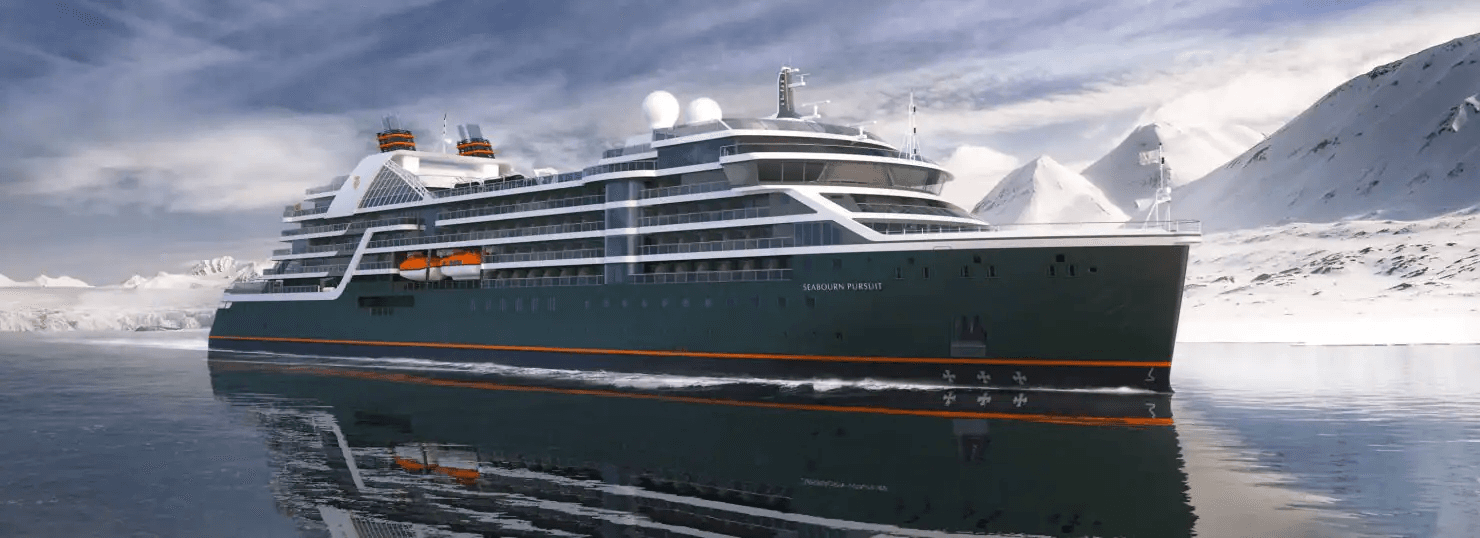
Construction for Seabourn Pursuit began in fall 2020 during a ceremony in San Giorgo di Nogare, Italy, and the build process is well underway. The ship is scheduled for delivery in 2023, with its sister ship, Seabourn Venture, slated for delivery in 2022. Seabourn Pursuit is the second Seabourn expedition ship slated to launch in 2023.
Ask our cruise specialists about cruise line loyalty benefits, status match options, drinks packages, gratuities and any current offers available on this sailing.
On board

Bowlounge

Colonnade
Constellationlounge

Discoverycenter

Expeditionlounge

Landing
Pursuit square
Itinerary
Cruise from Lisbon to Reykjavik, Iceland
Day 1Cruise departs from LisbonJun 2, 2028 • Departs at: 5 pm
The great period of "the Discoveries" accounted for phenomenal wealth brought back from India, Africa and Brazil by the great Portuguese navigators. Gold, jewels, ivory, porcelain and spices helped finance grand new buildings and impressive monuments in Lisbon, the country's capital city. As you sail up the Tagus River, be on deck to admire Lisbon's panorama and see some of the great monuments lining the river. Lisbon is one of Europe's smallest capital cities but considered by many visitors to be one of the most likeable. Spread over a string of seven hills, the city offers a variety of faces, including a refreshing no-frills simplicity reflected in the people as they go unhurriedly through their day enjoying a hearty and delicious cuisine accompanied by the country's excellent wines.
Day 2At SeaJun 3, 2028
Day 3At SeaJun 4, 2028
Day 4Cherbourg (Normandy), FranceJun 5, 2028 • Arrives at: 8 am • Departs at: 9 pm
The seaport and naval station of Cherbourg is situated along the English Channel northwest of Paris at the mouth of the Divette River. Believed to rest on the site of an ancient Roman station, Cherbourg has been occupied since ancient times and was frequently contested by the French and English in the Middle Ages because of its strategic location. Most recently passed to France in the late 18th century, the town was extensively fortified by Louis XVI. During WWII the Germans held Cherbourg until it was captured by the American forces shortly after the Normandy landings. Following a vast rehabilitation program that returned it to working condition, Cherbourg became an important Allied supply port. Today, Cherbourg is important for transatlantic shipping, shipbuilding, electronics and telephone equipment manufacturing, yachting and commercial fishing.
Day 5Plymouth, EnglandJun 6, 2028 • Arrives at: 8 am • Departs at: 6 pm
Plymouth, the largest city in Devon, has a long maritime history. Construction on the Royal Naval Dockyard was begun by William III in the late 17th century, and the site continues to serve as a naval base today. Excellent views of Plymouth Sound, with its many bays and inlets, may be enjoyed from the grassy esplanade known as the Hoe. Although heavy bombing destroyed much of Plymouth during World War II, a fascinating part of the past may still be seen in the Barbican, the oldest surviving section of the city. The Mayflower Steps mark the spot from which the Pilgrims sailed for the New World in 1620. You may wish to take a look inside the massive Royal Citadel, built by Charles II in 1666. The city houses Europe's premier oceanography institute with an unrivalled aquarium. An excursion into the lovely Devonshire countryside should prove a most pleasant diversion.
Day 6Lundy Island, United KingdomJun 7, 2028 • Arrives at: 12 pm • Departs at: 8 pm
A delightful escape from the hubbub of the modern world, three-and-a-half-mile-long Lundy Island is located where the Atlantic Ocean meets the Bristol Channel. Roads are undisturbed by cars. There's a small village, a Victorian church, even a 13th-century castle. The surrounding waters are home to Great Britain's first marine nature reserve. On this granite outcropping, there are farms and open moorlands. Seals blanket the eastern shore. Owned by Britain's National Trust and maintained by the Landmark Trust, the island evokes a more tranquil time.
Day 7Skomer Island, WalesJun 8, 2028 • Arrives at: 7 am • Departs at: 3 pm
Surrounded by high dramatic sea cliffs, treeless Skomer Island is a National Nature Reserve and one of the finest wildlife sites in the country. This is truly a birders paradise! It’s best known for its large population of breeding seabirds, most notably some 600,000 Manx shearwaters and 20,000 Atlantic puffins, the largest puffin colony in Britain. Nesting razorbills, fulmars, Storm petrels and gannets, as well as the endemic Skomer vole are found here. It is surrounded by nutrient rich waters where harbour porpoises and magnificent whales come to feed. Grey seals are also plentiful on Skomer, especially during the pupping season in September. Currently uninhabited, the island has several important archeological sites. Stone circles, standing stones and the remnants of prehistoric houses, date ancient human settlements as far back as 5,000 years. The volcanic basaltic rocks of which Skomer is comprised date from the Silurian Period around 440 million years ago.
Day 8Bantry, IrelandJun 9, 2028 • Arrives at: 7 am • Departs at: 8 pm
Bantry Bay, framed by the Sheep's Head Hills and the Caha Mountains, offers one of the Ireland’s most magnificent seascapes and picturesque harbors. As with other areas on Ireland's south-west coast, Bantry claims an ancient connection to the sixth-century Saint Breandán the Navigator, who was, in Irish folklore, the first person to discover America. A highlight of the area is stately Bantry House and Garden Estate. The magnificent garden is laid out in the Italian style over seven terraces. In addition to the many spirited Irish pubs are the Bantry Museum and the architecture of St. Brendan's and St. Finbarr's Churches. There are pristine, white-sand beaches, interspersed with jagged outcrops of rock and bordered by the verdant-green hills that make Ireland famous. County Cork is renowned for its megalithic stone circles and standing stones. Historic castles dot the landscape. The coastline of Cork is also home to basking sharks and fin, pilot, and minke whales.
Day 9Schull, IrelandJun 10, 2028 • Arrives at: 7 am • Departs at: 5 pm
Day 10Cape Clear Island, IrelandJun 11, 2028 • Arrives at: 7 am • Departs at: 5 pm
Day 11Kinsale, IrelandJun 12, 2028 • Arrives at: 7 am • Departs at: 5 pm
Day 12Calf of Man, Isle of ManJun 13, 2028 • Arrives at: 12 pm • Departs at: 8 pm
Day 13Belfast, Northern IrelandJun 14, 2028 • Arrives at: 7 am • Departs at: 5 pm
Belfast, Northern Ireland's largest urban area is situated on Ireland's eastern coast. To the northwest, the city is flanked by hills, including Cavehill, thought to be Jonathan Swift's inspiration for his novel, "Gulliver's Travels." Belfast's location is ideal for the shipbuilding industry that once made it famous. The Titanic was built here in 1912, at the largest shipyard in the world. Until the Good Friday Agreement of 1998 was reached, the worst of Ireland's "troubles" was experienced in Belfast, which suffered almost half the conflict's resulting deaths. Since that time, however, Belfast's city center has emerged into an attractive pedestrian-oriented environment with street musicians and the like, and a revitalized river front.
Day 14Calf of Man, Isle of ManJun 15, 2028 • Arrives at: 7 am • Departs at: 12 pm
Day 14Douglas, Isle of ManJun 15, 2028 • Arrives at: 2 pm • Departs at: 8 pm
Douglas is the capital of the Isle of Man. Mann, as it is also called, is a British Crown Dependency, with its own parliament and postage stamps (a popular souvenir). Here visitors can sample means of transport ranging from horse-drawn trams, to steam trains and the high-speed motorcycles that compete in the renowned Isle of Man TT races. In summer the town maintains much of the seaside resort charm of an earlier period, including the Victorian-era Grand Union Camera Obscura, now restored for your amusement.
Day 15Rothesay, Isle of ButeJun 16, 2028 • Arrives at: 7 am • Departs at: 6 pm
Rothesay, standing along the Firth of Clyde, presents the visitor with a combination of illustrious gardens and grand architecture. The magnificent ruins of Rothesay Castle, which date from the 13th century, are what most people visualize when they think of a medieval castle. With a drawbridge, encircling moat, immense circular curtain wall and tall stone towers, Rothesay is unique in Scotland for its circular plan. The ruins of St Blane's Chapel, a 6th century monastery, sit atop a hill with views over the Sound of Bute. For true elegance, visit the country estate of Mount Stuart House with its colonnaded Marble Hall and extraordinary Marble Chapel. Built in the late 1870’s in the Gothic Revivalist style, it was constructed of reddish-brown stone and houses a library of 25,000 books. The Ardencraig Gardens, sitting atop Canada Hill, feature a walled garden and exotic aviary. Ascog Hall Fernery, located on the grounds of a baronial-style house from 1844, is a beautiful garden with the…
Day 16Tobermory, Scotland, UKJun 17, 2028 • Arrives at: 7 am • Departs at: 2 pm
Tiny, tidy Tobermory welcomes you to the Isle of Mull, largest of the Inner Hebrides. The colorful town is curved around its harbor, and the Mull Museum is a good place to start discovering more about the island, as well as its maritime and crofting background. Iona Abbey is an atmospheric relic of ancient times, with a Gothic and Romanesque nave. Nearby Duart Castle is one of the oldest inhabited castle in Ireland, the seat of Clan MacClean. The central keep was built in 1360. Glengorm Castle is scenically situated overlooking the sea and the distant Outer Hebrides. Retire to the small Tobermory Distillery, one of Scotland’s earliest, for a taste of single malt whisky, then keep an eye out for a glimpse of the magnificent white-tailed sea eagles recently re-introduced on the island.
Day 16Isle of EiggJun 17, 2028 • Arrives at: 3:30 pm • Departs at: 7 pm
Day 17Am Baile, St Kilda, Scotland, United KingdomJun 18, 2028 • Arrives at: 7 am • Departs at: 12 pm
The St Kilda volcanic archipelago has the highest sea cliffs in Britain and the most important seabird breeding colonies in northwestern Europe. The entire archipelago is owned by the National Trust for Scotland and is one of the few UNESCO World Heritage Sites chosen for both its natural and cultural qualities. In spite of its extreme isolation, some 40 miles (64 km) off of the remote Hebrides, there has been permanent habitation here for 2,000 years. The one-time population of hardy Kildians were finally forced to leave because of starvation. Their abandoned stone huts stand as silent witnesses to past settlement, but two of their ancient sheep species, dating from the Neolithic and Iron Ages, continue to thrive here. Some one million nesting seabirds breed in St Kilda, including the largest colony of guillemots on earth, and the largest colony of gannets, fulmars, Leach's petrels and Atlantic puffins in Britain. The St Kilda wren and the St Kilda field mouse are species found only…
Day 18Fair IsleJun 19, 2028 • Arrives at: 7 am • Departs at: 12 pm
Fair Isle is an island in Shetland, in northern Scotland. It lies about halfway between mainland Shetland and Orkney. It is known for its bird observatory and a traditional style of knitting. The island has been owned by the National Trust for Scotland since 1954.
Day 18LerwickJun 19, 2028 • Arrives at: 7 pm
Lerwick, Britain's most northerly town, and is a small, bustling, cosmopolitan seaport with a population of over 7,000 people and fine architecture. Shetland Museum, located on Hay's Dock, is an award- winning attraction. Discover the island’s many secrets through its exhibits, and take a look in the boat shed, where you can see demonstrations of traditional boat building. Also of interest is the stone-walled town hall, built in 1884, displaying an impressive array of beautifully intricate stained glass. Towering St. Magnus Cathedral, constructed in 1863, is likewise well worth a visit. People have lived and prospered here since Neolithic times. The site of Clickimin Broch, a hollow-stone-walled structure, was a Late Bronze Age farmstead of the 7th century BCE. Historic Fort Charlotte, built in 1653, is a five-sided fortress, with cannon batteries pointing out to sea. The Shetland Textile Museum, with its fine weaving, and the quaint Crofters Museum will detail life in a much gentler…
Day 19LerwickJun 20, 2028 • Departs at: 3 pm
Lerwick, Britain's most northerly town, and is a small, bustling, cosmopolitan seaport with a population of over 7,000 people and fine architecture. Shetland Museum, located on Hay's Dock, is an award- winning attraction. Discover the island’s many secrets through its exhibits, and take a look in the boat shed, where you can see demonstrations of traditional boat building. Also of interest is the stone-walled town hall, built in 1884, displaying an impressive array of beautifully intricate stained glass. Towering St. Magnus Cathedral, constructed in 1863, is likewise well worth a visit. People have lived and prospered here since Neolithic times. The site of Clickimin Broch, a hollow-stone-walled structure, was a Late Bronze Age farmstead of the 7th century BCE. Historic Fort Charlotte, built in 1653, is a five-sided fortress, with cannon batteries pointing out to sea. The Shetland Textile Museum, with its fine weaving, and the quaint Crofters Museum will detail life in a much gentler…
Day 19Isle of NossJun 20, 2028 • Arrives at: 4 pm • Departs at: 10 pm
Day 20Tvoroyri, Faroe IslandsJun 21, 2028 • Arrives at: 2 pm • Departs at: 8 pm
Day 21Torshavn, Faroe IslandJun 22, 2028 • Arrives at: 7 am • Departs at: 5 pm
A distant outpost of Denmark, the Faroe Islands suddenly appear out of the misty North Atlantic, nearly 200 miles from the nearest landfall. Of the twenty-two islands in the group, seventeen are inhabited, with a population of 17,000 residing in the capital city of Torshavn. Irish monks discovered the islands in the 8th century and became the first settlers, only to be driven out by Viking explorers a century later. The traditions and legends of their Viking forefathers are kept alive in a language so close to old Norse that Faroe Islanders can still read the ancient texts inscribed centuries ago. The name Faroe comes from faereyjar, the Old Norse word meaning "Sheep Islands." With thousands of sheep dotting the hillsides, the name remains apt today. While sheep are important to the economy, the real wealth of the islands comes from the fishing industry. A fleet of over 300 trawlers and line-fishing boats bring in an average annual haul of 245,000 tons of cod and herring. Ultra-modern…
Day 22KlaksvikJun 23, 2028 • Arrives at: 7 am • Departs at: 5 pm
Day 23At SeaJun 24, 2028
Day 24Exploring The Outer Islands of HeimaeyJun 25, 2028 • Arrives at: 7 am • Departs at: 11 am
Day 24Heimaey, Westman Islands, IcelandJun 25, 2028 • Arrives at: 12 pm • Departs at: 7:30 pm
Day 25Reykjavik, IcelandJun 26, 2028 • Arrives at: 7 am • Departs at: 5 pm
Warmed by the Gulf Stream as well as by highly active thermal hot springs and volcanoes, Iceland is somewhat misnamed. While it is a stark and barren country with three huge areas of glaciers, one theory is that early Norsemen sought to mislead other potential settlers by giving a pleasant name to fierce, inhospitable Greenland, and a forbidding name to the imminently habitable Iceland. Irish monks and hermits established themselves here in the 8th century, but left a century later when the pagan Norsemen arrived. Europe's first Parliament of General Assembly, the Althing, was established in the year 930 and still functions as the legislative body, although it was suspended by the Danes at the end of the 18th century and not reconvened until 1843. Reykjavik was the site picked by the island's first permanent resident, Ingolfur Arnarson in 874, and is home to more than half of the island's total population. The world's northernmost capital, Reykjavik is proud of its virtual lack of air…
Day 26Isafjordur, IcelandJun 27, 2028 • Arrives at: 8 am • Departs at: 6 pm
Like most Icelandic towns, this one on the northwest coast was started by fisherman and whalers. The name means ice-fjord. It is a perfect place from which to explore the cultural and economic staples of Iceland. An excursion to Sudavik reveals a town started by whalers and nearly destroyed by an avalanche in 1995, now rebuilt out of the path of further slides. Its lovely church was donated by whalers, as well. The own also holds a center for the study of the indigenous arctic foxes. The Maritime Museum in Isafjordur illustrates the lifestyles of the early inhabitants, including many implements of their trades, and also a wall of accordions, one of the few forms of entertainment on bygone days. Another option is a boat ride to nearby Vigur island, a nesting site for many species of seabirds, including eider ducks, whose down is yet another example of local economy based on the surrounding seas.
Day 27At SeaJun 28, 2028
Day 28Jan MayenJun 29, 2028 • Arrives at: 7 am • Departs at: 5 pm
Remote and isolated, Jan Mayen is dominated by 2,277 meter (7,470’) high Beerenberg Volcano and its large ice cap. The island has two parts: larger northeast Nord-Jan and smaller southwest Sør-Jan, linked by a 2.5 kilometer (1.6 mile) wide isthmus. The League of Nations gave jurisdiction of Jan Mayen to the Kingdom of Norway in 1921. Except for being used as a meteorological, radio and navigation aid for shipping in the Atlantic, the island has remained untouched, its only inhabitants are 18 military personnel. In 2010 Jan Mayen was declared a nature reserve for the protection of its wildlife and is recognized as one of the most important breeding sites for over 250,000 seabirds in the North Atlantic. It supports large colonies of northern fulmars, little auks and thick-billed guillemots. Polar bears found here are genetically distinguishable from those found elsewhere. Although ‘officially’ discovered by the Dutch whaling captain Fopp Gerritsz in 1614, it may have been sighted by exp…
Day 29At SeaJun 30, 2028
Day 30Longyearbyen, NorwayJul 1, 2028 • Arrives at: 10 am • Departs at: 7 pm
Longyearbyen, the seat of the Governor of Svalbard, is located in a narrow valley along the shores of Adventfjorden a small tributary of Isfjord, the largest fjord system in Svalbard. It extends 100 kilometers (60 miles) into the island of Spitsbergen. Nine large tidewater glaciers, with a combined ice-front of 21 kilometers (13 miles), as well as dozens hanging glaciers drain into the fjord. The town’s 2,100 inhabitants exist in one of the most northern settlements on Earth, making their living by a combination of coal mining, education and tourism. Because of the town’s extreme isolation, proximity to wildlife, and Svalbard’s pristine environment, unique laws exist that are found in few other places. All individuals venturing outside of town are required to carry a rifle for protection against polar bears, possessing a cat is illegal, no one is allowed to be buried here and how much alcohol can be purchased each month is restricted. Longyearbyen was named after the American industri…
Day 31Svalbard ExperienceJul 2, 2028 • Arrives at: 7 am • Departs at: 5 pm
Svalbard is a Norwegian archipelago between mainland Norway and the North Pole. One of the world’s northernmost inhabited areas, it's known for its rugged, remote terrain of glaciers and frozen tundra sheltering polar bears, Svalbard reindeer and Arctic foxes. The Northern Lights are visible during winter, and summer brings the “midnight sun”—sunlight 24 hours a day.
Day 32Svalbard ExperienceJul 3, 2028 • Arrives at: 7 am • Departs at: 5 pm
Svalbard is a Norwegian archipelago between mainland Norway and the North Pole. One of the world’s northernmost inhabited areas, it's known for its rugged, remote terrain of glaciers and frozen tundra sheltering polar bears, Svalbard reindeer and Arctic foxes. The Northern Lights are visible during winter, and summer brings the “midnight sun”—sunlight 24 hours a day.
Day 33Svalbard ExperienceJul 4, 2028 • Arrives at: 7 am • Departs at: 5 pm
Svalbard is a Norwegian archipelago between mainland Norway and the North Pole. One of the world’s northernmost inhabited areas, it's known for its rugged, remote terrain of glaciers and frozen tundra sheltering polar bears, Svalbard reindeer and Arctic foxes. The Northern Lights are visible during winter, and summer brings the “midnight sun”—sunlight 24 hours a day.
Day 34Svalbard ExperienceJul 5, 2028 • Arrives at: 7 am • Departs at: 5 pm
Svalbard is a Norwegian archipelago between mainland Norway and the North Pole. One of the world’s northernmost inhabited areas, it's known for its rugged, remote terrain of glaciers and frozen tundra sheltering polar bears, Svalbard reindeer and Arctic foxes. The Northern Lights are visible during winter, and summer brings the “midnight sun”—sunlight 24 hours a day.
Day 35Svalbard ExperienceJul 6, 2028 • Arrives at: 7 am • Departs at: 5 pm
Svalbard is a Norwegian archipelago between mainland Norway and the North Pole. One of the world’s northernmost inhabited areas, it's known for its rugged, remote terrain of glaciers and frozen tundra sheltering polar bears, Svalbard reindeer and Arctic foxes. The Northern Lights are visible during winter, and summer brings the “midnight sun”—sunlight 24 hours a day.
Day 36Svalbard ExperienceJul 7, 2028 • Arrives at: 7 am • Departs at: 5 pm
Svalbard is a Norwegian archipelago between mainland Norway and the North Pole. One of the world’s northernmost inhabited areas, it's known for its rugged, remote terrain of glaciers and frozen tundra sheltering polar bears, Svalbard reindeer and Arctic foxes. The Northern Lights are visible during winter, and summer brings the “midnight sun”—sunlight 24 hours a day.
Day 37At SeaJul 8, 2028
Day 38At SeaJul 9, 2028
Day 39Siglufjordur, IcelandJul 10, 2028 • Arrives at: 8 am • Departs at: 6 pm
Siglufjörður is the northernmost town on the Icelandic mainland, a small fishing village of some 1,200 people. Founded in 1918, it was in the past the capital of the North Atlantic herring fishing industry. The Síldarminjasafnið Herring Era Museum, one of Iceland's largest seafaring and industrial museums, houses three different areas where one can learn about both the traditional and the modern herring industry. A collection of many historic fishing vessels and artifacts is proudly displayed by the people of Siglufjörður, detailing how herring was salted, processed and collected. The small harbor with its colorful fishing boats and the red-roofed steeple of the Lutheran church dominate the village-scape. The natural beauty of the area includes high mountains that rim the fjord, freshwater lakes, the Hólsá river, black sand beaches, and a wealth of birdlife all around. This northernmost region of Iceland is renowned for some of the largest and most dramatic waterfalls in the country.
Day 40Patreksfjordur, IcelandJul 11, 2028 • Arrives at: 8 am • Departs at: 6 pm
Day 41Cruise returns to Reykjavik, IcelandJul 12, 2028 • Arrives at: 7 am
Warmed by the Gulf Stream as well as by highly active thermal hot springs and volcanoes, Iceland is somewhat misnamed. While it is a stark and barren country with three huge areas of glaciers, one theory is that early Norsemen sought to mislead other potential settlers by giving a pleasant name to fierce, inhospitable Greenland, and a forbidding name to the imminently habitable Iceland. Irish monks and hermits established themselves here in the 8th century, but left a century later when the pagan Norsemen arrived. Europe's first Parliament of General Assembly, the Althing, was established in the year 930 and still functions as the legislative body, although it was suspended by the Danes at the end of the 18th century and not reconvened until 1843. Reykjavik was the site picked by the island's first permanent resident, Ingolfur Arnarson in 874, and is home to more than half of the island's total population. The world's northernmost capital, Reykjavik is proud of its virtual lack of air…
Cabin options
Compare the cabin types and onboard features shown for this sailing. Final price and availability are confirmed by our team when you inquire.
10 cabin grades listed for this sailing.
Next step
Cabin grades and prices
View every cabin grade and current availability on the next step.