Grecian Gems, Spanish Explorer & Atlantic Crossing
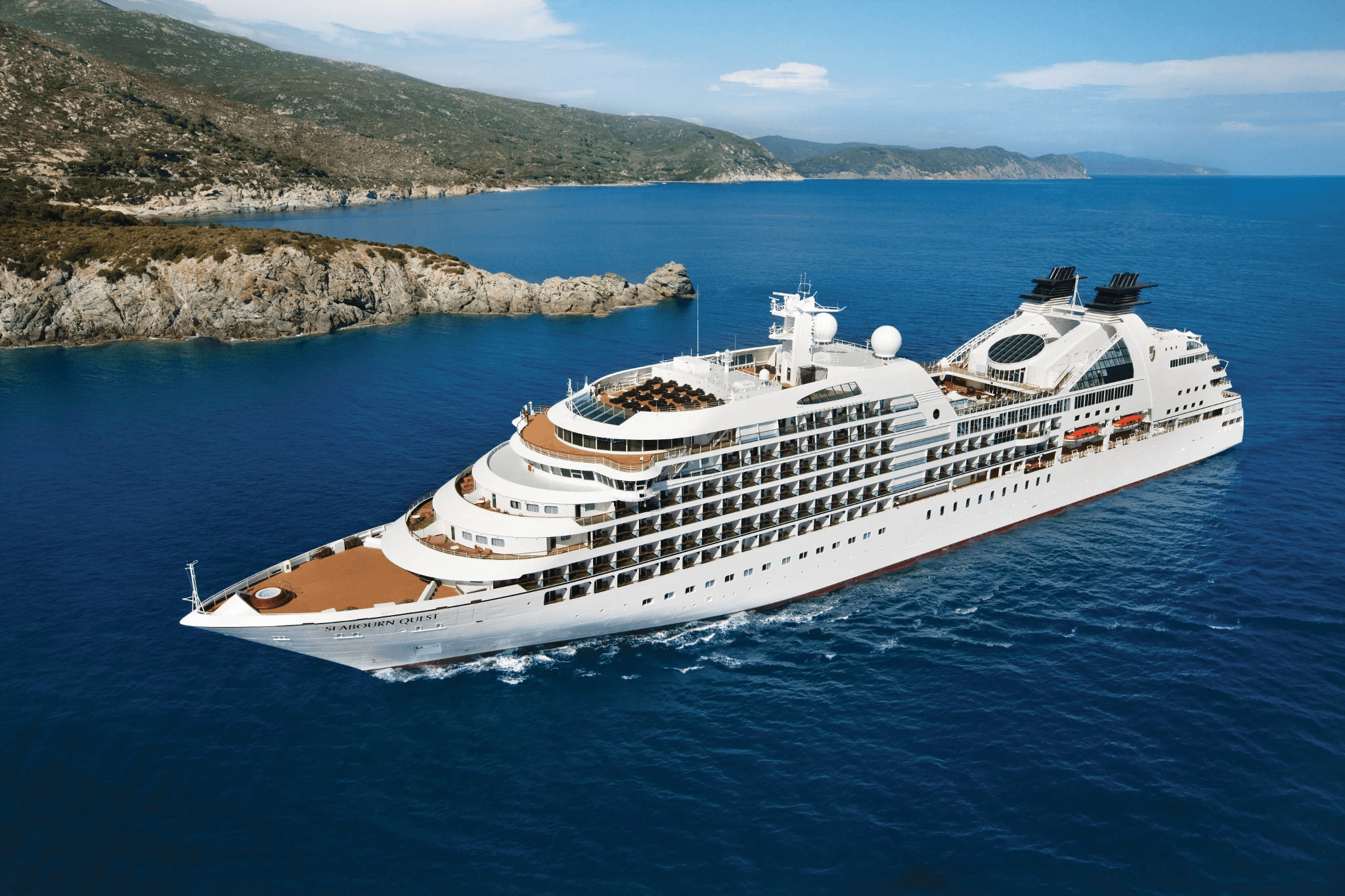
Seabourn · Seabourn Quest
Depart
Oct 25, 2026
Return
Nov 22, 2026
Port
Athens (Piraeus), Greece
Nights
28 nights
At a glance
- Built
- 2011
- Tonnage
- 32000
- Cabins
- 225
- Crew
- 330
Seabourn Quest is the third iteration of the vessel design that has been called “a game-changer for the luxury segment. ” True to her Seabourn bloodlines, wherever she sails around the world, Seabourn Quest carries with her a bevy of award-winning dining venues that are comparable to the finest restaurants to be found anywhere.
Ask our cruise specialists about cruise line loyalty benefits, status match options, drinks packages, gratuities and any current offers available on this sailing.
On board

Club

Patio Bar
Itinerary
Cruise from Athens (Piraeus), Greece to Miami, Florida
Day 1Piraeus (Athens), GreeceOct 25, 2026 • Departs at: 5 pm
Piraeus has been the port for Athens since 482 BC. The busy harbor is filled with ferries and cruise ships making their way to the Greek Islands and other Mediterranean cities. The busy metropolis of Athens and its treasure trove of antiquities lie just a few miles from the port. Even as the reality of the modern city took hold, with its high-rise apartments, crowded sidewalks and bustling traffic, the beauty of the Acropolis, the outstanding museums, charming cafés, sidewalk markets and startling views come together in a cultural mosaic for all to enjoy.
Day 2Nafplion, GreeceOct 26, 2026 • Arrives at: 8 am • Departs at: 5 pm
Held to be one of the loveliest small towns in all the islands, Navplion has a tradition and culture all its own. The sheltered location, below a rocky headland crowned by a Venetian fortress is perhaps unrivaled in Greece. After the Greek revolution of the early 19th century, Navplion served as the first modern capital. The neoclassical houses, large official buildings and carefully planned seafront streets all date from this period.
Day 3Katakolon (Olympia), GreeceOct 27, 2026 • Arrives at: 10 am • Departs at: 6 pm
The small commercial port of Katakolon serves the inland town of Pyrgos as chief export center for grapes, raisins, regional fruits and vegetables that grow in the fertile hinterland. Fifteen miles in the distance lies Olympia, the sacred ancient site where the Olympic Games had their beginnings.
Day 4Kerkira, GreeceOct 28, 2026 • Arrives at: 8 am • Departs at: 6 pm
A scant few miles off the Albanian coast lies the island of Corfu, one of the most richly endowed of all the Greek Isles. Praised by Homer in "The Odyssey" and selected by Shakespeare as the setting for "The Tempest," the island retains evidence of cultural heritage from each of its past rulers - Byzantium, Venice, France, Russia and Great Britain. Rolling acres of olive groves, small orchards of lemon and orange trees, tall cypress, oleander, and myrtle bushes lend a lush, verdant look to the island. While the oldest part of Corfu Town has cobblestone lanes so narrow only pedestrian travel is possible, the modern sector has wide avenues. Residents boast that its "Spianada" is the largest and most beautiful square in all Greece.
Day 5Sarande, AlbaniaOct 29, 2026 • Arrives at: 8 am • Departs at: 6 pm
This important port on Southern Albania curls around a superb natural harbor, dominated by the hilltop 16th century Lekuresi Castle with distinctive round towers. In the town center are the ruins of a 5th century synagogue, later a Christian basilica, with remnant mosaic floors. Another picturesque ruin is the Forty Saints Monastery from the 6th century, which is thought to have been an important pilgrimage site. But the main attraction in southern Albania is the archaeological site of Butrint, a UNESCO World Heritage Site with extensive ruins of communities dating from prehistory, though the Greek and Roman eras, as well as the Byzantine period, until the medieval period.
Day 6At SeaOct 30, 2026
Day 7Naples (Pompeii/Amalfi), ItalyOct 31, 2026 • Arrives at: 8 am • Departs at: 6 pm
There is saying among the Italians, "See Naples and Die," meaning that this city's splendor and magnificent vistas are so grand that life is not complete without visiting it. Whether you want to explore in the shadow of Mt. Vesuvius, experience the scenic wonders and hairpin curves of the Amalfi Drive, cruise across the bay to the fabled Isle of Capri, or shop for coral and cameos along Via Santa Lucia and in the Galleria Umberto, the passionate city of Naples has an attraction for every taste.
Day 8Civitavecchia (Rome), ItalyNov 1, 2026 • Arrives at: 7 am • Departs at: 5 pm
Originally built by Emperor Trajan who had a villa here, Civitavecchia has flourished as a major port for Rome since the 13th century. Today it is an important ferry terminal and for many travelers the gateway to the Eternal City, Rome. The Renaissance fortifications that surround the harbor area were begun by Bramante and completed by Michelangelo in 1535.
Day 9Ajaccio, Corsica, FranceNov 2, 2026 • Arrives at: 8 am • Departs at: 6 pm
Corsica, the "scented isle," was the birthplace of Napoleon, and as late as the last century bands of brigands controlled his mountainous and rugged homeland. The beaches of Ajaccio, ranging from narrow crescents to broad, golden expanses help to account for the city's rise as a popular resort. Such scenic attractions as the Calanches of Piana, those red granite mountains with their spectacular slopes and formations add an additional element of interest.
Day 10Alghero, ItalyNov 3, 2026 • Arrives at: 8 am • Departs at: 5 pm
The mountainous island of Sardinia, just ten miles south of Corsica, is the second largest in the Mediterranean. Fought over by various invaders over the centuries (from Romans to Goths to Vandals to Byzantines to Saracens), the island was eventually given to the King of Aragon. Spanish rule continued up until 1713, when Sardinia fell under Austrian rule, followed by the House of Savoy. The King of Sardinia, Victor Emmanuel II, would become the first King of Italy.The walled town of Alghero is a good starting point for excursions into the scenic northwest coast. Steep cliffs slice into the aquamarine waters of the Mediterranean, with jagged mountains serving as dramatic backdrops.
Day 11Mahon, Menorca, SpainNov 4, 2026 • Arrives at: 8 am • Departs at: 6 pm
Mahon is the capital of Menorca, second largest of the Balearic Islands. It stands out from the others because of the abundance of prehistoric structures, and because its culture was influenced by British occupation in the 18th century. The people who built the prehistoric constructions are believed to have been responsible for similar works in Sardinia, and for Stonehenge in England. Believed to have been founded by the Carthaginian General Mago, Mahon was held by the Moors from the 8th to the 13th century and in turn occupied by the English, the French and the Spanish. Mahon was finally ceded to Spain by the Treaty of Amiens in 1802.
Day 12Ibiza, SpainNov 5, 2026 • Arrives at: 8 am • Departs at: 6 pm
Ibiza, the third largest of the Balearics, began to grow from a quiet, little-known island into a playground for the rich and an enclave for artists in the 1950s and 1960s. The island's brilliant, whitewashed houses reflect not only the summer sun, but 300 years of Moorish rule, earning it the nickname of 'Isla Blanca' or White Island. The town of Ibiza, also known as Eivissa, is a delightful combination of Medieval and 19th-century architecture. Visit the picturesque upper town (Dalt Vila), far removed from the sometimes hectic pace of the rest of the island. The ancient cathedral, enclosed by 16th-century walls which are a national monument in their own right, provides a stunning view of the Mediterranean below.
Day 13Cartagena, SpainNov 6, 2026 • Arrives at: 8 am • Departs at: 6 pm
Founded by Carthaginians in the third century BC, this ancient Mediterranean port city exemplifies the region's tumultuous history. Romans, Visigoths, Castilians and Moors have all left their marks. Under King Philip II, Cartagena's naturally deep, sheltered harbor was developed into the nation's premier naval base, a position it still enjoys today. Ancient ramparts remain, as does a lighthouse erected in Moorish times.
Day 14Motril (Granada), SpainNov 7, 2026 • Arrives at: 8 am • Departs at: 6 pm
This city of the Mediterranean coast is the second largest on the so-called Costa Tropical. But for us it is the port from which to ascend the slopes of the snow-capped Sierra Nevada to the ethereal Moorish city of Granada and the astounding complex of the Alhambra, the most beautiful display of Islamic architecture in Europe. Dramatically sited overlooking the city, the walled series of halls, courts, gardens and colonnades drip with airy carving and elaborate decorative reliefs that embody the term Arabesque. The sprawling Generalife Gardens adjoining the fortress are a memorable site unto themselves. Elsewhere in Granada, the Capilla Real is a purely Spanish Gothic building, holding the marble tombs of the Reyes Catolicos Ferdinand and Isabella behind a gilded wrought-iron screen.
Day 15Ceuta, Spanish North AfricaNov 8, 2026 • Arrives at: 8 am • Departs at: 6 pm
Spain maintains this tiny slice of the Moroccan coast as its own, and the beaches are popular with visitors from across the Gibraltar Strait. A day-trip across the border brings you to Tetouan, a picturesque Moroccan town.
Day 16At SeaNov 9, 2026
Day 17Lisbon, PortugalNov 10, 2026 • Arrives at: 7 am • Departs at: 5 pm
The great period of "the Discoveries" accounted for phenomenal wealth brought back from India, Africa and Brazil by the great Portuguese navigators. Gold, jewels, ivory, porcelain and spices helped finance grand new buildings and impressive monuments in Lisbon, the country's capital city. As you sail up the Tagus River, be on deck to admire Lisbon's panorama and see some of the great monuments lining the river. Lisbon is one of Europe's smallest capital cities but considered by many visitors to be one of the most likeable. Spread over a string of seven hills, the city offers a variety of faces, including a refreshing no-frills simplicity reflected in the people as they go unhurriedly through their day enjoying a hearty and delicious cuisine accompanied by the country's excellent wines.
Day 18At SeaNov 11, 2026
Day 19Funchal (Madeira), PortugalNov 12, 2026 • Arrives at: 8 am • Departs at: 11 pm
The Madeira Archipelago, consisting of the islands Madeira, Porto Santo and Desertas, is situated in the Atlantic, about 400 miles from the African coast and 560 miles from Lisbon. Discovered by the Portuguese in 1419, Madeira, the largest of the islands, became of great importance to Portugal for its sugar production and later on for the cultivation of wine. The unusually temperate oceanic climate and extraordinary scenery had Northern Europeans flocking to Madeira as early as the 18th century to spend the winter months. The winning combination of high, rocky peaks, steep green ravines and waterfalls in the interior, with the flowering charm of Funchal still attracts nearly half a million visitors each year.
Day 20At SeaNov 13, 2026
Day 21At SeaNov 14, 2026
Day 22At SeaNov 15, 2026
Day 23At SeaNov 16, 2026
Day 24At SeaNov 17, 2026
Day 25At SeaNov 18, 2026
Day 26At SeaNov 19, 2026
Day 27At SeaNov 20, 2026
Day 28At SeaNov 21, 2026
Day 29Cruise returns to Miami, FloridaNov 22, 2026 • Arrives at: 7 am
Miami is the busiest cruise port in the world, hosting a myriad of ships year-round from all over the globe. Although it is technically not on the Caribbean Sea, no other American city exudes more of the diverse tropical appeal of the Caribbean. The city is home to a large and vibrant immigrant population that blends snowbird refugees from more northern climes with emigres from all Latin America and the Caribbean, as well as sizable groups from Europe, the Middle East and Asia. From the hot-blooded Art Deco haunts of South Beach to the natural wonders of the UNESCO-inscribed Everglades and the laid-back charms of the Keys, South Florida offers a bounty of appealing attractions that make an extended stay in the region nearly mandatory for those either embarking or disembarking here.
Cabin options
Compare the cabin types and onboard features shown for this sailing. Final price and availability are confirmed by our team when you inquire.
14 cabin grades listed for this sailing.
Next step
Cabin grades and prices
View every cabin grade and current availability on the next step.