Jewels of Andalusia & the Balearic Islands
Seabourn · Seabourn Quest
Depart
Nov 1, 2026
Return
Nov 10, 2026
Port
Civitavecchia, Rome
Nights
9 nights
At a glance
- Built
- 2011
- Tonnage
- 32000
- Cabins
- 225
- Crew
- 330
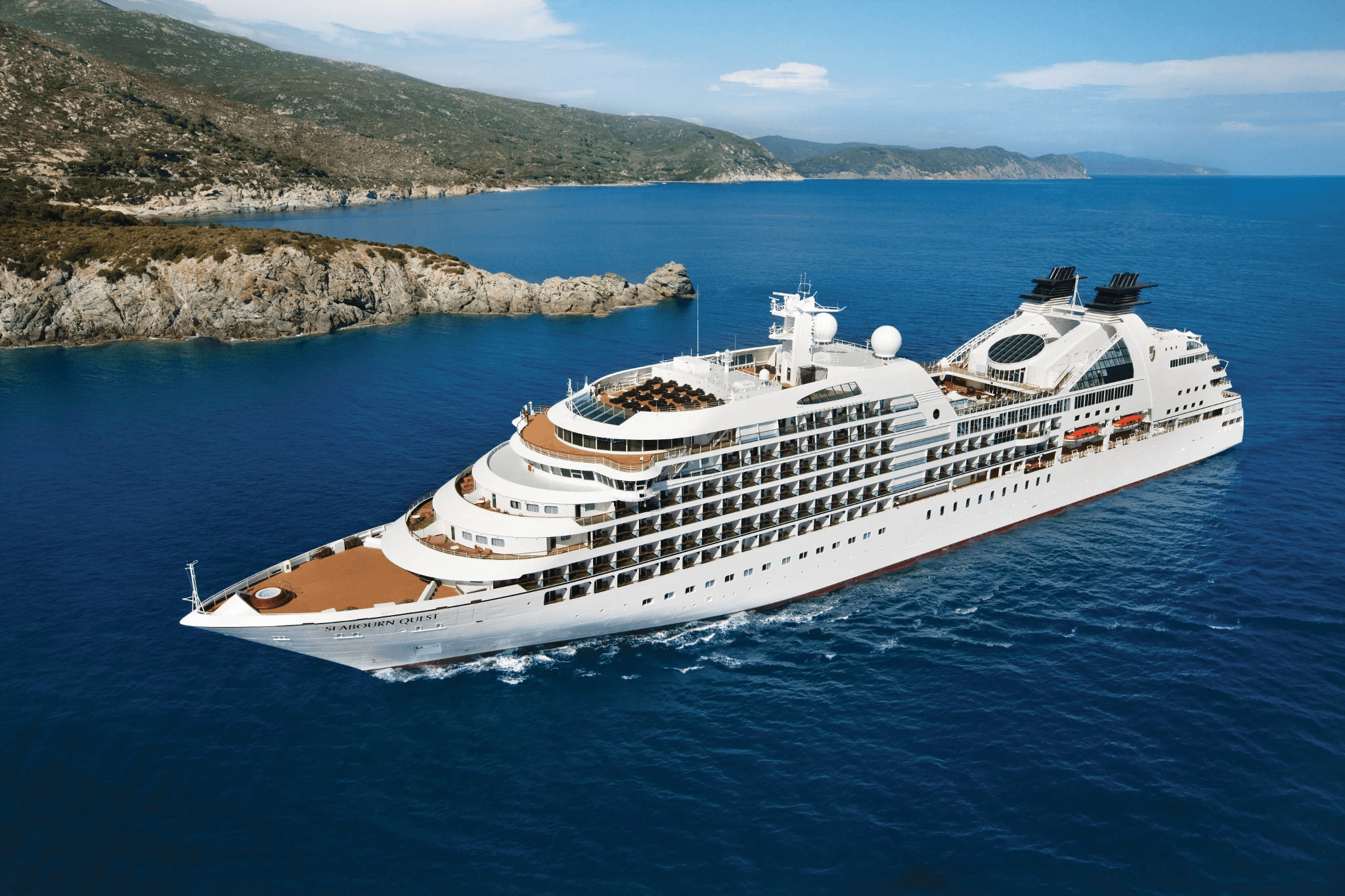
Seabourn Quest is the third iteration of the vessel design that has been called “a game-changer for the luxury segment. ” True to her Seabourn bloodlines, wherever she sails around the world, Seabourn Quest carries with her a bevy of award-winning dining venues that are comparable to the finest restaurants to be found anywhere.
Ask our cruise specialists about cruise line loyalty benefits, status match options, drinks packages, gratuities and any current offers available on this sailing.
On board

Club

Patio Bar
Itinerary
Cruise from Civitavecchia, Rome to Lisbon
Day 1Civitavecchia (Rome), ItalyNov 1, 2026 • Departs at: 5 pm
Originally built by Emperor Trajan who had a villa here, Civitavecchia has flourished as a major port for Rome since the 13th century. Today it is an important ferry terminal and for many travelers the gateway to the Eternal City, Rome. The Renaissance fortifications that surround the harbor area were begun by Bramante and completed by Michelangelo in 1535.
Day 2Ajaccio, Corsica, FranceNov 2, 2026 • Arrives at: 8 am • Departs at: 6 pm
Corsica, the "scented isle," was the birthplace of Napoleon, and as late as the last century bands of brigands controlled his mountainous and rugged homeland. The beaches of Ajaccio, ranging from narrow crescents to broad, golden expanses help to account for the city's rise as a popular resort. Such scenic attractions as the Calanches of Piana, those red granite mountains with their spectacular slopes and formations add an additional element of interest.
Day 3Alghero, ItalyNov 3, 2026 • Arrives at: 8 am • Departs at: 5 pm
The mountainous island of Sardinia, just ten miles south of Corsica, is the second largest in the Mediterranean. Fought over by various invaders over the centuries (from Romans to Goths to Vandals to Byzantines to Saracens), the island was eventually given to the King of Aragon. Spanish rule continued up until 1713, when Sardinia fell under Austrian rule, followed by the House of Savoy. The King of Sardinia, Victor Emmanuel II, would become the first King of Italy.The walled town of Alghero is a good starting point for excursions into the scenic northwest coast. Steep cliffs slice into the aquamarine waters of the Mediterranean, with jagged mountains serving as dramatic backdrops.
Day 4Mahon, Menorca, SpainNov 4, 2026 • Arrives at: 8 am • Departs at: 6 pm
Mahon is the capital of Menorca, second largest of the Balearic Islands. It stands out from the others because of the abundance of prehistoric structures, and because its culture was influenced by British occupation in the 18th century. The people who built the prehistoric constructions are believed to have been responsible for similar works in Sardinia, and for Stonehenge in England. Believed to have been founded by the Carthaginian General Mago, Mahon was held by the Moors from the 8th to the 13th century and in turn occupied by the English, the French and the Spanish. Mahon was finally ceded to Spain by the Treaty of Amiens in 1802.
Day 5Ibiza, SpainNov 5, 2026 • Arrives at: 8 am • Departs at: 6 pm
Ibiza, the third largest of the Balearics, began to grow from a quiet, little-known island into a playground for the rich and an enclave for artists in the 1950s and 1960s. The island's brilliant, whitewashed houses reflect not only the summer sun, but 300 years of Moorish rule, earning it the nickname of 'Isla Blanca' or White Island. The town of Ibiza, also known as Eivissa, is a delightful combination of Medieval and 19th-century architecture. Visit the picturesque upper town (Dalt Vila), far removed from the sometimes hectic pace of the rest of the island. The ancient cathedral, enclosed by 16th-century walls which are a national monument in their own right, provides a stunning view of the Mediterranean below.
Day 6Cartagena, SpainNov 6, 2026 • Arrives at: 8 am • Departs at: 6 pm
Founded by Carthaginians in the third century BC, this ancient Mediterranean port city exemplifies the region's tumultuous history. Romans, Visigoths, Castilians and Moors have all left their marks. Under King Philip II, Cartagena's naturally deep, sheltered harbor was developed into the nation's premier naval base, a position it still enjoys today. Ancient ramparts remain, as does a lighthouse erected in Moorish times.
Day 7Motril (Granada), SpainNov 7, 2026 • Arrives at: 8 am • Departs at: 6 pm
This city of the Mediterranean coast is the second largest on the so-called Costa Tropical. But for us it is the port from which to ascend the slopes of the snow-capped Sierra Nevada to the ethereal Moorish city of Granada and the astounding complex of the Alhambra, the most beautiful display of Islamic architecture in Europe. Dramatically sited overlooking the city, the walled series of halls, courts, gardens and colonnades drip with airy carving and elaborate decorative reliefs that embody the term Arabesque. The sprawling Generalife Gardens adjoining the fortress are a memorable site unto themselves. Elsewhere in Granada, the Capilla Real is a purely Spanish Gothic building, holding the marble tombs of the Reyes Catolicos Ferdinand and Isabella behind a gilded wrought-iron screen.
Day 8Ceuta, Spanish North AfricaNov 8, 2026 • Arrives at: 8 am • Departs at: 6 pm
Spain maintains this tiny slice of the Moroccan coast as its own, and the beaches are popular with visitors from across the Gibraltar Strait. A day-trip across the border brings you to Tetouan, a picturesque Moroccan town.
Day 9At SeaNov 9, 2026
Day 10Cruise returns to LisbonNov 10, 2026 • Arrives at: 7 am • Departs at: 5 pm
The great period of "the Discoveries" accounted for phenomenal wealth brought back from India, Africa and Brazil by the great Portuguese navigators. Gold, jewels, ivory, porcelain and spices helped finance grand new buildings and impressive monuments in Lisbon, the country's capital city. As you sail up the Tagus River, be on deck to admire Lisbon's panorama and see some of the great monuments lining the river. Lisbon is one of Europe's smallest capital cities but considered by many visitors to be one of the most likeable. Spread over a string of seven hills, the city offers a variety of faces, including a refreshing no-frills simplicity reflected in the people as they go unhurriedly through their day enjoying a hearty and delicious cuisine accompanied by the country's excellent wines.
Cabin options
Compare the cabin types and onboard features shown for this sailing. Final price and availability are confirmed by our team when you inquire.
14 cabin grades listed for this sailing.
Next step
Cabin grades and prices
View every cabin grade and current availability on the next step.