
North Sea to the Black Sea from Amsterdam
Scenic River Cruises · Scenic Opal
Depart
Sep 29, 2026
Return
Oct 21, 2026
Port
Amsterdam
Nights
22 nights
At a glance
- Built
- 2015
- Tonnage
- 2721
- Cabins
- 0
- Crew
- 53
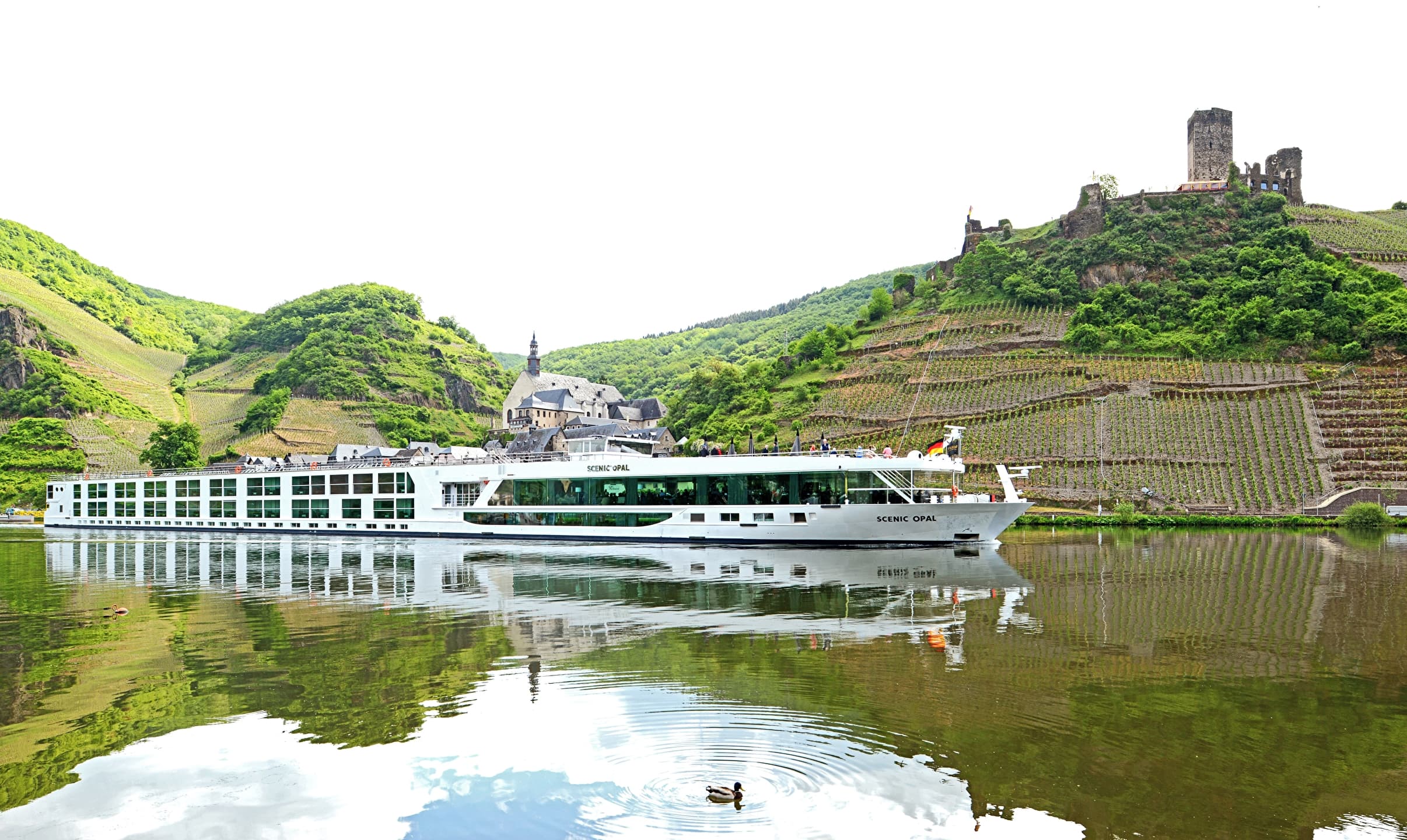
Built in 2015 and 2016 to join our European fleet the Scenic Jasper, Opal and Amber are the latest generation of Space-Ships, complete with vitality pool, sun deck and a range of exclusive dining venues. Every Scenic European river cruise begins aboard one of our boutique vessels or custom-built Space-Ships, so named for their spacious guest cabins, dining, and entertaining areas.
Ask our cruise specialists about cruise line loyalty benefits, status match options, drinks packages, gratuities and any current offers available on this sailing.
On board
Cafe
Portobello Restaurant
Itinerary
Cruise from Amsterdam to Bucharest
Day 1Cruise departs from AmsterdamSep 29, 2026
Amsterdam is the Netherlands’ capital, known for its artistic heritage, elaborate canal system and narrow houses with gabled facades, legacies of the city’s 17th-century Golden Age. Its Museum District houses the Van Gogh Museum, works by Rembrandt and Vermeer at the Rijksmuseum, and modern art at the Stedelijk. Cycling is key to the city’s character, and there are numerous bike paths.
Day 2AmsterdamSep 30, 2026
Amsterdam is the Netherlands’ capital, known for its artistic heritage, elaborate canal system and narrow houses with gabled facades, legacies of the city’s 17th-century Golden Age. Its Museum District houses the Van Gogh Museum, works by Rembrandt and Vermeer at the Rijksmuseum, and modern art at the Stedelijk. Cycling is key to the city’s character, and there are numerous bike paths.
Day 3CologneOct 1, 2026
Eau de Cologne, or simply cologne, is a perfume originating from Cologne, Germany. Originally mixed by Johann Maria Farina in 1709, it has since come to be a generic term for scented formulations in
Day 4Rhine GorgeOct 2, 2026
The Rhine Gorge is a popular name for the Upper Middle Rhine Valley, a 65 km section of the Rhine between Koblenz and Bingen in the states of Rhineland-Palatinate and Hesse in Germany.
Day 5MiltenbergOct 3, 2026
Miltenberg is a town in the Regierungsbezirk of Lower Franconia in Bavaria, Germany. It is the seat of the like-named district and has a population of over 9,000.
Day 6WurzburgOct 4, 2026
Würzburg is a city in Germany's Bavaria region. It's known for lavish baroque and rococo architecture, particularly the 18th-century Residenz palace, with ornate rooms, a huge fresco by Venetian artist Tiepolo and an elaborate staircase. Home to numerous wine bars, cellars and wineries, Würzburg is the center of the Franconian wine country, with its distinctive bocksbeutel (bottles with flattened round shapes).
Day 7BambergOct 5, 2026
Bamberg is known for its special beer and many local breweries and beer gardens. The most famous of Bamberg's breweries is the historic smoked beer brewery, Schlenkerla. This 6th-generation family brewery has been quenching thirst since 1405 and still taps beer the old-world way – from wooden barrels.
Day 8NurembergOct 6, 2026
Nuremberg is the largest city of the German federal state of Bavaria after its capital Munich, and its 518,370 inhabitants make it the 14th-largest city in Germany.
Day 9RegensburgOct 7, 2026
Regensburg, a Bavarian city on the Danube River in southeast Germany, is known for its well-preserved medieval core. The 12th-century Stone Bridge, a 310m-long icon with 16 arches, crosses the river to the old town. The 13th-century Regensburg Cathedral, a twin-spired Gothic landmark, is home to the Regensburger Domspatzen choir. Walhalla, a Parthenon replica just east of the city, honors illustrious Germans.
Day 10PassauOct 8, 2026
Passau, a German city on the Austrian border, lies at the confluence of the Danube, Inn and Ilz rivers. Known as the Three Rivers City, it's overlooked by the Veste Oberhaus, a 13th-century hilltop fortress housing a city museum and observation tower. The old town below is known for its baroque architecture, including St. Stephen's Cathedral, featuring distinctive onion-domed towers and an organ with 17,974 pipes.
Day 11DurnsteinOct 9, 2026
Dürnstein is a small town on the Danube river in the Krems-Land district, in the Austrian state of Lower Austria. It is one of the most-visited tourist destinations in the Wachau region and also a well-known wine growing area.
Day 12KremsOct 10, 2026
Day 13ViennaOct 11, 2026
Vienna, Austria’s capital, lies in the country’s east on the Danube River. Its artistic and intellectual legacy was shaped by residents including Mozart, Beethoven and Sigmund Freud. The city is also known for its Imperial palaces, including Schönbrunn, the Habsburgs’ summer residence. In the MuseumsQuartier district, historic and contemporary buildings display works by Egon Schiele, Gustav Klimt and other artists.
Day 14BudapestOct 12, 2026
Budapest, Hungary’s capital, is bisected by the River Danube. Its 19th-century Chain Bridge connects the hilly Buda district with flat Pest. A funicular runs up Castle Hill to Buda’s Old Town, where the Budapest History Museum traces city life from Roman times onward. Trinity Square is home to 13th-century Matthias Church and the turrets of the Fishermen’s Bastion, which offer sweeping views.
Day 15BudapestOct 13, 2026
Budapest, Hungary’s capital, is bisected by the River Danube. Its 19th-century Chain Bridge connects the hilly Buda district with flat Pest. A funicular runs up Castle Hill to Buda’s Old Town, where the Budapest History Museum traces city life from Roman times onward. Trinity Square is home to 13th-century Matthias Church and the turrets of the Fishermen’s Bastion, which offer sweeping views.
Day 16MohacsOct 14, 2026
Mohács is a town in Baranya county, Hungary on the right bank of the Danube.
Day 17OsijekOct 15, 2026
Osijek is the fourth largest city in Croatia with a population of 108,048 in 2011. It is the largest city and the economic and cultural centre of the eastern Croatian region of Slavonia, as well as the administrative centre of Osijek-Baranja County.
Day 18BelgradeOct 16, 2026
Belgrade is the capital of the southeast European country of Serbia. Its most significant landmark is the Beogradska Tvrđava, an imposing fortress at the confluence of the Danube and the Sava rivers. The fort is a testament to the city’s strategic importance to the Roman, Byzantine, Ottoman, Serbian and Austrian empires, and it's now the site of several museums as well as Kalemegdan, a vast
Day 19Iron GateOct 17, 2026
Iron Gate
Day 20SvistovOct 18, 2026
Svishtov is a town in northern Bulgaria, located in Veliko Tarnovo Province on the right bank of the Danube river opposite the Romanian town of Zimnicea. It is the administrative centre of the homonymous Svishtov Municipality.
Day 21SilistraOct 19, 2026
Silistra is a town in Northeastern Bulgaria. The town lies on the southern bank of the lower Danube river, and is also the part of the Romanian border where it stops following the Danube.
Day 22GiurgiuOct 20, 2026
Giurgiu is a city in southern Romania. The seat of Giurgiu County, it lies in the historical region of Muntenia. It is situated amongst mud-flats and marshes on the left bank of the Danube facing the Bulgarian city of Ruse on the opposite bank.
Day 23Cruise returns to BucharestOct 21, 2026
Bucharest, in southern Romania, is the country's capital and commercial center. Its iconic landmark is the massive, communist-era Palatul Parlamentului government building, which has 1,100 rooms. Nearby, the historic Lipscani district is home to an energetic nightlife scene as well as tiny Eastern Orthodox Stavropoleos Church and 15th-century Curtea Veche Palace, where Prince Vlad III (“The Impaler”) once ruled.
Cabin options
Compare the cabin types and onboard features shown for this sailing. Final price and availability are confirmed by our team when you inquire.
12 cabin grades listed for this sailing.
Next step
Cabin grades and prices
View every cabin grade and current availability on the next step.