Mediterranean & Aegean Grand Adventure
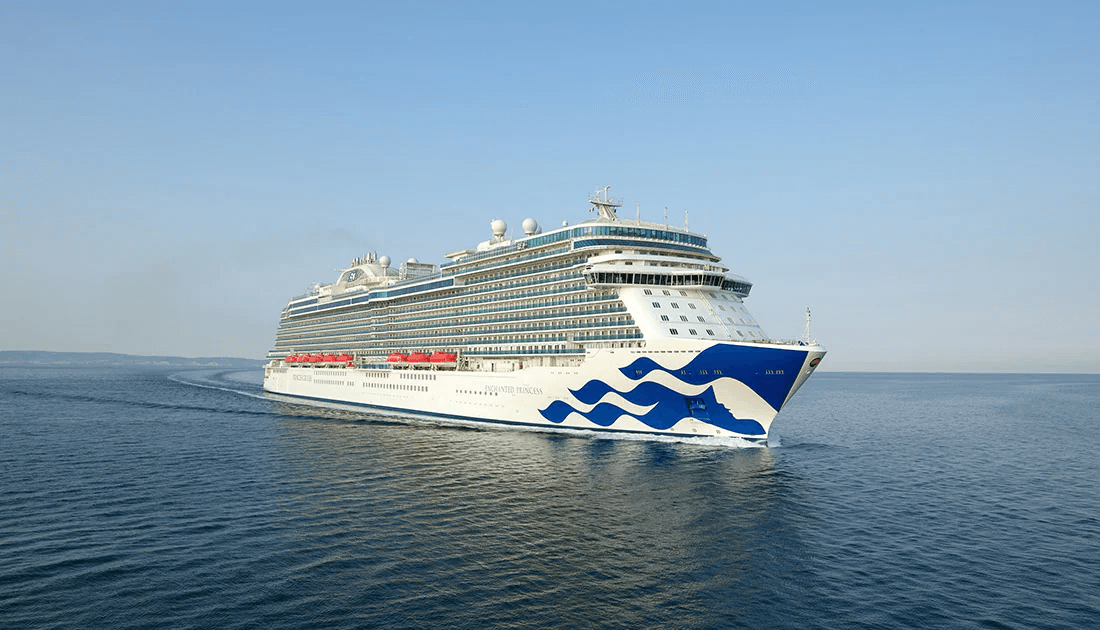
Princess Cruises · Enchanted Princess
Depart
Apr 16, 2027
Return
May 22, 2027
Port
Fort Lauderdale
Nights
36 nights
At a glance
- Launched
- 2021
- Tonnage
- 145000
- Cabins
- 1830
- Crew
- 1,346
Enchanted Princess shares the spectacular style and luxury of our fleet and introduces new attractions all her own. Get ready for exquisite, one-of-a-kind dining experiences. The most pools and whirlpool hot tubs in our fleet. World-class entertainment venues hosting dazzling performances. As well as the breathtaking new Sky Suite, with expansive views from our largest balcony.
Ship features
- Dine My Way
- Discovery At Sea
- International Cafe
- Kids play area
Ask our cruise specialists about cruise line loyalty benefits, status match options, drinks packages, gratuities and any current offers available on this sailing.
On board

International Cafe
Itinerary
- 1Fort LauderdaleDay 1 · Departure
- 2Bermuda (West End)Day 4
- 3Azores Islands (Ponta Delgada)Day 9
- 4GibraltarDay 12
- 5Cartagena, SpainDay 13
- 6Corsica (Ajaccio), FranceDays 15, 18
- 7Rome (Civitavecchia)Days 16, 37
- 8Florence/Pisa (Livorno)Day 17
- 9Sardinia (Alghero)Day 19
- 10VallettaDay 21
- 11BarDay 23
- 12DubrovnikDay 24
- 13SplitDays 25, 27
- 14Trieste (Venice)Day 26
- 15Kotor, MontenegroDay 28
- 16CorfuDay 29
- 17Katakolon (For Olympia)Day 30
- 18SantoriniDay 31
- 19Kusadasi (Ephesus)Day 32
- 20RhodesDay 33
- 21Crete (Chania), GreeceDay 34
- 22Naples, ItalyDay 36
Lines connect the ports in visiting order; the sailing path may vary.
Cruise from Fort Lauderdale to Civitavecchia, Rome
Day 1Cruise departs from Fort LauderdaleApr 16, 2027 • Departs at: 4 pm
According to the popular 1960 beach movie, Fort Lauderdale is "where the boys are." The city's reputation as America's Spring Break capital, however, has been replaced with the more favorable image of a prime family tourist destination, attracting more than 10 million visitors annually. The most popular beach resort in Florida is even more rightly famed as the "Yachting Capital of the World," with more than 40,000 registered crafts calling its waters home. The city also prides itself on being the "Venice of America" with more than 300 miles of navigable waterways. Fort Lauderdale boasts world-class theaters, museums, sightseeing, and shopping.
Day 2At SeaApr 17, 2027
Day 3At SeaApr 18, 2027
Day 4Bermuda (West End)Apr 19, 2027 • Arrives at: 9 am • Departs at: 5 pm
The Royal Naval Dockyard, the westernmost point in Bermuda, not only showcases Bermuda's nautical heritage, but it also provides a home for an impressive array of attractions and shopping opportunities. The fortifications of the Royal Naval Dockyard were built by British convicts and slave labor during the mid-1800s. Since then it has served many purposes, including the headquarters for the Royal Navy and a strategic defense post for the British in the North Atlantic. Most recently it has been redeveloped into a fascinating attraction offering visitors a glimpse into Bermuda's history, and has become a fun place to shop or explore. The centerpiece of the Dockyard is the commanding Clocktower building, which once served as a naval store and the captain's offices. Today, it has been marvelously restored. Throughout the Dockyard, you will find several restaurants, art galleries, the Bermuda Craft Market, and the Bermuda Maritime Museum, as well as an array of specialty shops and boutique…
Day 5At SeaApr 20, 2027
Day 6At SeaApr 21, 2027
Day 7At SeaApr 22, 2027
Day 8At SeaApr 23, 2027
Day 9Azores Islands (Ponta Delgada)Apr 24, 2027 • Arrives at: 9 am • Departs at: 6 pm
Rising from the depths of the Atlantic, the rugged, volcanic Azores lie 800 miles off the coast of Portugal. Colonized by the Portuguese in the 16th century, the nine islands have provided a haven to Atlantic mariners for over five centuries. The Azores offer travelers spectacular landscapes that range from lush meadows fringed with brightly colored hydrangea to ancient caldera filled with lakes. And the many small villages and shops retain an otherworldly air and 18th-century charm. Ponta Delgada is located on São Miguel, the largest of the nine Azores. The island's rich volcanic soil sustains fields of tobacco and tea, vineyards, and pineapple greenhouses. The Azores are also noted for fine crafts, particularly basketry and pottery.
Day 10At SeaApr 25, 2027
Day 11At SeaApr 26, 2027
Day 12GibraltarApr 27, 2027 • Arrives at: 8 am • Departs at: 5 pm
The Rock crouches over the sea like an ancient stone beast, looking Sphinx-like to Africa. Beneath the white cliffs of this natural fortress grows a profusion of palm, pine, and cypress. No fewer than 600 varieties of flowers thrive here, some not found anywhere else on Earth. Gibraltar's stunning setting is matched by its history - five countries have battled for 13 centuries to control the passage between the Atlantic and the Mediterranean. The result made for a cultural melting pot. Veiled Moroccan women in caftans and vacationing Englishmen and Spaniards stroll along the narrow, steep lanes. The locals revert to a liquid Spanish when talking among themselves. And visitors to a 15th-century cathedral pass through a blue-tiled courtyard, once part of a 13th-century mosque.
Day 13Cartagena, SpainApr 28, 2027 • Arrives at: 9 am • Departs at: 6 pm
Cartagena is an ancient port - the city served as Hannibal's Spanish headquarters during the 2nd Punic War with Rome. The city remained a major trading port under the Romans and the Moors. Today, Cartagena is Spain's principal naval establishment and the site of an annual international maritime festival. The city is also your gateway to the Costa Calida, a region that boasts some of Spain's mildest weather along with 175 miles of beaches.
Day 14At SeaApr 29, 2027
Day 15Corsica (Ajaccio), FranceApr 30, 2027 • Arrives at: 8 am • Departs at: 5 pm
Day 16Rome (Civitavecchia)May 1, 2027 • Arrives at: 6 am • Departs at: 6 pm
Your gateway to the Eternal City, Civitavecchia has served as Rome's seaport since the 13th century. The port has a long and venerable history. The emperor Trajan built a pleasure villa near the modern city, while Bernini and Michelangelo designed the harbor fortifications. Yet the Eternal City eternally beckons. The ancient capital of the Western World and the center of Christianity for nearly 2,000 years, Rome provides an inexhaustible feast. Visit the ruins of the Forum, view the splendors of the Sistine Chapel, or climb the Spanish Steps, once the heart of Rome's Bohemian Quarter. Rome has been a magnet luring the world's greatest artists, architects, and philosophers since the days of the Caesars.
Day 17Florence/Pisa (Livorno)May 2, 2027 • Arrives at: 7 am • Departs at: 7 pm
Livorno is the gateway to glorious Tuscany. Visit Florence - the cradle of the Renaissance - home to the Duomo, the Uffizi and the Ponte Vecchio. Here the Medici fostered a city-state whose cultural legacy is as great as classical Athens. Giants like Dante, Da Vinci, Michelangelo and Galileo infused the West with a new creative spirit. Then there is Pisa, Florence's rival for political power. Pisa, a brash, commercial seafaring town rivaled the great maritime powers of Venice and Genoa. The city was a leader in art and architecture second only to Florence.
Day 18Corsica (Ajaccio), FranceMay 3, 2027 • Arrives at: 9 am • Departs at: 6 pm
Day 19Sardinia (Alghero)May 4, 2027 • Arrives at: 8 am • Departs at: 5 pm
Sardinia is the second largest island in the Mediterranean. Like its neighbor Corsica, Sardinia boasts a dramatic coastline, superb small harbors and beaches that draw visitors from around the world. Gaunt hills crowned with granite outcropping take up most of the island interior, though the landscape is broken by vineyards and groves of olive trees and cork oaks. The island's harsh beauty is counterpointed by its rich culture - the island boasts extensive prehistoric ruins, fine Pisan churches and medieval walled towns. For centuries, Italian city-states and Spain vied for control of Sardinia. The old port of Alghero has a distinctive Catalan feel - it was known as "Little Barcelona." The Albi Palace was a residence for the Spanish viceroys who governed Sardinia. Alghero is an anchorage port. Passengers transfer to shore via ship's tender.
Day 20At SeaMay 5, 2027
Day 21VallettaMay 6, 2027 • Arrives at: 7 am • Departs at: 9 pm
Malta is the largest in a group of seven islands that occupy a strategic position between Europe and Africa. The island's history is long and turbulent. Everyone from the Normans to the Nazis have vied for control of this small, honey-colored rock. For centuries the island was the possession of the knightly Order of St. John - the Knights Hospitaller. Valletta, Malta's current capital, was planned by the Order's Grandmaster Jean de la Valette to secure the island's eastern coast from Turk incursions. Founded in 1566, Valletta's bustling streets are lined with superb Baroque buildings and churches. Malta has a long history: the megalithic stone temples at Gozo may be the oldest freestanding structures on Earth. Malta has two official languages, Maltese (constitutionally the national language) and English. Malta was admitted to the European Union in 2004 and in 2008 became part of the eurozone.
Day 22At SeaMay 7, 2027
Day 23BarMay 8, 2027 • Arrives at: 7:30 am • Departs at: 7 pm
Day 24DubrovnikMay 9, 2027 • Arrives at: 7 am • Departs at: 7 pm
Dubrovnik is a beautiful stone jewel hugging the Adriatic Sea. This picture-perfect medieval walled city offers ancient stone buildings, narrow cobbled streets and fortified ramparts rising above red-tiled rooftops. Stradun is the city's focal point and main artery while Dubrovnik's streets are blessedly free of vehicular traffic. Despite the heavy damage inflicted by shelling in the early '90s, Dubrovnik has been restored to its pre-war beauty. A UNESCO World Heritage Site, the old city remains the pride of the Republic of Croatia. For six centuries Dubrovnik was an independent republic - an oligarchy ruled by patrician families. The Republic was overthrown by Napoleon in 1808.
Day 25SplitMay 10, 2027 • Arrives at: 7 am • Departs at: 4 pm
Pine-clad hills, secluded coves, beaches - Split and the Dalmatian Riviera have been premier destinations on the Adriatic since the days of the Roman emperors. In fact, medieval Split was built within and around the palace complex built for the emperor Diocletian in his retirement. (The complex included both a villa and a castrum - a Roman camp capable of garrisoning three legions!) The charms that soothed an emperor are still evident today. The Dalmatian Riviera offers the traveler a heady blend of natural beauty and fascinating cultural sites.
Day 26Trieste (Venice)May 11, 2027 • Arrives at: 6 am • Departs at: 8 pm
Trieste is the capital city of the Friuli Venezia Giulia region in northeast Italy. A port city, it occupies a thin strip of land between the Adriatic coast and Slovenia’s border on the limestone-dominated Karst Plateau. Italian, Austro-Hungarian and Slovenian influences are all evident in its layout, which encompasses a medieval old city and a neoclassical Austrian quarter.
Day 27SplitMay 12, 2027 • Arrives at: 11 am • Departs at: 9 pm
Pine-clad hills, secluded coves, beaches - Split and the Dalmatian Riviera have been premier destinations on the Adriatic since the days of the Roman emperors. In fact, medieval Split was built within and around the palace complex built for the emperor Diocletian in his retirement. (The complex included both a villa and a castrum - a Roman camp capable of garrisoning three legions!) The charms that soothed an emperor are still evident today. The Dalmatian Riviera offers the traveler a heady blend of natural beauty and fascinating cultural sites.
Day 28Kotor, MontenegroMay 13, 2027 • Arrives at: 8 am • Departs at: 6 pm
Kotor lies at the head of Boka Bay. Bordered by towering limestone cliffs, the winding bay is actually Southern Europe's longest and most dramatic fjord. The port itself is a medieval gem: its narrow, asymmetrical streets are lined with ancient stone houses, old palaces, and churches dating from the 12th century. Kotor is also your gateway to the cultural and scenic wonders of Montenegro, from the old royal capital at Cetinje to the marshes and wildlife of Lake Skadar National Park. Kotor is renowned for its nightlife: the streets of the old port are lined with pubs, taverns and cafés. The city is also host to a renowned summer carnival. Kotor is an anchorage port. Passengers transfer to shore via ship's tender.
Day 29CorfuMay 14, 2027 • Arrives at: 9 am • Departs at: 7 pm
The lush and verdant island of Corfu lies in the Ionian Sea, midway between Greece and Italy. The island has a long and colorful history. First colonized by the city-state of Corinth, Corfu has been ruled by the Romans, the Venetians, the French and the English. Corfu Town boasts fortresses bearing the insignia of the Venetian Republic, an esplanade lavishly planted by the French during the Napoleonic Wars, and an English cricket pitch. The island also offers some of the finest coastal scenery in the entire Mediterranean.
Day 30Katakolon (For Olympia)May 15, 2027 • Arrives at: 7 am • Departs at: 4 pm
Perched on the west coast of the Peloponnesus, Greece's largest peninsula, this sleepy fishing village of some 300 souls is your gateway to Olympia, site of the original Olympic Games. Held every four years between 776 B.C. and 393 A.D., when the Emperor Theodosius banned pagan festivals, the Olympic Games celebrated the ideal harmony of mind and body. Every four years, the sacred flame of Altis is rekindled to light the torch for the Modern Games. Olympia's temples were destroyed after the games were banned. An earthquake in the 6th century compounded the destruction, and floods buried the site. Excavation of the ruins began in 1875, and Olympia was declared a National Park in 1976.
Day 31SantoriniMay 16, 2027 • Arrives at: 9 am • Departs at: 8 pm
Did the catastrophic volcanic eruption that ravaged Santorini circa 1600 B.C. destroy Crete's ancient Minoan civilization - and give birth to the myth of Atlantis? In 1967, archaeologists on Santorini unearthed the remains of a Bronze Age city that may have been home to as many as 30,000 people. Whether the Lost Continent of Atlantis is rooted in myth or reality, an undisputed fact remains. The eruption created a caldera - and one of the most dramatic land and seascapes in the entire Mediterranean. On Santorini, whitewashed buildings cling to vertiginous cliffs that plunge to a turquoise sea. Part of the Cyclades Archipelago, the three-island group of Santorini, Thirasia and uninhabited Aspronisi present the traveler with unforgettable vistas. The island has had a number of names throughout history - from Strongyle or "Round" to Thera in honor of an ancient hero. Santorini is more recent and stems from the island church dedicated to St. Irene - Santa Rini to foreign sailors.
Day 32Kusadasi (Ephesus)May 17, 2027 • Arrives at: 7 am • Departs at: 5 pm
From the port of Kusadasi on Turkey's Anatolian Coast, one travels into the past. Nearby stand the ruins of ancient Ephesus, a major site of archeological excavation. The city was once a Roman provincial capital and trading center. Ephesus is also home to several of Christendom's holiest sites. St. Paul preached at the Great Theater and the ruins of Ephesus' Basilica cover the tomb of Christ's most beloved disciple, St. John the Apostle. In Kusadasi, whitewashed stone houses rise in tiers behind the market district. The palm-lined esplanade is the center of town life, with thousands of merchants offering wares to rival the Grand Bazaar in Istanbul.
Day 33RhodesMay 18, 2027 • Arrives at: 7 am • Departs at: 4 pm
The largest and arguably the most beautiful of the 12 islands forming the Dodecanese, Rhodes has long played a major role in history. Lying just 12 miles off the coast of Turkey, the island straddles the sea-lanes linking Egypt, Southern Europe and the Holy Land. Rhodes Town bears witness to that long history. The ancient city features a classical stadium and the ruins of the Temple of Apollo. The "old" city is a walled town with medieval buildings and streets harking back to the days of the Crusades. The new town is a Mecca of luxury resorts lining the island's picturesque Mandaraki Harbor. The Colossus of Rhodes, one of the Seven Wonders of the Ancient World, is reputed to have once stood guard over the harbor. Today, the bronze statues of a stag and doe top the two columns marking the harbor entrance.
Day 34Crete (Chania), GreeceMay 19, 2027 • Arrives at: 7 am • Departs at: 5 pm
Weaving a tapestry of awe and wonder, Chania is a centuries-old mix of Minoan myths, well-preserved Venetian mansions, a mesmerizing Old Town complete with labyrinthine passageways, and atmospheric Kastelli Hill, once the site of a Roman acropolis. But Chania may be best known as the gateway to the breathtaking 4,000 year-old Minoan ruins at Knossos, home of the legendary King Minos and the part man and part bull known creature as the Minotaur. And around every corner of this idyllic area you'll find picturesque villages, breathtaking views and architectural wonders that will remain with you for a lifetime.
Day 35At SeaMay 20, 2027
Day 36Naples, ItalyMay 21, 2027 • Arrives at: 7 am • Departs at: 6 pm
Italy's third-largest city, Naples is a bustling metropolis famed for it stately buildings, crowded streets, pizza - and notoriously bad traffic. However, this beautiful city is rich in centuries-old culture and customs. Naples is also your gateway to the Isle of Capri, the fabled Amalfi Coast and the ruins of Pompeii, buried in ash by the cataclysmic eruption of Mt. Vesuvius in 79 A.D. Naples boasts an ideal location, with both the ruins of Roman cities and the stunning Amalfi Coast in easy reach.
Day 37Rome (Civitavecchia)May 22, 2027 • Arrives at: 6 am
Your gateway to the Eternal City, Civitavecchia has served as Rome's seaport since the 13th century. The port has a long and venerable history. The emperor Trajan built a pleasure villa near the modern city, while Bernini and Michelangelo designed the harbor fortifications. Yet the Eternal City eternally beckons. The ancient capital of the Western World and the center of Christianity for nearly 2,000 years, Rome provides an inexhaustible feast. Visit the ruins of the Forum, view the splendors of the Sistine Chapel, or climb the Spanish Steps, once the heart of Rome's Bohemian Quarter. Rome has been a magnet luring the world's greatest artists, architects, and philosophers since the days of the Caesars.
Cabin options
Choose your cabin type, compare its fares, then pick your cabin. Prices and availability are checked for your party.
See cabins to check current grades, prices and availability for your party.
Next step
Choose your cabin type
View every cabin grade and current availability on the next step.