21-Day Adriatic & Western Mediterranean: Italy & Spain
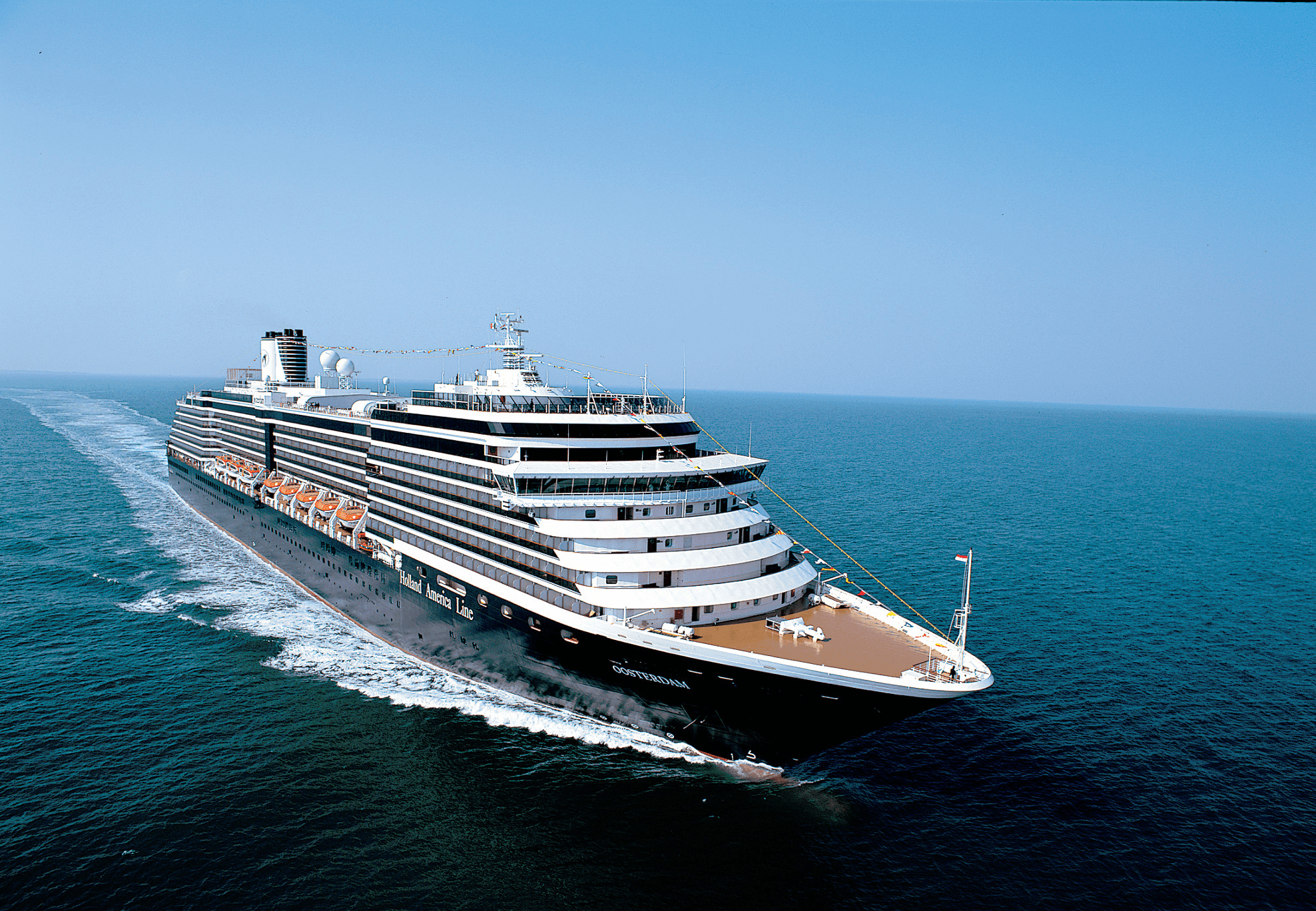
Holland America Line · Oosterdam
Depart
May 15, 2027
Return
Jun 5, 2027
Port
Trieste
Nights
21 nights
At a glance
- Built
- 2003
- Tonnage
- 82305
- Cabins
- 1012
- Crew
- 817
Oosterdam, a Vista-class ship, recently emerged from dry dock with exciting updates—including completely refreshed suites and new lounge, dining and entertainment venues, such as Music Walk, with Lincoln Center Stage, B. B. King’s Blues Club and Billboard Onboard. Guests can choose from among delectable specialty restaurants, hone culinary skills with EXC Port to Table and thrill to BBC Earth Experiences.
Ask our cruise specialists about cruise line loyalty benefits, status match options, drinks packages, gratuities and any current offers available on this sailing.
On board

Pinnacle Grill

The Dining Room
Itinerary
Cruise from Trieste to Barcelona
Day 1Cruise departs from TriesteMay 15, 2027 • Departs at: 5 pm
Trieste is the capital city of the Friuli Venezia Giulia region in northeast Italy. A port city, it occupies a thin strip of land between the Adriatic coast and Slovenia’s border on the limestone-dominated Karst Plateau. Italian, Austro-Hungarian and Slovenian influences are all evident in its layout, which encompasses a medieval old city and a neoclassical Austrian quarter.
Day 2Zadar, CroatiaMay 16, 2027 • Arrives at: 7 am • Departs at: 4 pm
It may sound like the name of some fantastic distant land or even a planet, but the only things out of this world about Zadar are its seaside views, delicious Croatian-Mediterranean cuisine and wines and the warm welcome when you arrive in this history-steeped Croatian town. Perched on a peninsula extending into the Adriatic, Zadar was a crossroads in the ancient world and a cornerstone of the Venetian Empire. As in many Croatian towns, layers of history and art are everywhere (keep your eyes open for the ubiquitous signature Venetian lions). In recent years, Croatia has found some new fame as the backdrop for Game of Thrones, but Zadar’s story of survival rivals anything that Hollywood could imagine. Caught on the front lines between the Allies and Mussolini’s troops, some 60 percent of the city’s buildings were destroyed in World War II. Today, however, the city that was once described as \"the Dresden of the Adriatic\" has been meticulously restored. From the new tourist port, Gaže…
Day 3DubrovnikMay 17, 2027 • Arrives at: 9 am • Departs at: 11 pm
On the southern end of Croatia's Adriatic coast, Dubrovnik staked its claim to glory during the 450 years it existed as the independent Ragusan Republic, shoulder to shoulder with mighty forces like Venice and the Ottoman Empire. Once a renowned seafaring, shipbuilding and trading center, today it's an enchanting tourist destination. Dubrovnik seduces sightseeing visitors with its polished (and very clean!) limestone streets, theatrical architecture, charming café, welcoming restaurants and distinctive shops along scenic side streets. The natural backdrop, much of which is protected, consists of pine and cypress forests and the shimmering Adriatic, dotted with uninhabited islands. Visitors quickly discover that the wider Dubrovnik area is just as striking as its main attraction—the Old Town. A wander around the historic heart of Dubrovnik can hit the main sights, but take it a step further (or a staircase further, really), and you'll see that people do still live in the historic quart…
Day 4KotorMay 18, 2027 • Arrives at: 8 am • Departs at: 5 pm
Kotor is located along one of Montenegro's most beautiful bays. First settled during the days of ancient Rome, the city today has a well preserved urban centre with a vibrant community. Medieval architecture and numerous monuments of cultural heritage have made Kotor a UNESCO listed “World Natural and Historical Heritage Site."
Day 4Scenic cruising Bay of KotorMay 18, 2027
Day 5Kerkira (Corfu)May 19, 2027 • Arrives at: 8 am • Departs at: 9 pm
Fortresses flank your entrance to this most beautiful of the Ionians. Lose yourself in the Venetian old town or head north for dramatic seascapes. Sample shore excursion: Achillion Palace & Private Villa.
Day 6At SeaMay 20, 2027
Day 7Messina, ItalyMay 21, 2027 • Arrives at: 7 am • Departs at: 5 pm
Messina's astrological clock is as much a man-made masterpiece as the road leading to Taormina, which canitlevers out of the rocky cliff face and stands on impossibly tall pylons. Leave it to the Italians to design a road that's both a thrill-ride and a feat of engineering! Once you're safely in Taormina, walk to the sublime Greco-Roman theatre that overlooks Naxos Bay and snow-capped Mt Etna, and spend some time on the Corso Umberto with a gelato firmly in hand.
Day 8Naples (Pompeii)May 22, 2027 • Arrives at: 8 am • Departs at: 5 pm
Rising behind the wide curve of its bay with brooding Mount Vesuvius and the deep blue sea as a backdrop, Naples, Italy enjoys a magnificent natural setting. It is the third-largest city in Italy after Rome and Milan, and arguably the most colorful and seductive of them all: Splendor and squalor live side by side in 21st-century Naples, and the mix is intoxicating. Cruise to Naples, home to world-class museums and attractions. Naples has something for everyone - superb restaurants, eclectic shopping, a thriving contemporary art scene and an edgy and vibrant street life. But once you’ve had enough of the pounding traffic and jostling crowds while sightseeing in Naples, there are endless opportunities for exploration further afield. The celebrated Roman ruins of Pompeii and Herculaneum, both victims of Vesuvius’ devastating 79 C.E. eruption, lie just south of the city. Explore Naples' history or take a short ride over to the island of Capri on a Naples shore excursion. The delightful to…
Day 9Civitavecchia (Rome)May 23, 2027 • Arrives at: 8 am • Departs at: 11 pm
When you embark on a cruise to Rome with Holland America Line you experience its bustling modernism along with its rich history. You can walk in the footsteps of emperors, have coffee in Renaissance piazzas and see contemporary art all in one afternoon. Your sightseeing time in Rome begins at the nearby port of Civitavecchia, a seaside town with roots that stretch back to the Etruscan era. Take note of the Forte Michelangelo (both Bramante and Michelangelo had a hand in its design), and the lungomare, a lively stretch along the sea with beach clubs, bars and restaurants. Once in the Eternal City you can fill your day with museums, churches, archaeological sites, traditional trattorias, artisan shops and, of course, gelato. The Colosseum and the Vatican Museums are Rome's superstar attractions, but there are plenty of quieter gems to explore. For food lovers there are the markets in Campo de' Fiori or the slightly farther flung Testaccio. The hip neighborhood of Monti, next to the Colo…
Day 10At SeaMay 24, 2027
Day 11BarcelonaMay 25, 2027 • Arrives at: 7 am • Departs at: 5 pm
On the northeast coast of Spain, overlooking the Mediterranean, Barcelona is a vibrant port city, packed with centuries of iconic art and architecture—Gaudí and Picasso both called it home—and lined with sunny white-sand beaches. Explore the Catalan capital's tourist attractions and historic neighborhoods, Modernisme and world-renowned art museums, galleries and local crafts shops—some of which are centuries old and stock traditional Catalan wares. After you see the sights, there are lively tapas bars around every corner where you can stop for a drink, a café amb llet (Catalan for espresso with steamed milk) or a snack, no matter the hour. Green spaces for picnics, long walks and respite from the hustle and bustle are scattered throughout Barcelona's attractions: There's Gaudí's mosaic-decorated park, a neoclassical maze at the Laberint d'Horta, as well as plenty of high places (mountains, monuments and edifices) where sightseeing visitors can take in the view. A short trip from Barce…
Day 12At SeaMay 26, 2027
Day 13MalagaMay 27, 2027 • Arrives at: 8 am • Departs at: 6 pm
Málaga is your chance to tour to the Moorish wonders of the Alhambra with its elaborate carvings, grand columns and delicate arches. Stalagmites and stalactites reach calcite fingers into the caverns of Nerja, near Malaga. 30,000 years ago, people lived in the shadowy recesses of these caves. In nearby Mijas, shop tables are laden with hand-made ceramics, and the people live in shuttered, whitewashed cottages.
Day 14Strait Of GibraltarMay 28, 2027
Day 14TangierMay 28, 2027 • Arrives at: 8 am • Departs at: 6 pm
Tangier is Africa's whitewashed gateway to Europe and the Mediterranean. Wide palm-lined boulevards and humming souks are Tangier's distinctively Moroccan features, but Spanish, French and Berber characteristics are found everywhere: arched wooden doors, hefty silver ornamentations, tightly-woven carpets that tell tribal legends.
Day 15AlmeriaMay 29, 2027 • Arrives at: 8 am • Departs at: 6 pm
While there is archaeological evidence of Phoenician, Greek and Roman settlements in the Andalucían province of Almería, the city of the same name was founded by the Moorish king Abd ar-Rahman in 955. (Its Spanish name comes from its original Arabic one: Al-Mari'yah, or The Watchtower.) Strategically situated on the Mediterranean, it remained a Muslim stronghold until Christians conquered it in the 15th century. The Muslim influence can still be seen throughout the province, and especially in its capital city. The Alcazaba, a massive 10th-century Moorish palace, hovers above the town and has played a starring role in a number of films, including Indiana Jones and the Last Crusade, Conan the Barbarian and the James Bond movie Never Say Never Again. The city also boasts a remarkable Gothic cathedral dating from the 16th century; resembling a fortress with its towers and battlements, it served as both a place of worship and a bulwark against attacks by pirates. Nicolás Salmerón Park, a l…
Day 16At SeaMay 30, 2027
Day 17CagliariMay 31, 2027 • Arrives at: 8 am • Departs at: 4 pm
"And suddenly there is Cagliari: a naked town rising steep, steep, golden-looking, piled naked to the sky," wrote D.H. Lawrence in 1921 when he traveled to Sardinia. Nearly 100 years later, the city that made the writer "think of Jerusalem" is just as impressive, sitting between a blue sea and an azure sky. According to Greek mythology, "Caralis" was founded by Aristeus, son of Apollo, though historians date it to the 8th century B.C.E., when the Phoenicians established a trading port here. Sardinia's capital was later fought over by Carthaginians, Romans, Pisans, Spanish and Piedmontese—all of whom shaped its development. Most sights are in Castello, the old town that climbs the hill behind Saint Remy's rampart. It's a rough grid of narrow streets and small squares with breathtaking views of sea, city and mountains. And while the old stones of Castello reflect millennia of history, Cagliari also has natural riches, with white beaches and flamingo-dotted blue lagoons nearby. Sardinia…
Day 18Civitavecchia (Rome)Jun 1, 2027 • Arrives at: 8 am • Departs at: 9:30 pm
When you embark on a cruise to Rome with Holland America Line you experience its bustling modernism along with its rich history. You can walk in the footsteps of emperors, have coffee in Renaissance piazzas and see contemporary art all in one afternoon. Your sightseeing time in Rome begins at the nearby port of Civitavecchia, a seaside town with roots that stretch back to the Etruscan era. Take note of the Forte Michelangelo (both Bramante and Michelangelo had a hand in its design), and the lungomare, a lively stretch along the sea with beach clubs, bars and restaurants. Once in the Eternal City you can fill your day with museums, churches, archaeological sites, traditional trattorias, artisan shops and, of course, gelato. The Colosseum and the Vatican Museums are Rome's superstar attractions, but there are plenty of quieter gems to explore. For food lovers there are the markets in Campo de' Fiori or the slightly farther flung Testaccio. The hip neighborhood of Monti, next to the Colo…
Day 19Livorno (Florence)Jun 2, 2027 • Arrives at: 8 am • Departs at: 8 pm
Access to the best of Tuscany: Florence, with its magnificent art and architecture and elegant shopping; Pisa's Leaning Tower; and ancient Lucca. Sample shore excursions: Tuscan Countryside & Wine Tasting; Florence & the Academia.
Day 20AjaccioJun 3, 2027 • Arrives at: 8 am • Departs at: 5 pm
Most famous as the birthplace of a diminutive, strong-willed local who went on to become known simply as Napoleon, the port of Ajaccio is Corsica’s small, walkable capital. The roots of this city on the island’s western coast are said to go back to another strong man, the Greek hero Ajax. Only 200 miles from its parent France, you might as well be in another country on Corsica, where everything from the food to the language is unique. Anchored by a magnificent citadel and a fine Baroque cathedral, Ajaccio is filled with pastel buildings whose wooden shutters keep out the Mediterranean sun, while its streets, plazas and statues are all marked by Napoleon’s aura. Dining and shopping along the palm tree–studded waterfront have been popular since the days of English travelers in the 19th century—activities that have once again marked daily life in the port since De Gaulle liberated the town and island in World War II. Ringed by craggy natural formations both on land and sea, as well as st…
Day 21Marseille (Provence)Jun 4, 2027 • Arrives at: 8 am • Departs at: 5 pm
Marseille, in the south of France, has more spice, grit and edge than the Provençal towns that surround it. A trade city since the time of ancient Greece, the port always seems to be on the brink of change, generating a certain energy that’s hard to find in the timeless and traditional countryside. In fact, sometimes it doesn't seem very French at all. Thanks to a multicultural population, the culinary scene (with seafood dishes and Michelin-starred restaurants galore) goes beyond the classic steak frites at bistros and brasseries. A 19th-century cathedral presides over the city and the working-class Le Panier district has winding streets flanked by fading facades, while Baroque edifices grace the commercial thoroughfare La Canebière, once compared to the Champs-Élysées. Marseille’s 2013 turn as the European Capital of Culture sprouted a crop of cultural venues, from striking museums to cutting-edge gallery spaces and thought-provoking concept shops that showcase local talent. The wat…
Day 22Cruise returns to BarcelonaJun 5, 2027 • Arrives at: 7 am
On the northeast coast of Spain, overlooking the Mediterranean, Barcelona is a vibrant port city, packed with centuries of iconic art and architecture—Gaudí and Picasso both called it home—and lined with sunny white-sand beaches. Explore the Catalan capital's tourist attractions and historic neighborhoods, Modernisme and world-renowned art museums, galleries and local crafts shops—some of which are centuries old and stock traditional Catalan wares. After you see the sights, there are lively tapas bars around every corner where you can stop for a drink, a café amb llet (Catalan for espresso with steamed milk) or a snack, no matter the hour. Green spaces for picnics, long walks and respite from the hustle and bustle are scattered throughout Barcelona's attractions: There's Gaudí's mosaic-decorated park, a neoclassical maze at the Laberint d'Horta, as well as plenty of high places (mountains, monuments and edifices) where sightseeing visitors can take in the view. A short trip from Barce…
Cabin options
Compare the cabin types and onboard features shown for this sailing. Final price and availability are confirmed by our team when you inquire.
29 cabin grades listed for this sailing.
Next step
Cabin grades and prices
View every cabin grade and current availability on the next step.