Fjords, Folklore & Canada Fall Foliage
Seabourn · Seabourn Quest
Depart
Sep 1, 2027
Return
Sep 25, 2027
Port
Copenhagen, Denmark
Nights
24 nights
At a glance
- Built
- 2011
- Tonnage
- 32000
- Cabins
- 225
- Crew
- 330
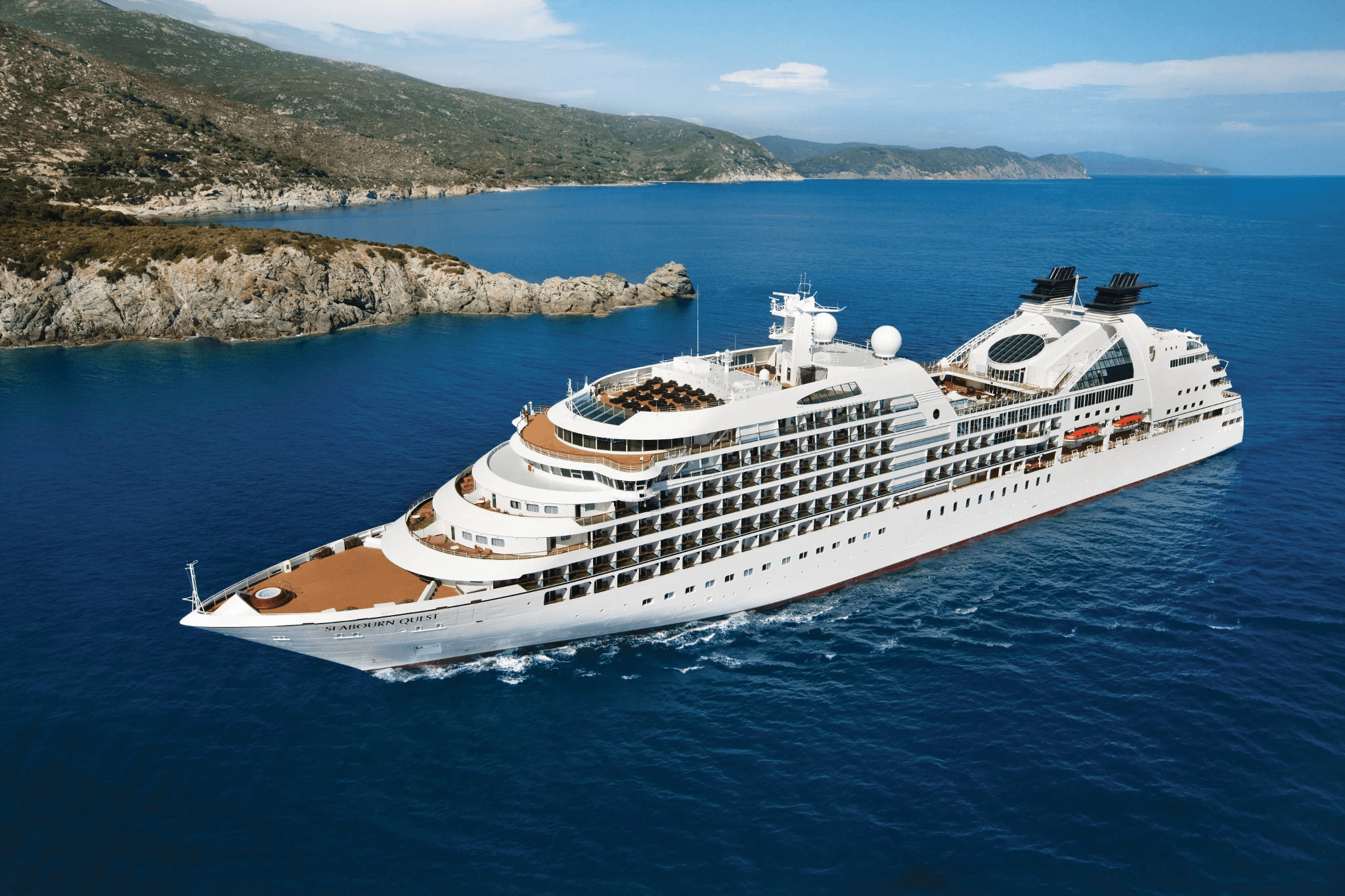
Seabourn Quest is the third iteration of the vessel design that has been called “a game-changer for the luxury segment. ” True to her Seabourn bloodlines, wherever she sails around the world, Seabourn Quest carries with her a bevy of award-winning dining venues that are comparable to the finest restaurants to be found anywhere.
Ask our cruise specialists about cruise line loyalty benefits, status match options, drinks packages, gratuities and any current offers available on this sailing.
On board

Club

Patio Bar
Itinerary
Cruise from Copenhagen, Denmark to Montreal
Day 1Cruise departs from Copenhagen, DenmarkSep 1, 2027 • Departs at: 10 pm
Denmark's capital is arguably one of the world's best-loved cities, and certainly the liveliest of all the Scandinavian capitals. It is a gracious and comfortable place, with a decidedly friendly, hospitable and fun-loving atmosphere. If there is such a thing as a cozy city, Copenhagen is it. From the lingering memory of the tales of Hans Christian Andersen to the colored lights of Tivoli Gardens, there is a delightful ambience that surrounds the visitor everywhere. Tidy, narrow streets are lined with tempting restaurants and cafes, and the pedestrian-only Stroget abounds with stylish shops. The spirited Copenhageners are imaginative and unconventional and exude a "do-what-you-want" philosophy that embraces and respects almost all aspects of life. Every friendly Dane you meet further illustrates the city's motto "Wonderful, wonderful, Copenhagen."
Day 2At SeaSep 2, 2027
Day 3Stavanger, NorwaySep 3, 2027 • Arrives at: 7 am • Departs at: 4 pm
A Romanesque cathedral and old medieval lanes blend beautifully with Stavanger's modern city and spectacular countryside. In 872, when Harald Fairhair won the Battle of Hafrsfjord near Stavanger, he united Norway for the first time. Huge harvests of brisling, herring and sardines have made the key of a sardine can the city symbol. Today, the town is the center of Norway's oil industry, and has become one of the country's most cosmopolitan cities.
Day 4LerwickSep 4, 2027 • Arrives at: 8 am • Departs at: 5 pm
Lerwick, Britain's most northerly town, and is a small, bustling, cosmopolitan seaport with a population of over 7,000 people and fine architecture. Shetland Museum, located on Hay's Dock, is an award- winning attraction. Discover the island’s many secrets through its exhibits, and take a look in the boat shed, where you can see demonstrations of traditional boat building. Also of interest is the stone-walled town hall, built in 1884, displaying an impressive array of beautifully intricate stained glass. Towering St. Magnus Cathedral, constructed in 1863, is likewise well worth a visit. People have lived and prospered here since Neolithic times. The site of Clickimin Broch, a hollow-stone-walled structure, was a Late Bronze Age farmstead of the 7th century BCE. Historic Fort Charlotte, built in 1653, is a five-sided fortress, with cannon batteries pointing out to sea. The Shetland Textile Museum, with its fine weaving, and the quaint Crofters Museum will detail life in a much gentler…
Day 5Torshavn, Faroe IslandSep 5, 2027 • Arrives at: 12:01 pm • Departs at: 10 pm
A distant outpost of Denmark, the Faroe Islands suddenly appear out of the misty North Atlantic, nearly 200 miles from the nearest landfall. Of the twenty-two islands in the group, seventeen are inhabited, with a population of 17,000 residing in the capital city of Torshavn. Irish monks discovered the islands in the 8th century and became the first settlers, only to be driven out by Viking explorers a century later. The traditions and legends of their Viking forefathers are kept alive in a language so close to old Norse that Faroe Islanders can still read the ancient texts inscribed centuries ago. The name Faroe comes from faereyjar, the Old Norse word meaning "Sheep Islands." With thousands of sheep dotting the hillsides, the name remains apt today. While sheep are important to the economy, the real wealth of the islands comes from the fishing industry. A fleet of over 300 trawlers and line-fishing boats bring in an average annual haul of 245,000 tons of cod and herring. Ultra-modern…
Day 6Runavik, Faroe IslandsSep 6, 2027 • Arrives at: 8 am • Departs at: 5 pm
Originally a fishing port, Kongshavn harbor on the southern end of Eysturoy, the Faroes’ second-largest isle, is now a major staging port for the North Sea oil platforms as well. Runavik’s buildings are scattered across an alluvial fan below looming, green-clad peaks beside the Skalafjordur fjord. The mountainous island is criss-crossed with hiking trails, some of which date from Viking times. The main attraction for visitors is the grandeur of nature, along with the birds and animals that inhabit the island. Lake Toftavatn is one place to see them, on a Ventures by Seabourn hike. A drive around the island will include views of 2,890-foot Mt. Slaettaratindur with stops at the picturesque village of Gjogr on the north end, and a visit to Glyvrar to see the Forni Museum that preserves a typical 17th century island home. Your Ventures by Seabourn team will offer kayaking excursions on Skalafjord, or an excursion the the major Viking site of Toftanes with your expert archaeologist.
Day 7At SeaSep 7, 2027
Day 8HusavikSep 8, 2027 • Arrives at: 8 am • Departs at: 6 pm
Day 9Siglufjordur, IcelandSep 9, 2027 • Arrives at: 7 am • Departs at: 4 pm
Siglufjörður is the northernmost town on the Icelandic mainland, a small fishing village of some 1,200 people. Founded in 1918, it was in the past the capital of the North Atlantic herring fishing industry. The Síldarminjasafnið Herring Era Museum, one of Iceland's largest seafaring and industrial museums, houses three different areas where one can learn about both the traditional and the modern herring industry. A collection of many historic fishing vessels and artifacts is proudly displayed by the people of Siglufjörður, detailing how herring was salted, processed and collected. The small harbor with its colorful fishing boats and the red-roofed steeple of the Lutheran church dominate the village-scape. The natural beauty of the area includes high mountains that rim the fjord, freshwater lakes, the Hólsá river, black sand beaches, and a wealth of birdlife all around. This northernmost region of Iceland is renowned for some of the largest and most dramatic waterfalls in the country.
Day 10Grundarfjordur, IcelandSep 10, 2027 • Arrives at: 9 am • Departs at: 6 pm
The charming small fishing village of Grundarfjörður is located in the middle of the Snæfellsnes Peninsula and thus provides easy access to Stykkishólmur, Snæfellsbær and the Snæfellsnes National Park. Its best-known landmark is undoubtedly the peak of Mt. Kirkjufell. Translated as ‘church mountain,’ Kirkjufell is the most easily recognizable peak, and one of the most photographed mountains in Iceland. During summer months a Viking Village is built in the center of town where Viking re-enactments occur quite regularly. During the Á góðri stund town festival in July, the town’s 900 residents decorate their houses in red, blue, yellow, and green, transforming the town into a spinning kaleidoscope of color. The town first began trade in 1786, and around 1800, French merchants came to Iceland and settled in Grundarfjörður, where they constructed a church and a hospital. The town has prospered through the fishing industry for a long time. The surrounding sea is rich with birdlife & marine…
Day 11Reykjavik, IcelandSep 11, 2027 • Arrives at: 7 am • Departs at: 6 pm
Warmed by the Gulf Stream as well as by highly active thermal hot springs and volcanoes, Iceland is somewhat misnamed. While it is a stark and barren country with three huge areas of glaciers, one theory is that early Norsemen sought to mislead other potential settlers by giving a pleasant name to fierce, inhospitable Greenland, and a forbidding name to the imminently habitable Iceland. Irish monks and hermits established themselves here in the 8th century, but left a century later when the pagan Norsemen arrived. Europe's first Parliament of General Assembly, the Althing, was established in the year 930 and still functions as the legislative body, although it was suspended by the Danes at the end of the 18th century and not reconvened until 1843. Reykjavik was the site picked by the island's first permanent resident, Ingolfur Arnarson in 874, and is home to more than half of the island's total population. The world's northernmost capital, Reykjavik is proud of its virtual lack of air…
Day 12Grundarfjordur, IcelandSep 12, 2027 • Arrives at: 8 am • Departs at: 6 pm
The charming small fishing village of Grundarfjörður is located in the middle of the Snæfellsnes Peninsula and thus provides easy access to Stykkishólmur, Snæfellsbær and the Snæfellsnes National Park. Its best-known landmark is undoubtedly the peak of Mt. Kirkjufell. Translated as ‘church mountain,’ Kirkjufell is the most easily recognizable peak, and one of the most photographed mountains in Iceland. During summer months a Viking Village is built in the center of town where Viking re-enactments occur quite regularly. During the Á góðri stund town festival in July, the town’s 900 residents decorate their houses in red, blue, yellow, and green, transforming the town into a spinning kaleidoscope of color. The town first began trade in 1786, and around 1800, French merchants came to Iceland and settled in Grundarfjörður, where they constructed a church and a hospital. The town has prospered through the fishing industry for a long time. The surrounding sea is rich with birdlife & marine…
Day 13Isafjordur, IcelandSep 13, 2027 • Arrives at: 8 am • Departs at: 6 pm
Like most Icelandic towns, this one on the northwest coast was started by fisherman and whalers. The name means ice-fjord. It is a perfect place from which to explore the cultural and economic staples of Iceland. An excursion to Sudavik reveals a town started by whalers and nearly destroyed by an avalanche in 1995, now rebuilt out of the path of further slides. Its lovely church was donated by whalers, as well. The own also holds a center for the study of the indigenous arctic foxes. The Maritime Museum in Isafjordur illustrates the lifestyles of the early inhabitants, including many implements of their trades, and also a wall of accordions, one of the few forms of entertainment on bygone days. Another option is a boat ride to nearby Vigur island, a nesting site for many species of seabirds, including eider ducks, whose down is yet another example of local economy based on the surrounding seas.
Day 14At SeaSep 14, 2027
Day 15Cruising Prince Christian SundSep 15, 2027
Day 16Nanortalik, GreenlandSep 16, 2027 • Arrives at: 8 am • Departs at: 6 pm
The immense scale of the peaks around this village dwarfs anything built there. Still, the tall white steeple of the church juts up with a spirit of endurance and perseverance that matches the character of those who make this arctic outpost their home. It also echoes the shape of icebergs floating in the surrounding seas, shed from the immense icefields that cover much of the island.
Day 17Qaqortoq, GreenlandSep 17, 2027 • Arrives at: 7 am • Departs at: 5 pm
The largest town in South Greenland with over 3,500 citizens, Qaqortoq was founded in 1775 and still reveals some examples of colonial-period architecture. There is not infrastructure to support shore excursions here, but guests can explore the town and its museum, or possibly arrange a visit to a nearby hot springs. Like other towns in Greenland, there are also possibilities to buy examples of traditional Inuit arts and crafts, including items crafted of bone, soapstone and wild-harvested furs.
Day 18At SeaSep 18, 2027
Day 19At SeaSep 19, 2027
Day 20St AnthonySep 20, 2027 • Arrives at: 8 am • Departs at: 6 pm
Anthony of Padua or Anthony of Lisbon was a Portuguese Catholic priest and friar of the Franciscan Order. He was born and raised by a wealthy family in Lisbon, Portugal, and died in Padua, Italy.
Day 21At SeaSep 21, 2027
Day 22Gaspe, Quebec, CASep 22, 2027 • Arrives at: 7 am • Departs at: 4 pm
At the tip of Quebec’s southern peninsula, in the heart of the Gulf of St. Lawrence, Gaspé is like a remnant of Brittany marooned on the North American continent. Charming fishing villages, lighthouses and marine vistas abound. Nearby Percé Rock is a huge stone arch stuck into the sea, and offshore, Bonaventure Island hosts the largest nesting colony of gannets in the world.
Day 23Baie Comeau, Quebec, CanadaSep 23, 2027 • Arrives at: 9 am • Departs at: 4 pm
Located on the North Shore of the St. Lawrence River northeast of Quebec, this town was born of the forest and river resources and still thrives on them. Timber and paper production. hydroelectric power from two huge dams and aluminum smelting are the mainstays. Explore the boreal forest, its wildlife and the geology of the Laurentian Shield in displays and in person.
Day 24Quebec City, QuebecSep 24, 2027 • Arrives at: 9 am • Departs at: 7:30 pm
Founded in 1608 as a fur-trading base by Samuel de Champlain, Québec has a long and exciting history. In 1759, the English defeated the French on the Plains of Abraham and helped determine the outcome of the French and Indian Wars, which under the Treaty of 1763, established British supremacy in Canada. The joie de vivre and panache, however are totally French, as are the cuisine, language and heritage. The first buildings were close to the St. Lawrence waterfront and are known as Lower Town. Most hotels are on a hill that rises steeply from the river in what today is called Upper Town. Québec is still North America's only walled city north of Mexico. Handsome old structures throughout the city are fine examples of classical French architecture. The towers and spire of the imposing Château Frontenac Hotel, built by the Canadian and Pacific Railway in 1892, lend the city an aura of the Belle Epoque.
Day 25Montréal, QuébecSep 25, 2027 • Arrives at: 7 am
Montreal, an island city of approximately three million people, claims to be the largest French-speaking city outside of Paris. It was here in 1535 that Jacques Cartier, the first European to explore the St. Lawrence River, founded a small settlement on the island. This settlement failed, so the official founding date of the city is May 1642. In modern days, Expo '67 and the Summer Olympics of 1976 brought hundreds of thousands of visitors to Montreal. Major conventions, film festivals and cultural events are held in Montreal, attracted by the city's extensive facilities, fine hotels and excellent dining.
Cabin options
Compare the cabin types and onboard features shown for this sailing. Final price and availability are confirmed by our team when you inquire.
14 cabin grades listed for this sailing.
Next step
Cabin grades and prices
View every cabin grade and current availability on the next step.