
26-Day Japan'S Fall Foliage, Osaka Nights & Taiwan
Seabourn · Seabourn Encore
Depart
Nov 10, 2028
Return
Dec 6, 2028
Port
Tokyo
Nights
26 nights
At a glance
- Built
- 2016
- Tonnage
- 40350
- Cabins
- 266
- Crew
- 330
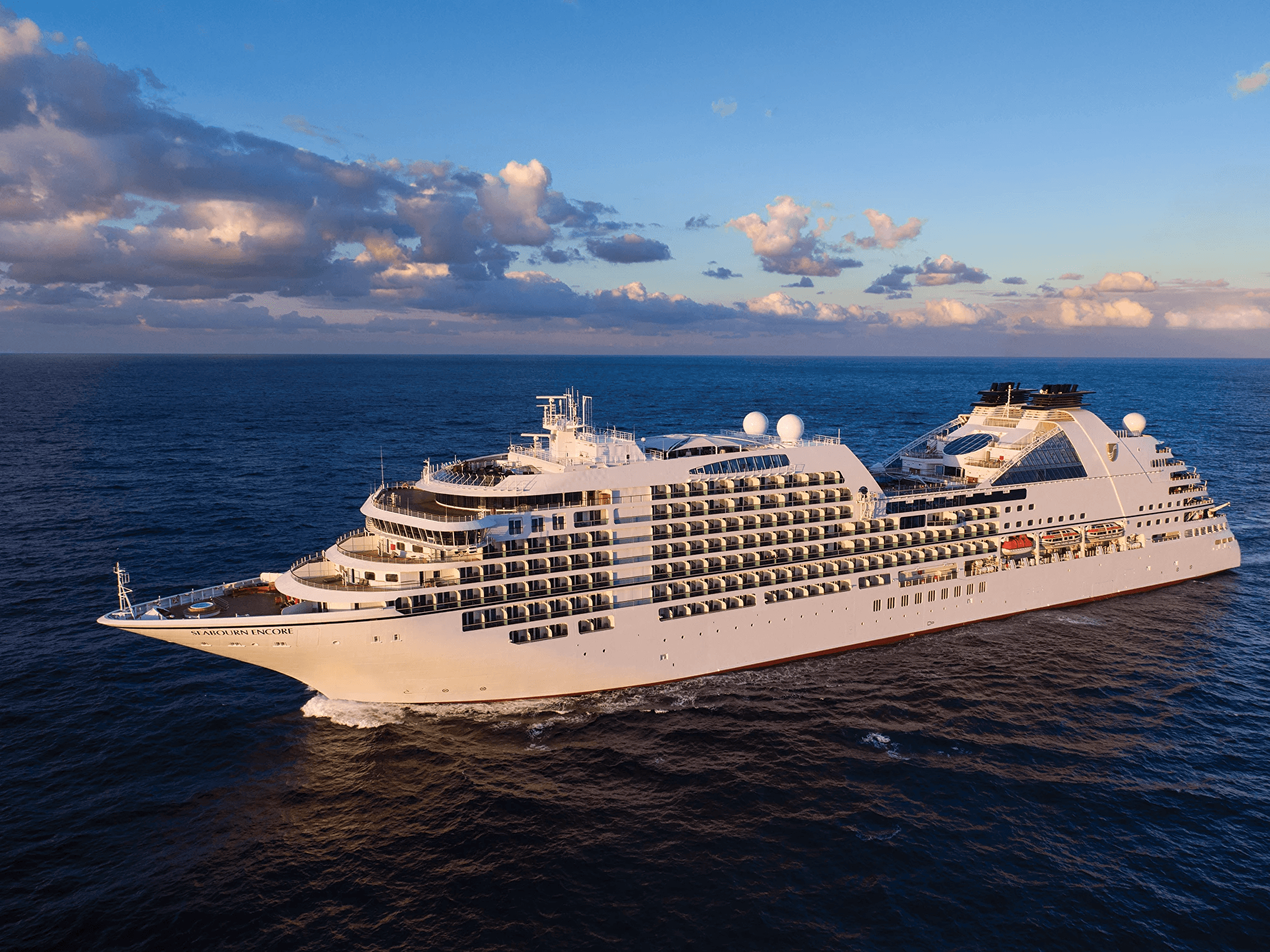
Seabourn Encore is as strikingly beautiful and as excitingly innovative as any Seabourn has ever debuted. She crowns a fleet of luxury cruise ships that is already the newest, most modern and most acclaimed in the ultra-luxury segment.
Ask our cruise specialists about cruise line loyalty benefits, status match options, drinks packages, gratuities and any current offers available on this sailing.
On board

Sushi

The Grill By Thomas Keller

The Restaurant
Itinerary
Cruise from Tokyo to Hong Kong, China
Day 1Cruise departs from TokyoNov 10, 2028 • Departs at: 7 pm
Day 2Shimizu, JapanNov 11, 2028 • Arrives at: 8 am • Departs at: 6 pm
Sprawling, semi-rural Shimizu Ward is dominated by forested coastal mountains, with hiking trails and ropeway rides to dramatic viewpoints above Suruga Bay. Miho Beach Park is popular for swimming and water sports in summer, and there are baseball and soccer fields nearby, plus an aquarium at the Marine Science Center. Busy fisheries supply sushi bars and seafood markets with local specialties like sakura shrimp.
Day 3At SeaNov 12, 2028
Day 4Kagoshima, JapanNov 13, 2028 • Arrives at: 8 am • Departs at: 6 pm
Capital of Japan's southernmost prefecture, Kagoshima faces the Kinko-wan Bay and the active Sakurajima Volcano. Kagoshima played an important role in Japanese history, starting in the early 7th century when Bounotsu Port was a base for trading with China and other Asian nations. The region, formerly known as Satsuma was dominated by 29 generations Shimazu lords for over 700 years until the 1867 Meiji Restoration. Between the 9th and 15th centuries, Satsuma was an important trading port with the countries of east Asia, as well as Europe, becoming one of Japan’s earliest points of contact with the West.
Day 5Nagasaki, JapanNov 14, 2028 • Arrives at: 8 am • Departs at: 5 pm
Nagasaki is situated on the West Coast of Kyushu on a scenic bay. Located closest to the Asian mainland, it has historically been an important trading center and highly influenced by Chinese culture. When Japan chose to isolate itself from the Western world for two hundred years starting in the mid 1600's, Nagasaki was the only port open to foreign vessels. In recent history, Nagasaki was the second city after Hiroshima to be destroyed by an atomic bomb, bringing an end to World War II.
Day 6Jeju Island, South KoreaNov 15, 2028 • Arrives at: 8 am • Departs at: 8 pm
Jeju (Cheju) Island is a volcanic island, dominated by Halla-san (Halla Mountain), a volcano 6,398 feet high and the tallest mountain in South Korea. The island was created entirely from volcanic eruptions approximately 2 million years ago. Because of the relative isolation of the island, the people of Jeju have developed a culture and language that are distinct from those of mainland Korea. The most distinct cultural artifact is the ubiquitous dol hareubang ("stone grandfather") carved from a block of lava. Jeju translates to “Island of the Gods” and lives up to its name with beautiful beaches, waterfalls and volcanic rock formations.
Day 7Scenic Cruising Kanmon StraitsNov 16, 2028
Day 8Hiroshima, JapanNov 17, 2028 • Arrives at: 7 am • Departs at: 10 pm
Hiroshima means “wide island” in Japanese. The city was established in the 16th Century on Japan’s largest island, Honshu, and grew into an important shipping center and prefecture capital, boasting a fine castle. Although it was an important city in Japan throughout the imperial period, its reputation in the greater world was burned into history when it became to target of the first atomic bombing of a civilian target in August of 1945. The United States airplane Enola Gay dropped a nuclear device nicknamed “Little Boy” on the city that morning, obliterating everything within a two-kilometer radius and directly killing 80,000 people. Approximately 70 percent of Hiroshima’s buildings were destroyed. Within a year, injury and radiation illness had killed an additional 90, 000 to 116,000 citizens. The attacks on Hiroshima and nearby Nagasaki quickly led to the surrender of Japan and effectively precipitated the end of World War II in Asia. Within a few years, Hiroshima had begun to rebu…
Day 9MatsuyamaNov 18, 2028 • Arrives at: 7 am • Departs at: 5 pm
Day 10Kochi, JapanNov 19, 2028 • Arrives at: 9 am • Departs at: 6 pm
Japan’s Shikoku island is a popular place of pilgrimage among Japanese Buddhists. Kochi has three of the 88 temples on the route. Chikurinji Temple, with its five-story pagoda, is one of them. Located on Mount Godaisan, it also features an adjacent botanical garden. The town is most famous for its castle, originally built in the early 17th century, but largely rebuilt following a fire in the mid-18th century. It is one of only 12 existing feudal-period castles in Japan. South of the town, Katsurahama beach is a popular destination, although swimming is not allowed due to strong currents. A picturesque shrine located on a high point overlooking the sea is the perfect postcard image of rural Japan. The beach is also a good spot to enjoy Katsuo no Tataki, the traditional local dish of lightly grilled and seasoned bonito tuna.
Day 11Kobe, JapanNov 20, 2028 • Arrives at: 8 am
Kobe has been an important port city for many centuries, and was one of the first Japanese ports to be opened to foreign trade in the late Edo Period. Today, Kobe is one of Japan's ten largest cities. Sustaining heavy damage from the devastating Great Hanshin Earthquake of 1995, the city has fully recovered, and remains one of Japan's more cosmopolitan cities. A typical Japanese harbor town, foreign culture was introduced here centuries ago, and Kobe's food and architecture posses a diverse and exotic flavor.
Day 12Kobe, JapanNov 21, 2028 • Departs at: 6 pm
Kobe has been an important port city for many centuries, and was one of the first Japanese ports to be opened to foreign trade in the late Edo Period. Today, Kobe is one of Japan's ten largest cities. Sustaining heavy damage from the devastating Great Hanshin Earthquake of 1995, the city has fully recovered, and remains one of Japan's more cosmopolitan cities. A typical Japanese harbor town, foreign culture was introduced here centuries ago, and Kobe's food and architecture posses a diverse and exotic flavor.
Day 13Shingu, JapanNov 22, 2028 • Arrives at: 7 am • Departs at: 4:30 pm
Day 14At SeaNov 23, 2028
Day 15Tokyo, JapanNov 24, 2028 • Arrives at: 8 am • Departs at: 7 pm
Day 16Shimizu, JapanNov 25, 2028 • Arrives at: 8 am • Departs at: 6 pm
Sprawling, semi-rural Shimizu Ward is dominated by forested coastal mountains, with hiking trails and ropeway rides to dramatic viewpoints above Suruga Bay. Miho Beach Park is popular for swimming and water sports in summer, and there are baseball and soccer fields nearby, plus an aquarium at the Marine Science Center. Busy fisheries supply sushi bars and seafood markets with local specialties like sakura shrimp.
Day 17Shingu, JapanNov 26, 2028 • Arrives at: 8 am • Departs at: 6 pm
Day 18OsakaNov 27, 2028 • Arrives at: 7 am
Day 19OsakaNov 28, 2028 • Departs at: 4 pm
Day 20Kochi, JapanNov 29, 2028 • Arrives at: 7 am • Departs at: 4 pm
Japan’s Shikoku island is a popular place of pilgrimage among Japanese Buddhists. Kochi has three of the 88 temples on the route. Chikurinji Temple, with its five-story pagoda, is one of them. Located on Mount Godaisan, it also features an adjacent botanical garden. The town is most famous for its castle, originally built in the early 17th century, but largely rebuilt following a fire in the mid-18th century. It is one of only 12 existing feudal-period castles in Japan. South of the town, Katsurahama beach is a popular destination, although swimming is not allowed due to strong currents. A picturesque shrine located on a high point overlooking the sea is the perfect postcard image of rural Japan. The beach is also a good spot to enjoy Katsuo no Tataki, the traditional local dish of lightly grilled and seasoned bonito tuna.
Day 21At SeaNov 30, 2028
Day 22Naha, JapanDec 1, 2028 • Arrives at: 8 am • Departs at: 6 pm
Okinawa’s capital was heavily damaged during World War II. Its most famous landmark, the Chinese-style Shuri Castle, is a reconstruction, but well worth visiting, especially its impressive Shureimon gate, a UNESCO Heritage Site. Just nearby, a couple of relic sites remain: the stone houses and cobbled walkways of the Shrikinjocho Stone-Path Road, and the tranquil Shikina-en Garden. The Okinawa Prefecture Museum and Art Museum reveals a great deal of the local history. Okinawa has long been famous for a distinctive style of ceramic wares, which are still made in Naha’s Tsuboya neighborhood. Visit the Tsuboya Pottery Museum to earn about the craft, then stroll the shops along Yachimun Street to pick up some examples as souvenirs.
Day 23Miyakojima (Hirara), JapanDec 2, 2028 • Arrives at: 8 am • Departs at: 4 pm
Miyako Island is 300 km south of Okinawa island, and is famous for its beaches, said to be Japan’s most beautiful. Maehama beach is for swimmers, while Yoshino has great coral reefs for snorkelers and the white-sand Sunayama has dramatic rock formations. Cape Higashi-Hennazaki is a long, narrow cape with the picturesque lighthouse at the end. The city’s Botanical Garden boasts over 1600 tropical varieties. Nakasone Tuyumya was an important leader of Miyako and the Okinawan people in the 16th century. Near the port in Hirara is memorial to him and his descendants, a designated national cultural asset. At the island’s north end, the graceful Ikema Ohashi bridge leads to the small Ikema Island.
Day 24Hualien, Taiwan, Province of ChinaDec 3, 2028 • Arrives at: 8 am • Departs at: 6 pm
Located on the Pacific coast of Taiwan island, where the Hualien River enters the sea, Hualien is a gateway to the island’s most spectacular natural splendors. It was here that Portuguese sailors in the 16th century caught a first glimpse of the grandeur and named the island Formosa. For a first visit nothing could beat a tour to the Taroko National Park, a swathe of mountain peaks, deep-cut canyons, rivers and waterfalls that is simply breathtaking. The rivers here have carved deep gorges into the marble cliffs, and attractions such as the Tunnel of Nine Turns make it even more dramatic. This path leads through marble-walled tunnels, interrupted by natural windows that let the light stream down from above, culminating in a rushing waterfall.
Day 25Keelung (Taipei), TaiwanDec 4, 2028 • Arrives at: 8 am • Departs at: 6 pm
Keelung is the second largest port in Taiwan, and a booming trade industry has turned it into a very prosperous city and international seaport. However, the main reason for calling here is to travel inland to visit the contemporary metropolis of Taipei. Not long ago, the scenic valley of the Tanshui River was home to rice and vegetable farmers, but today it is the site of Taiwan's bustling center of culture, commerce and government.
Day 26At SeaDec 5, 2028
Day 27Cruise returns to Hong Kong, ChinaDec 6, 2028 • Arrives at: 7 am
Hong Kong is divided into four sections: Hong Kong Island, Kowloon, the New Territories, and the numerous outlying islands. One hundred sixty-four square miles of dense real estate dominate Hong Kong Island, including enormous skyscrapers with futuristic architecture, opulent hotels, residential compounds on Victoria Peak, and some of the oldest Chinese communities in the region. All these elements create one of the most exotic and exciting ports of call in the world; one that is universally loved by tourists and its own enterprising citizens.
Cabin options
Compare the cabin types and onboard features shown for this sailing. Final price and availability are confirmed by our team when you inquire.
14 cabin grades listed for this sailing.
Next step
Cabin grades and prices
View every cabin grade and current availability on the next step.