53-Day Chilean Fjords, Antarctica & South Atlantic Explorer
Seabourn · Seabourn Quest
Depart
Feb 5, 2028
Return
Mar 29, 2028
Port
Valparaiso
Nights
53 nights
At a glance
- Built
- 2011
- Tonnage
- 32000
- Cabins
- 225
- Crew
- 330
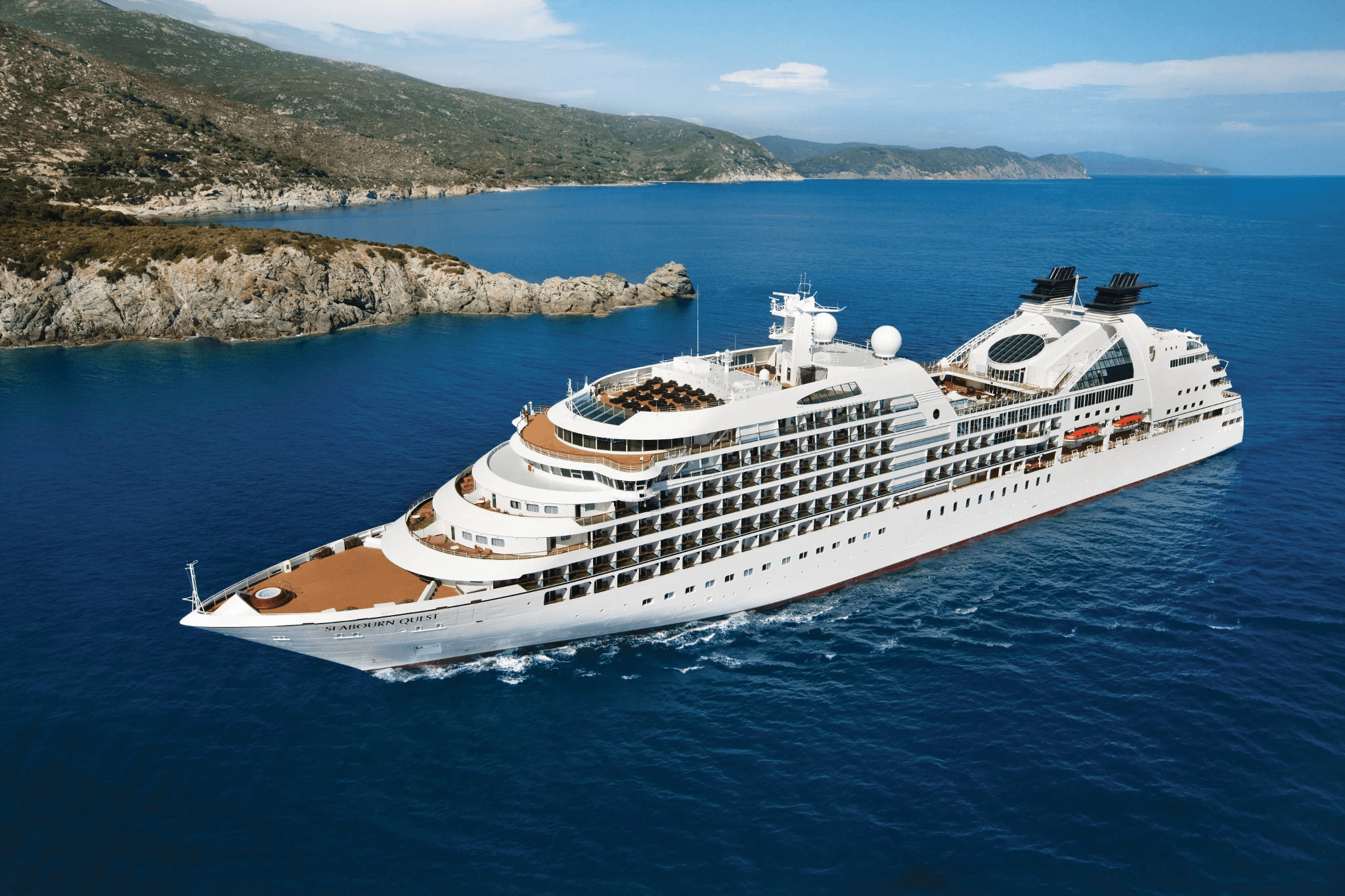
Seabourn Quest is the third iteration of the vessel design that has been called “a game-changer for the luxury segment. ” True to her Seabourn bloodlines, wherever she sails around the world, Seabourn Quest carries with her a bevy of award-winning dining venues that are comparable to the finest restaurants to be found anywhere.
Ask our cruise specialists about cruise line loyalty benefits, status match options, drinks packages, gratuities and any current offers available on this sailing.
On board

Club

Patio Bar
Itinerary
Cruise from Valparaiso to Cape Town
Day 1Cruise departs from ValparaisoFeb 5, 2028 • Departs at: 3 pm
Picturesque Valparaiso was one of the first Chilean cities founded by the Spanish. The city is an historic port and university town, famous for its labyrinth hills, which are covered in quaint, colorful old houses and accessible only by a steep climb or by the city's unique system of funicular railways. Through the efforts of the Chilean government emphasizing the city's culture, heritage preservation, and economic development via tourism, Valparaiso was bestowed designation as a World Heritage Site by UNESCO in 2003.
Day 2At SeaFeb 6, 2028
Day 3Puerto Montt, ChileFeb 7, 2028 • Arrives at: 10 am • Departs at: 8 pm
The lake country of southern Chile seems to be altogether another world from the deserts of the north. The Lake District is graced with spectacular scenery, including the magnificent snowcapped volcanic cone, Mt. Osorno. Puerto Montt serves as the principal port for this region and as a gateway for cruises southward into Chile's fjords.
Day 4Castro, Chiloe Island, ChileFeb 8, 2028 • Arrives at: 7 am • Departs at: 4 pm
The towns are largely built of abundant local woods, and many houses are elaborately shingled in intricate designs. Even the cathedral is a beautiful, vaulted structure crafted of local hardwoods. The forest and the sea are the source of livelihood and much more in this rustic outpost.
Day 4Scenic Cruising Gulf of CorcovadoFeb 8, 2028
The Gulf of Corcovado is a large body of water between Chiloe Island and the coast of Chile. It is surrounded by the Corcovado National Park on the east and Chiloe Island’s Valdivian forest on the west. On the eastern horizon rise the snowcapped volcanic cones of Corcovado and Yanteles. The shoreline is largely unspoiled and forests of southern beech and the magnificent alerce (similar to North American sequoia) trees predominate. The waters are dotted with islands, leading to the bay and harbor of Chiloe’s primary town, Castro. The Gulf is actually a submerged fore-basin carved by a massive glacier. The waters are home to some endangered species, including blue whales, as well as humpback, minke and sei whales. Salmon farms have blossomed in recent years. Cruise this important, weather-protected shipping channel between the long, mountainous Pitt Island and the equally mountainous mainland of British Columbia’s northern coast.
Day 5Puerto Chacabuco, ChileFeb 9, 2028 • Arrives at: 10 am • Departs at: 7 pm
The wild and beautiful Aysén District of Chile lies south of Chiloe and Puerto Montt. Here you find cliffs that drop into immense river valleys, numerous waterfalls and ravines that open into vast valleys, while the Andes form a continuous barrier. Puerto Chacabuco is a popular entry port to the Aysén region. It lies at the eastern end of a very narrow fjord and has replaced Puerto Aysén as the main shipping port and ferry terminal to this region. Puerto Chacabuco is also a departure point for sailings to Laguna San Rafael. Local vessels make the scenic trip through the channels and islands of Western Patagonia.
Day 6At SeaFeb 10, 2028
Day 7Scenic Cruising Wide ChannelFeb 11, 2028
The Wide Channel is an inside passage along the coast of southern Chile. It separates the eastern lobe of the huge Wellington Island from the Chilean mainland, starting between Saumarez Island and Icy Channel in the north and opening into the Concepcion Channel in the south adjacent to the Bernardo O’Higgins National Park on the mainland Wilcock Peninsula. Surrounded by precipitous mountains, its shoreline on the mainland side is interrupted by two large fjords, the Europa and Penguin fjords. Join your expedition team members on deck or in an observation lounge for expert insights into the area.
Day 7Scenic Cruising Eyre FjordFeb 11, 2028
Eyre Fjord penetrates the mainland of southern Chile from the Icy Channel about 20 miles to the broad face of the massive Pio XI glacier, also known as the Brüggen Glacier. It is the longest glacier in the Southern Hemisphere outside Antarctica, flowing some 40 miles from the Southern Patagonian Ice Field to the fjord. It is also one of the very few advancing glaciers on earth. The glacier face is located near a large eastern arm of Eyre Fjord called Exmouth Fjord.
Day 7Pio XI GlacierFeb 11, 2028 • Arrives at: 8 am • Departs at: 6 pm
Day 8Scenic Cruising Peel FjordFeb 12, 2028
Cutting eastward from the Sarmiento Channel in Southern Chile, this fjord divides into three separate fjords, called Amalia, Asia and Calvo Fjords. Amalia leads to Amalia Glacier, the El Brujo Glacier is in Asia Fjord, and Calvo boasts several small glaciers of its own. The mainland to the east is all part of the huge Torres del Paine National Park. The area is a fascinating geological panorama, and your expedition team members will be available to interpret the sights, as well as identify wildlife spotted while cruising the scenic waterways.
Day 8Brujo GlacierFeb 12, 2028 • Arrives at: 7 am • Departs at: 9 am
Day 8Scenic Cruising Sarmiento ChannelFeb 12, 2028
Canal Sarmiento, or the Sarmiento Channel, is a protected inside passage that runs generally north-and-south along Chile’s Pacific Coast between the mainland and Esperanza, Vancouver and Piazzi Islands. It is in the Magallanes y Antárctica Chilena region. Although the native Kawésgar people routinely navigated the channel for 6,000 years up until the 20th century, it was named for the first European to do so, the Spanish explorer Pedro Sarmiento de Gamboa, who sailed it in 1579-80. The channel begins at the Guia Narrows on the north end, and runs general south-to-southeast for approximately 64 miles, passing Esperanza Island on the west with mountain peaks of 300 to over 1000 meters, before turning eastward into the Farquhar Pass. It then turns southward again, merging with the Collingwood Strait for approximately eight miles, at which time the Cordillera Sarmiento rises on the eastern side, crowned with snow-capped peaks, several tidewater glaciers, and a number of shipwrecks on the…
Day 9Strait of MagellanFeb 13, 2028
The Strait of Magellan is a 350-mile/570 km channel separating the mainland of South America from the large Isla Grande de Tierra del Fuego and connecting the Atlantic and Pacific Oceans. It was first navigated by the explorer Ferdinand Magellan during his circumnavigation voyage in 1520. He named it the Strait of All Saints, because his transit started on November 1, All Saints Day. It was also Magellan who name the southern island Tierra del Fuego, after seeing the smokes from fires in the camps of the native Yahgan people, whom he named the Patagones, meaning “big feet,” and their land Patagonia. The strait is between two and 20 miles wide, and earned the nickname Dragon’s Tail among sailors, for its tortuous path. Along with the Beagle Channel, it was one of two protected channels for sailing between the oceans prior to the construction of the Panama Canal The third alternative was the notoriously turbulent open ocean Drake Passage beyond Cape Horn. There is one sizeable port city…
Day 9Punta Arenas, ChileFeb 13, 2028 • Arrives at: 10 am • Departs at: 11 pm
Red roofs and smoking chimneys decorate the gently sloping hillsides of Punta Arenas (Sandy Point), the bustling center of one of the world's largest sheep farming areas. This pleasant community welcomes you with attractive parks and delightful Victorian architecture.
Day 10At SeaFeb 14, 2028
Day 11Garibaldi Glacier, ChileFeb 15, 2028 • Arrives at: 7 am • Departs at: 5 pm
Day 12Ushuaia, ArgentinaFeb 16, 2028 • Arrives at: 8 am • Departs at: 7 pm
The southernmost city in the world, Ushuaia is the capital of Argentine Tierra del Fuego and an important naval base boasting a strategic as well as a picturesque location on the shores of Ushuaia Bay and the Beagle Channel. This rustic coastal town is set among waterfalls, glaciers, snow-clad mountains and beech forests, and the nutrient-rich local waters abound with marine life. Though the houses here are painted warm, pastel colors, the weather is chilly year-round and winter sports such as downhill and cross-country skiing and skating are popular. Ushuaia's principal industries are raising sheep, logging, fishing and trapping. It became a boomtown with 30,000 residents in the late 1980's when the government sought to increase Argentina's presence near Antarctica by giving tax breaks to citizens who settled here.
Day 13At SeaFeb 17, 2028
Day 14At SeaFeb 18, 2028
Day 15The Seabourn Antarctic ExperienceFeb 19, 2028 • Arrives at: 7 am • Departs at: 5 pm
Day 16The Seabourn Antarctic ExperienceFeb 20, 2028 • Arrives at: 7 am • Departs at: 5 pm
Day 17The Seabourn Antarctic ExperienceFeb 21, 2028 • Arrives at: 7 am • Departs at: 5 pm
Day 18The Seabourn Antarctic ExperienceFeb 22, 2028 • Arrives at: 7 am • Departs at: 5 pm
Day 19The Seabourn Antarctic ExperienceFeb 23, 2028 • Arrives at: 7 am • Departs at: 5 pm
Day 20At SeaFeb 24, 2028
Day 21At SeaFeb 25, 2028
Day 22The Seabourn Falkland Island ExperienceFeb 26, 2028 • Arrives at: 7 am • Departs at: 5 pm
Day 23The Seabourn Falkland Island ExperienceFeb 27, 2028 • Arrives at: 7 am • Departs at: 5 pm
Day 24Stanley/Falkland Is/Islas MalvinasFeb 28, 2028 • Arrives at: 7 am • Departs at: 5 pm
An archipelago of over 700 islands spread over 4,700 square miles lies about 300 miles east of the coast of Argentina. Its political affiliation is with the United Kingdom, and it is named the Falkland Islands, although this is disputed by Argentina, which calls the island group Islas Malvinas. The islands were the focus of a short, violent military confrontation between the two nations in 1982 which resulted in many lives lost. Most visitors come to the islands attracted by the severe beauty of the landscape and the unusual wildlife to be seen there, especially colonies of penguins. Port Stanley, the capital, is a plucky outpost supporting the hardy islanders who farm and fish and, lately, newcomers set on exploiting the recently discovered oil reserves offshore.
Day 25At SeaFeb 29, 2028
Day 26At SeaMar 1, 2028
Day 27At SeaMar 2, 2028
Day 28Montevideo, UruguayMar 3, 2028 • Arrives at: 7 am • Departs at: 4 pm
Tucked in between Brazil and Argentina, the republic of Uruguay has nevertheless maintained its own identity and traditions. As South America's second smallest country, it has been called a city surrounded by a big ranch. Montevideo has also been referred to as "The Switzerland of South America," for its same secretive bank system guaranteed by law. Uruguay is principally middle class and boasts the most highly educated citizens on the continent.
Day 29Buenos Aires, ArgentinaMar 4, 2028 • Arrives at: 7 am
Founded in 1536, Buenos Aires was administered by a Spanish viceroy for nearly three centuries before winning its independence in 1816. A sleepy port town for most of that time, it wasn't until the turn of the 20th century that the city finally emerged as an important shipping center. Today, Argentina's democratically elected government has made it South America's safest (and most expensive) country. This cosmopolitan city is characterized by broad boulevards with huge shade trees, beautiful residential districts, plazas containing monuments and fountains, interspersed with 20th-century high-rise buildings. It is a truly great walking city.
Day 30Buenos Aires, ArgentinaMar 5, 2028 • Departs at: 5 pm
Founded in 1536, Buenos Aires was administered by a Spanish viceroy for nearly three centuries before winning its independence in 1816. A sleepy port town for most of that time, it wasn't until the turn of the 20th century that the city finally emerged as an important shipping center. Today, Argentina's democratically elected government has made it South America's safest (and most expensive) country. This cosmopolitan city is characterized by broad boulevards with huge shade trees, beautiful residential districts, plazas containing monuments and fountains, interspersed with 20th-century high-rise buildings. It is a truly great walking city.
Day 31At SeaMar 6, 2028
Day 32At SeaMar 7, 2028
Day 33At SeaMar 8, 2028
Day 34At SeaMar 9, 2028
Day 35At SeaMar 10, 2028
Day 36At SeaMar 11, 2028
Day 37Scenic Cruising Inaccessible IslandMar 12, 2028
Day 37Tristan da Cunha, Saint HelenaMar 12, 2028 • Arrives at: 8 am • Departs at: 6 pm
Saint Helena, Ascension and Tristan da Cunha is a British Overseas Territory located in the South Atlantic and consisting of the island of Saint Helena, Ascension Island and the archipelago of Tristan da Cunha including Gough Island.
Day 38Nightingale Island, St HelenaMar 13, 2028 • Arrives at: 7 am • Departs at: 5 pm
Nightingale Island is an active volcanic island in the South Atlantic Ocean, 3 square kilometres in area, part of the Tristan da Cunha group of islands. They are administered by the United Kingdom as part of the overseas territory of Saint Helena, Ascension and Tristan da Cunha
Day 39At SeaMar 14, 2028
Day 40At SeaMar 15, 2028
Day 41At SeaMar 16, 2028
Day 42At SeaMar 17, 2028
Day 43At SeaMar 18, 2028
Day 44At SeaMar 19, 2028
Day 45Richards Bay, South AfricaMar 20, 2028 • Arrives at: 7 am • Departs at: 5 pm
Richards Bay is in the province of KwaZulu-Natal, the traditional homeland of the Zulu people on the Indian Ocean coast. Not surprisingly, most visitors are attracted here by interest in the Zulu culture and the indigenous wildlife of the region. Richards Bay offers Seabourn guests opportunities to experience both. The Zulu Nyala Private Game Reserve is one option, for an evening including a game drive and a dinner on the reserve. The Dumazulu is a fascinating living museum of traditional Zulu life and culture, populated by members of the group and endorsed by the tribal authorities. Hluhluwe Umfolozi Game Reserve is famous for its population of rare white rhinos, while a cruise on Lake St. Lucia gives visitors a view of two of South Africa’s most notorious animals: hippopotamus and crocodiles, on the iSimangaliso Nature Reserve, a UNESCO World Heritage Site.
Day 46Maputo, MozambiqueMar 21, 2028 • Arrives at: 12 pm • Departs at: 9 pm
The interests of the Portuguese in Africa were the earliest of any European power. And the independence of Africa’s Lusophone colonies was invariably the most bitterly disputed during the revolutions of the mid-20th century. As elsewhere, the departing colonials took much of the value and the skills with them when they fled. Maputo has been slowly rebuilding itself into a city worthy of its setting along the Indian Ocean coast, and you will be among only a few travelers to see the architectural treasures of its past and the spirit of its future.
Day 47At SeaMar 22, 2028
Day 48Durban, South AfricaMar 23, 2028 • Arrives at: 7 am • Departs at: 9 pm
At its founding in 1835, the city was named in honor of the then Governor of the Cape, Sir Benjamin D'Urban. Sugar cane transformed Durban into a vital port city, and its attractive parks and meticulously groomed gardens continue to testify to the land's richness. Today, the city sprawls along the coast, its golden beaches hugging the ice-blue Indian Ocean.
Day 49At SeaMar 24, 2028
Day 50Gqeberha (Port Elizabeth), South AfricaMar 25, 2028 • Arrives at: 6 am • Departs at: 5 pm
Day 51Mossel Bay, South AfricaMar 26, 2028 • Arrives at: 9 am • Departs at: 8 pm
South Africa’s Garden Route is among the world’s most attractive destinations, and Mossel Bay will welcome Seabourn guests to the heart of it. Those interested in wildlife will be thrilled with a visit to the Botlierskop Private Game Reserve for the chance to spot a rare white rhino and interact with huge, gentle African elephants at a feeding. The Diaz Museum Complex is named for Bartolomeu Diaz, the Portuguese explorer who was the first European to set foot in South Africa right here. It contains historical displays including the famous Post Office Tree that served as the message station for early sailors, a maritime museum and an aquarium. Another option is to travel along the coast to the famous seaside resort community at Knysna Heads and up into the arid, scenic Outeniqua Mountains.
Day 52At SeaMar 27, 2028
Day 53Cape Town, South AfricaMar 28, 2028 • Arrives at: 6:45 am
Nestled at the foot of Table Mountain and flanked by Devil's Peak and Lion's Head, Cape Town is known by South Africans simply as 'the Cape,' an acknowledgment of its uniqueness and its status as the Mother City. The first area to be settled by Europeans in the 17th century, it is today a major seaport and the legislative capital of South Africa. The feeling here is not African but cosmopolitan, and a sense of history remains.
Day 54Cruise returns to Cape TownMar 29, 2028 • Arrives at: 6 am
Nestled at the foot of Table Mountain and flanked by Devil's Peak and Lion's Head, Cape Town is known by South Africans simply as 'the Cape,' an acknowledgment of its uniqueness and its status as the Mother City. The first area to be settled by Europeans in the 17th century, it is today a major seaport and the legislative capital of South Africa. The feeling here is not African but cosmopolitan, and a sense of history remains.
Cabin options
Compare the cabin types and onboard features shown for this sailing. Final price and availability are confirmed by our team when you inquire.
14 cabin grades listed for this sailing.
Next step
Cabin grades and prices
View every cabin grade and current availability on the next step.