
28-Day Iceland, The Faroe Islands & Svalbard Expedition
Seabourn · Seabourn Pursuit
Depart
Jul 12, 2028
Return
Aug 9, 2028
Port
Reykjavik, Iceland
Nights
28 nights
At a glance
- Built
- 2023
- Tonnage
- 23000
- Cabins
- 132
- Crew
- 120
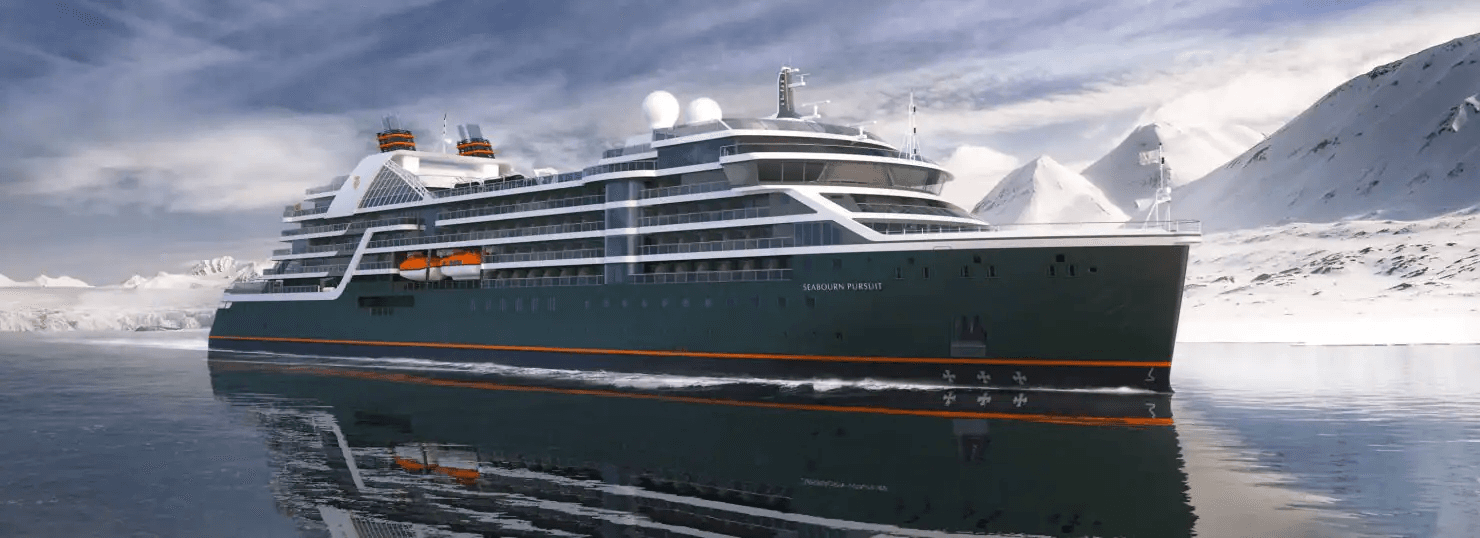
Construction for Seabourn Pursuit began in fall 2020 during a ceremony in San Giorgo di Nogare, Italy, and the build process is well underway. The ship is scheduled for delivery in 2023, with its sister ship, Seabourn Venture, slated for delivery in 2022. Seabourn Pursuit is the second Seabourn expedition ship slated to launch in 2023.
Ask our cruise specialists about cruise line loyalty benefits, status match options, drinks packages, gratuities and any current offers available on this sailing.
On board

Bowlounge

Colonnade
Constellationlounge

Discoverycenter

Expeditionlounge

Landing
Pursuit square
Itinerary
Cruise from Reykjavik, Iceland and back
Day 1Cruise departs from Reykjavik, IcelandJul 12, 2028 • Departs at: 5 pm
Warmed by the Gulf Stream as well as by highly active thermal hot springs and volcanoes, Iceland is somewhat misnamed. While it is a stark and barren country with three huge areas of glaciers, one theory is that early Norsemen sought to mislead other potential settlers by giving a pleasant name to fierce, inhospitable Greenland, and a forbidding name to the imminently habitable Iceland. Irish monks and hermits established themselves here in the 8th century, but left a century later when the pagan Norsemen arrived. Europe's first Parliament of General Assembly, the Althing, was established in the year 930 and still functions as the legislative body, although it was suspended by the Danes at the end of the 18th century and not reconvened until 1843. Reykjavik was the site picked by the island's first permanent resident, Ingolfur Arnarson in 874, and is home to more than half of the island's total population. The world's northernmost capital, Reykjavik is proud of its virtual lack of air…
Day 2Flatey Island, IcelandJul 13, 2028 • Arrives at: 7 am • Departs at: 2 pm
Day 3Siglufjordur, IcelandJul 14, 2028 • Arrives at: 8 am • Departs at: 6 pm
Siglufjörður is the northernmost town on the Icelandic mainland, a small fishing village of some 1,200 people. Founded in 1918, it was in the past the capital of the North Atlantic herring fishing industry. The Síldarminjasafnið Herring Era Museum, one of Iceland's largest seafaring and industrial museums, houses three different areas where one can learn about both the traditional and the modern herring industry. A collection of many historic fishing vessels and artifacts is proudly displayed by the people of Siglufjörður, detailing how herring was salted, processed and collected. The small harbor with its colorful fishing boats and the red-roofed steeple of the Lutheran church dominate the village-scape. The natural beauty of the area includes high mountains that rim the fjord, freshwater lakes, the Hólsá river, black sand beaches, and a wealth of birdlife all around. This northernmost region of Iceland is renowned for some of the largest and most dramatic waterfalls in the country.
Day 4HusavikJul 15, 2028 • Arrives at: 8 am • Departs at: 6 pm
Day 5Grimsey IslandJul 16, 2028 • Arrives at: 8 am • Departs at: 6 pm
Day 6Seydisfjordur, IcelandJul 17, 2028 • Arrives at: 8 am • Departs at: 6 pm
The remote town of Seydisfjördur is perched at the end of a narrow twisting fjord in East Iceland. A very picturesque village of 700 people, it is known for its thriving arts scene and large number of resident artists. Tourism is on the rise as well, as its natural setting of mountains and waterfalls is simply breathtaking. Surrounded by impressive 1,085 meter (3,560’) tall snow-capped mountains, Seydisfjördur is home to the Technical Museum of Iceland and hosts populations of both eider ducks and Atlantic puffins. It was settled by Norwegian fishermen in 1848 and quickly became an important trading center between Iceland and Europe. It is known throughout Iceland for its colorful Norwegian-style wooden houses. The first telegraph cable connecting Iceland to Europe made landfall here in 1906. A large dam was constructed here in 1913, which produced power for the country’s first high voltage AC power plant, a revolutionary achievement for its time.
Day 7At SeaJul 18, 2028
Day 8Torshavn, Faroe IslandJul 19, 2028 • Arrives at: 7 am • Departs at: 5 pm
A distant outpost of Denmark, the Faroe Islands suddenly appear out of the misty North Atlantic, nearly 200 miles from the nearest landfall. Of the twenty-two islands in the group, seventeen are inhabited, with a population of 17,000 residing in the capital city of Torshavn. Irish monks discovered the islands in the 8th century and became the first settlers, only to be driven out by Viking explorers a century later. The traditions and legends of their Viking forefathers are kept alive in a language so close to old Norse that Faroe Islanders can still read the ancient texts inscribed centuries ago. The name Faroe comes from faereyjar, the Old Norse word meaning "Sheep Islands." With thousands of sheep dotting the hillsides, the name remains apt today. While sheep are important to the economy, the real wealth of the islands comes from the fishing industry. A fleet of over 300 trawlers and line-fishing boats bring in an average annual haul of 245,000 tons of cod and herring. Ultra-modern…
Day 9KlaksvikJul 20, 2028 • Arrives at: 7 am • Departs at: 5 pm
Day 10Tvoroyri, Faroe IslandsJul 21, 2028 • Arrives at: 7 am • Departs at: 5 pm
Day 11At SeaJul 22, 2028
Day 12Exploring The Outer Islands of HeimaeyJul 23, 2028 • Arrives at: 7 am • Departs at: 10 am
Day 12Heimaey, Westman Islands, IcelandJul 23, 2028 • Arrives at: 12 pm • Departs at: 7 pm
Day 13Reykjavik, IcelandJul 24, 2028 • Arrives at: 7 am • Departs at: 5 pm
Warmed by the Gulf Stream as well as by highly active thermal hot springs and volcanoes, Iceland is somewhat misnamed. While it is a stark and barren country with three huge areas of glaciers, one theory is that early Norsemen sought to mislead other potential settlers by giving a pleasant name to fierce, inhospitable Greenland, and a forbidding name to the imminently habitable Iceland. Irish monks and hermits established themselves here in the 8th century, but left a century later when the pagan Norsemen arrived. Europe's first Parliament of General Assembly, the Althing, was established in the year 930 and still functions as the legislative body, although it was suspended by the Danes at the end of the 18th century and not reconvened until 1843. Reykjavik was the site picked by the island's first permanent resident, Ingolfur Arnarson in 874, and is home to more than half of the island's total population. The world's northernmost capital, Reykjavik is proud of its virtual lack of air…
Day 14Isafjordur, IcelandJul 25, 2028 • Arrives at: 8 am • Departs at: 6 pm
Like most Icelandic towns, this one on the northwest coast was started by fisherman and whalers. The name means ice-fjord. It is a perfect place from which to explore the cultural and economic staples of Iceland. An excursion to Sudavik reveals a town started by whalers and nearly destroyed by an avalanche in 1995, now rebuilt out of the path of further slides. Its lovely church was donated by whalers, as well. The own also holds a center for the study of the indigenous arctic foxes. The Maritime Museum in Isafjordur illustrates the lifestyles of the early inhabitants, including many implements of their trades, and also a wall of accordions, one of the few forms of entertainment on bygone days. Another option is a boat ride to nearby Vigur island, a nesting site for many species of seabirds, including eider ducks, whose down is yet another example of local economy based on the surrounding seas.
Day 15At SeaJul 26, 2028
Day 16Jan MayenJul 27, 2028 • Arrives at: 7 am • Departs at: 5 pm
Remote and isolated, Jan Mayen is dominated by 2,277 meter (7,470’) high Beerenberg Volcano and its large ice cap. The island has two parts: larger northeast Nord-Jan and smaller southwest Sør-Jan, linked by a 2.5 kilometer (1.6 mile) wide isthmus. The League of Nations gave jurisdiction of Jan Mayen to the Kingdom of Norway in 1921. Except for being used as a meteorological, radio and navigation aid for shipping in the Atlantic, the island has remained untouched, its only inhabitants are 18 military personnel. In 2010 Jan Mayen was declared a nature reserve for the protection of its wildlife and is recognized as one of the most important breeding sites for over 250,000 seabirds in the North Atlantic. It supports large colonies of northern fulmars, little auks and thick-billed guillemots. Polar bears found here are genetically distinguishable from those found elsewhere. Although ‘officially’ discovered by the Dutch whaling captain Fopp Gerritsz in 1614, it may have been sighted by exp…
Day 17At SeaJul 28, 2028
Day 18Longyearbyen, NorwayJul 29, 2028 • Arrives at: 10 am • Departs at: 7 pm
Longyearbyen, the seat of the Governor of Svalbard, is located in a narrow valley along the shores of Adventfjorden a small tributary of Isfjord, the largest fjord system in Svalbard. It extends 100 kilometers (60 miles) into the island of Spitsbergen. Nine large tidewater glaciers, with a combined ice-front of 21 kilometers (13 miles), as well as dozens hanging glaciers drain into the fjord. The town’s 2,100 inhabitants exist in one of the most northern settlements on Earth, making their living by a combination of coal mining, education and tourism. Because of the town’s extreme isolation, proximity to wildlife, and Svalbard’s pristine environment, unique laws exist that are found in few other places. All individuals venturing outside of town are required to carry a rifle for protection against polar bears, possessing a cat is illegal, no one is allowed to be buried here and how much alcohol can be purchased each month is restricted. Longyearbyen was named after the American industri…
Day 19Svalbard ExperienceJul 30, 2028 • Arrives at: 7 am • Departs at: 5 pm
Svalbard is a Norwegian archipelago between mainland Norway and the North Pole. One of the world’s northernmost inhabited areas, it's known for its rugged, remote terrain of glaciers and frozen tundra sheltering polar bears, Svalbard reindeer and Arctic foxes. The Northern Lights are visible during winter, and summer brings the “midnight sun”—sunlight 24 hours a day.
Day 20Svalbard ExperienceJul 31, 2028 • Arrives at: 7 am • Departs at: 5 pm
Svalbard is a Norwegian archipelago between mainland Norway and the North Pole. One of the world’s northernmost inhabited areas, it's known for its rugged, remote terrain of glaciers and frozen tundra sheltering polar bears, Svalbard reindeer and Arctic foxes. The Northern Lights are visible during winter, and summer brings the “midnight sun”—sunlight 24 hours a day.
Day 21Svalbard ExperienceAug 1, 2028 • Arrives at: 7 am • Departs at: 5 pm
Svalbard is a Norwegian archipelago between mainland Norway and the North Pole. One of the world’s northernmost inhabited areas, it's known for its rugged, remote terrain of glaciers and frozen tundra sheltering polar bears, Svalbard reindeer and Arctic foxes. The Northern Lights are visible during winter, and summer brings the “midnight sun”—sunlight 24 hours a day.
Day 22Svalbard ExperienceAug 2, 2028 • Arrives at: 7 am • Departs at: 5 pm
Svalbard is a Norwegian archipelago between mainland Norway and the North Pole. One of the world’s northernmost inhabited areas, it's known for its rugged, remote terrain of glaciers and frozen tundra sheltering polar bears, Svalbard reindeer and Arctic foxes. The Northern Lights are visible during winter, and summer brings the “midnight sun”—sunlight 24 hours a day.
Day 23Svalbard ExperienceAug 3, 2028 • Arrives at: 7 am • Departs at: 5 pm
Svalbard is a Norwegian archipelago between mainland Norway and the North Pole. One of the world’s northernmost inhabited areas, it's known for its rugged, remote terrain of glaciers and frozen tundra sheltering polar bears, Svalbard reindeer and Arctic foxes. The Northern Lights are visible during winter, and summer brings the “midnight sun”—sunlight 24 hours a day.
Day 24Svalbard ExperienceAug 4, 2028 • Arrives at: 7 am • Departs at: 5 pm
Svalbard is a Norwegian archipelago between mainland Norway and the North Pole. One of the world’s northernmost inhabited areas, it's known for its rugged, remote terrain of glaciers and frozen tundra sheltering polar bears, Svalbard reindeer and Arctic foxes. The Northern Lights are visible during winter, and summer brings the “midnight sun”—sunlight 24 hours a day.
Day 25At SeaAug 5, 2028
Day 26At SeaAug 6, 2028
Day 27Siglufjordur, IcelandAug 7, 2028 • Arrives at: 8 am • Departs at: 6 pm
Siglufjörður is the northernmost town on the Icelandic mainland, a small fishing village of some 1,200 people. Founded in 1918, it was in the past the capital of the North Atlantic herring fishing industry. The Síldarminjasafnið Herring Era Museum, one of Iceland's largest seafaring and industrial museums, houses three different areas where one can learn about both the traditional and the modern herring industry. A collection of many historic fishing vessels and artifacts is proudly displayed by the people of Siglufjörður, detailing how herring was salted, processed and collected. The small harbor with its colorful fishing boats and the red-roofed steeple of the Lutheran church dominate the village-scape. The natural beauty of the area includes high mountains that rim the fjord, freshwater lakes, the Hólsá river, black sand beaches, and a wealth of birdlife all around. This northernmost region of Iceland is renowned for some of the largest and most dramatic waterfalls in the country.
Day 28Patreksfjordur, IcelandAug 8, 2028 • Arrives at: 8 am • Departs at: 6 pm
Day 29Cruise returns to Reykjavik, IcelandAug 9, 2028 • Arrives at: 7 am
Warmed by the Gulf Stream as well as by highly active thermal hot springs and volcanoes, Iceland is somewhat misnamed. While it is a stark and barren country with three huge areas of glaciers, one theory is that early Norsemen sought to mislead other potential settlers by giving a pleasant name to fierce, inhospitable Greenland, and a forbidding name to the imminently habitable Iceland. Irish monks and hermits established themselves here in the 8th century, but left a century later when the pagan Norsemen arrived. Europe's first Parliament of General Assembly, the Althing, was established in the year 930 and still functions as the legislative body, although it was suspended by the Danes at the end of the 18th century and not reconvened until 1843. Reykjavik was the site picked by the island's first permanent resident, Ingolfur Arnarson in 874, and is home to more than half of the island's total population. The world's northernmost capital, Reykjavik is proud of its virtual lack of air…
Cabin options
Compare the cabin types and onboard features shown for this sailing. Final price and availability are confirmed by our team when you inquire.
10 cabin grades listed for this sailing.
Next step
Cabin grades and prices
View every cabin grade and current availability on the next step.